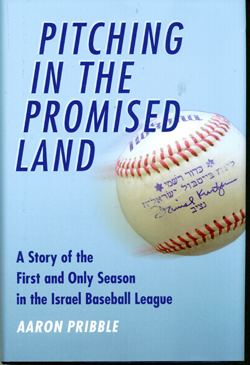
Pitching in the Promised Land by Aaron Pribble, University of Nebraska Press, 2011, 238 pages including epilogue and acknowledgments, $24.95.
By Donald H. Harrison
SAN DIEGO — It’s hard to imagine how putting bats in the hands of the people of the Middle East could bring peace to the region, but author Aaron Pribble is an idealist both about the game of baseball and about the prospects that peace is even still possible.
His book was carefully culled from a journal he kept while pitching for the Tel Aviv Lightning—one of six teams of the single-season, now-defunct Israel Baseball League. Pitching in the Promised Land recaptures the adventure of travel, the intensity of competition, the camaraderie of team mates, the high hopes Americans and others had that baseball would catch on in Israel, and the dejection and frustration borne of the realization that the League had been created with insufficient capital, resulting in the players having compete on inferior, even-dangerous playing grounds.
 Much of the action in the book takes place at Kfar Hayarok (“Green Village”), the school campus where 120 professional baseball players took over the dormitories for a summer. I’ve stayed with a veterinarian friend and his family at their home in Kfar HaYarok and found Pribble’s description of the guard gate, the wandering peacocks, the petting zoo, and the grounds of the village to be entirely accurate. This helped build my trust in his descriptions of other places, particularly such ballpark venues as the Sportek in Tel Aviv and Kibbutz Gezer.
After a baseball career that never had taken Pribble to the Major Leagues, he had accepted the inevitable and had become a high school political science teacher. But then, in the summer of 2007, his boyhood post-college dream was reignited. He could pitch a summer season for the Israel Baseball League, and still get back to Mill Valley in time to greet his new students. Or perhaps, just perhaps, a good season might even put him on a fast track to the “Show,” as professional baseballers refer to the Major Leagues.
If the San Francisco Bay area baseball player was uncertain about his own future, the reverse was true about his perceptions of the Middle East. Israel had no business building over the Green Line because, in his view, that land belonged to Palestinians, and the sooner Israel withdrew, the better off the world would be. He went to Israel with that belief, made a quick sortie to Ramallah and Bethlehem during one of his pitching breaks, and went home more certain than ever that he was right, and that Israel’s settlers and government were wrong. Pribble has lots of company in that view, especially in places like San Francisco and the United Nations..
If Pribble’s main passion were politics, he might have returned home alienated from Israel. But, in fact, the reverse occurred. Born to a Jewish mother and Christian father, he flew to Israel somewhat confused by the two religious traditions coursing through his heredity. Playing in the IBL deepened his sense of Jewish identity, he reported.
In the cafeteria of Kfar Hayarok, the boys of summer were served a seemingly unvaried menu of schnitzel, schnitzel and more schnitzel – and this fried chicken dish came to symbolize all the things that went wrong in the Israel Baseball League. At the end of the season, the ballplayers held a lighthearted banquet at which they bestowed upon each other and league officials “schnitzel awards” commemorating various errors, mishaps and screw ups. It’s a very funny episode.
Political and religious thoughts and speculation are mixed with Pribble’s professional recounting of the quirks and some of the play-by-play action of the Israel Baseball League, which was dominated by players from foreign countries—most particularly the United States, The Dominican Republic and Australia. All in all, the light-reading book takes us on an interesting and enjoyable jaunt through a unique moment in Israeli and baseball history.
*
Harrison is editor of San Diego Jewish World. He may be contacted at donald.harrison@sdjewishworld.com