By David Amos
 SAN DIEGO – The earth, the sun, the planets and beyond.
Such will be the theme of the next concert of the Tifereth Israel CommunityOrchestra in its programs of Tuesday, June 14, 7:30 p.m., and at 3:00 p.m. on Sunday, the 19th. Both concerts will be held at the Cohen Social Hall of Tifereth Israel Synagogue, 6660 Cowles Mountain Dirve. Be sure to pencil in these dates in your calendar.
The program will be musical selections of interstellar subjects, including our Earth. The multi-media presentation will feature photographic images to coordinate with the music. In cooperation with George Varga, astronomy volunteer and tour guide at Mission Trails Regional Park, there will be projections on a screen, with stunning displays of the Sun, the Earth, seven of the other planets in our Solar System, and a few spectacular photos of deep space, as they were captured by the Hubble Telescope.
The musical selections are equally intriguing and appropriate to the visual images. Denmark’s greatest composer, Carl Nielsen, wrote the Helios Overture while vacationing with his wife in the Greek Islands in 1902. The work begins softly, as the Sun rises over the Aegean Sea, gradually becomes louder, until the brass section announces its full brightness. The final measures depict the Sun as it gracefully sets over the Western sky.
The portrayal of Earth is through the Three Nocturnes For Orchestra by Claude Debussy, the pioneering composer who created Impressionistic Music. His musical pictures of clouds, an outdoor festival, and mythical, alluring sirens form one of the great masterpieces of all time.
And music from the iconic films and television series Star Trek launches our collective imaginations as to what may be “out there”, beyond our Solar System.
The highlight of the concert is the orchestral showpiece The Planets, by Gustav Holst. Written for large orchestra which calls for a complement of several instruments not frequently included in the traditional instrumentation we usually encounter, it has been a longtime favorite for musicians and audiences for generations.
Composed between 1914 and 1916, it is a description of the Planets (not including Earth or Pluto, the latter which was not discovered until the 1930’s and recently “demoted” as something less than a full planet), as seen from the mythological and astrological point of view. Its colorful movements, alternating with fast-slow and loud-soft contrasts are called Mars, The Bringer of War; Venus, The Bringer of Peace; Mercury, the Winged Messenger; Jupiter, the Bringer of Jollity (the most popular of the movements); Saturn, the Bringer of Old Age; Uranus, the Magician; and Neptune, the Mystic.
The June 19th Sunday concert is subtitled “A Fathers’ Day Concert”. The orchestra has received requests from potential concert-goers that a Sunday afternoon option will facilitate attendance for groups, families, and individuals who find that time slot more convenient.
This concert is certainly a fine one to celebrate with your favorite father and to introduce young people to serious orchestral music that is so vividly visual because of its musical content and audio-visual projections and images.
For more information, individual or group tickets, and directions call the Synagogue office (619) 697 6001, or you can buy your tickets on line at www.tiferethisrael.com/TICO.
**
An amusing musical story was told to me by Martin Bookspan. You may remember him as the well known broadcast voice of the New Your Philharmonic and “Live at Lincoln Center.” This is a true account of an incident which took place in New York around four decades ago:
About 15 years ago, a man well known in musical and record company circles passed away. His name was George Mendelssohn. He claimed to be a direct descendant of the famous composer of 160 years ago. (I also knew Mr. Mendelssohn, and he told me the same claim to his heritage. D.A.)
In the 1950’s and 60’s, Mr. Mendelssohn was the manager and director of Vox Records, a major record company which specialized in recording anthologies, complete works by specific composers, soloists, or conductors, and historical recordings. A deal was struck with the eminent conductor Walter Klemperer to conduct and record for commercial release several orchestral albums of the standard repertory.
One day, Klemperer visited Mendelssohn’s office and complained that his recordings were not receiving sufficient promotion and publicity from Vox, and therefore, sales were low; this caused his royalties to be meager. Mendelssohn tried to convince him that this was not the case, and to prove this more dramatically, he invited Klemperer to visit with him a local Manhattan record store in order to make his point.
Off they went together to Sam Goody Records, and asked the salesman in the classical music record section for a LP of Felix Mendelssohn’s Italian Symphony conducted by Klemperer. (This would prove to the conductor that his albums were in stock, available for sale, and consequently, generating royalties).
The clerk carefully checked his inventory, returned, and announced that he had the Italian Symphony on the shelves, conducted by Toscanini, Munch, Von Karajan, Szell, Walter, Bernstein, Barbirolli, and others. As he kept quoting all these other conductors, he could see the face of one of his potential clients distorting in rage more and more as the list increased.
He stopped and told him, “Sir, why are you so upset? Are you Klemperer?” To which Klemperer shouted, “Yes, I am, and standing next to me is Mendelssohn himself!”
*
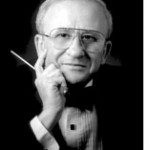
Amos is conductor of the Tifereth Israel Community Orchestra and ha guest conducted professional orchestra around the globe. He may be contacted at david.amos@sdjewishworld.com