By David Amos
SAN DIEGO — When the question is asked as to “which is the greatest symphony of them all?” classical music enthusiasts will name you their favorite, which could be one of several deserving masterpieces. But more often than not, the answer will be Ludwig Van Beethoven’s incomparable Symphony No. 9 in D Minor.
What creative forces within the composer came together in the right way at the right time, to create a musical work of such power, beauty, and mystique? Why is this symphony the favorite for even the casual concertgoer? Why has it become a December ritual to many Japanese musical organizations? Why have so many of its themes been quoted in film, television commercials, and children’s toys? Why the ever-popular theme from its fourth movement was adopted as the Anthem for Europe by the European Union? These valid questions may not be easily answered, but here are a few interesting facts which are part of history, and others of my personal experiences.
After Beethoven’s time, many composers struggled with the concept of composing a “ninth symphony”, simply because it would be under the shadow of Beethoven’s monumental work. Take the case of Mahler, Bruckner, and others. Shostakovich took a different turn; instead of being awed by Beethoven’s, he started his own Ninth Symphony with a comical, impish movement which was almost a clever defiance to the weight of tradition.
Brahms, who by word of mouth and press was anointed the greatest composer since Beethoven and his heir-apparent, struggled for over two decades before releasing his First Symphony, because even before it was premiered it was dubbed “Beethoven’s Tenth”. Think of the pressure and expectations that the music world created for him.
Beethoven’s Ninth certainly broke ground. Up to its premiere in 1824, it was the longest symphony ever composed. It took the audience, then and today, through Beethoven’s mastery of musical architecture and harmonic development, episodes of tragedy to triumph, despair to exhilaration, and solemnity to sublime exultation and hope.
And, of course, the text of Ode to Joy (An die Freude). Friedrich Schiller wrote the epic poem back in 1785 during the Age of Enlightenment, and many composers wrote music, mostly for duets and smaller forces, based on the text. Schiller revised it in 1803. Beethoven toyed with the words for three decades, before finally finding its rightful place, in the fourth movement of his Ninth Symphony. It really resounded with his own thoughts about the evolving society of his time, and with its emotional theme of brotherhood and equality for all the people of the Earth.
Beethoven also composed a work for piano, orchestra, solo voices and chorus, his popular Choral Fantasy, years earlier. Although it stands on its own as another of the composer’s masterpieces, in many ways, it resembles the Fourth Movement of the Ninth, and may have served him as a preparation for what was to follow. The Fantasy is closer to being an extended single movement piece for piano and orchestra, with the added vocal forces in the last section, singing a melody quite similar to the Ode to Joy.
Now is not the time to analyze in detail the beauty, power and complexity of this work, but a few comments are worth making. The first movement is a tour de force by itself, long, (around 65 minutes) and full of dark sounds, lyrical moments, and with the promise of things to come. The second, a “Demonic Scherzo” is forceful, dynamic, energetic and also very quotable. With its prominent tympani part and insistent, pulsating, repetitive rhythms, it could stand alone at a concert. The third, both mysterious and lyrical, shows how that quiet, pensive power, of simply “holding back”, can make for a convincing statement.
And then, the fourth movement. By itself it runs 25 minutes and it takes us through many levels of emotion. First, we hear what is called the “fanfare of terror”, which is followed by a quasi-operatic recitative, played by the string basses. Then, we are given brief quotes of the main themes of the previous three movements, and the main, well known theme is first introduced. First, in a quiet, simple way, and slowly it gains grandeur and additional instrumentation, until another climax is reached. The baritone intervenes with a plea for attention (words by Beethoven himself), which serve as an introduction to Schiller’s ode. The chorus joins, and so does the vocal quartet through a series of variations on the main theme. From there to its conclusion, its complexity, greatness and nobility are hard to describe in mere words.
There are many recordings available of this symphony. Every one of them has undisputed merit. Some, such as Otto Klemperer, are on the slow side, dignified, and authoritative. Other memorable ones, such as Toscanini and Bernstein are more propulsive and dynamic. There are many in between, mostly very inspired renditions, with outstanding soloists, and varied recording qualities.
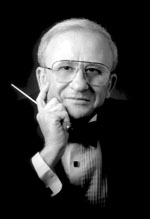
My personal experiences in conducting The Ninth are few, but unforgettable. First, was the excitement and humility to be privileged to conduct and put together the forces involved. Next, was my awe when studying the score and being marveled at its many wonders and challenges.
But, there were two occurrences I remember best. This symphony requires such technical, artistic and emotional involvement, that at the first concert, I concluded the first movement of over 15 minutes’ duration, and I felt drained and exhausted. I first thought that “I can’t go on”, but after catching my breath and gathering my thoughts and energies, we happily continued.
The strangest event happened to me twice, at rehearsals, but not at the concerts. While rehearsing the middle section of the fourth movement, with the chorus in full voice and the orchestra playing away fortissimo, I went through what I believe athletes call “in the zone”. It was, as I can best describe it, an out of body experience, where my physical and artistic efforts were taken over by an outside force, for no longer than about a minute, I became a mere, comfortable observer to that sublime moment. Apparently, no one else noticed these two episodes, and at their end I snapped back into my normal mode, seemingly in a seamless way. This is what the greatness of this piece did for me.
But, I’m glad that this did not happen during the concerts!
*
Amos is conductor of the Tifereth Israel Community Orchestra and has guest conducted professional orchestras around the world. He may be contacted at david.amos@sdjewishworld.com