By Ariel Schnitzer

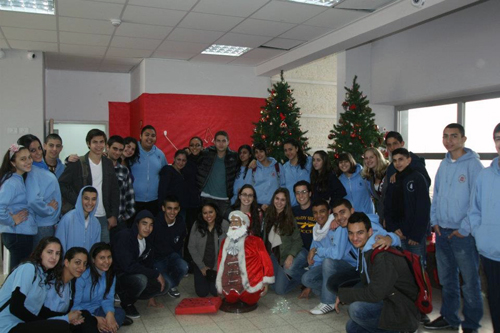
RAMLE, Israel — If it weren’t for the Hebrew exit sign that hung above the entrance, I would have never imagined I was in Israel, or rather, the Israel that I had always known. Boys played soccer, girls gossiped in tight groups. The setting was all too familiar–after all, I had only just been in high school a few months before. However, this was my first time in an Arab high school. I had come, as a component of my gap year program, to attempt to build relationships with Arab students and engage in dialogue that hopefully would better our understanding of one another.
Each year, a significant number of Jewish high-school graduates from all over the world spend a year studying in Israel. I was fortunate to be chosen to participate in “Kivunim: New Directions” through which I was able to live in Jerusalem and study history, politics, Hebrew and Arabic. We also visited many Jewish diaspora communities in North Africa, Europe, and Asia to learn more about their history and modern status and, as North American Jews, extend our support.
We lived in a hostel, Beit Shmuel, which was adjacent to Jerusalem’s Old City. I roomed with one of my best friends on the program, who is also a graduate of San Diego Jewish Academy.
As we were living in Israel for the year, Kivunim mandated that we spend time at least once a week to give back to the country by engaging in some form of community service. I chose to volunteer at The Christian Orthodox School in Ramle. Although Christian Arabs run the school, ironically, the overwhelming majority of the students are Muslim. I had volunteered at numerous Jewish organizations throughout my life, but never had I interacted on a one-to-one basis with Arab-Israeli students. When else would I have an opportunity such as this one?
Once a week, on Thursday mornings, eight of us piled into our 7:35 a.m. van and made our forty-five minute journey from Jerusalem to the small, historical city of three-thousand. On our first day, we had been divided into groups of approximately seven students per volunteer. That these kids were Israeli citizens, but most had never had any kind of relationship with another Jew, Israeli or foreign-born, surprised me.
We began by conversing with them about the generics: hobbies, school, and movies. They all wore very modern, Westernized clothing, even though some of the girls wore traditional Muslim hijabs as head-coverings. Most girls, however, walked around with no head-coverings and dressed in tight skinny jeans. For the first few weeks, our conversations were still awkward and surface-level.
Sometime later in the semester, an exceptionally friendly, outgoing boy, who always came up to talk me before anyone else, mentioned that he wanted to be a doctor when he was older.
“Where do you want to study after high school?”, I asked.
“Jenin,” he replied, referring to a West Bank city in the Palestinian territories.
“Why?” I asked, surprised. “It is so beautiful there,” he said. “There are a lot of trees and I have a lot of relatives there and the education is very good.
|“I want to move there and raise a family there,” he continued. “There, it is more peaceful… less complicated.”
Others I spoke with expressed the desire to stay in Israel.
“What do you want to study in college?” I asked a girl, whom I had gotten to know as an ambitious and hardworking overachiever.
“Science,” she said grinning.
“Where?” I asked.
“Hebrew University,” she answered. “It’s the best school in Israel.”
I noted that what differentiated her from the other boy was that she came from a very integrated, assimilated Arab family. Her family was wealthy, and though she lived in Ramle, she also had another home in a major Israeli city. She had grown up with Israeli neighbors and her mother has also been an employee of Jewish organizations. The other boy had spent his entire life within the confines of Ramle’s insular Arab community.
“What do you want to do when you’re older?” I asked another boy.
“I already know,” he replied. “I will manage my family’s bakery right here in Ramle.”
“Do you like Ramle?” I asked.
“I love it here,” he answered.
Several months later, I noticed a young girl giggling as she spoke to a large group of her friends who seemed captivated by her every word. I asked one of the girls to whom I had been speaking what this girl had done to deserve such attention.
“She got engaged this past weekend,” she explained. “The school announced it over the loudspeaker this morning.”
“How old is she?” I asked, stunned.
“Fifteen,” she replied, “she’s leaving the school now.”
I asked the girl more questions, my curiosity obviously piqued. “Does this happen a lot at this school?”
“No,” she answered, “maybe five or six girls every year.”
“How old is her fiance?” I prodded.
|
“Much older. Maybe 30.”
“Did she choose the man she will marry?” I asked.
“No,” she responded. “Her parents arranged it all.”
The young girl’s engagement prompted a subsequent discussion of dating. Some parents were less strict, others more conservative.
“My parents would never let me have a boyfriend!” One girl exclaimed.
Another girl said her parents weren’t religious and wouldn’t mind.
Another boy responded “no” to whether he has a girlfriend, then, several moments later, took it back. “I have a girlfriend, but my parents don’t know. We meet up in secret.”
I learned about the conservative traditions enforced upon these teenagers, and met many who were more secular and resisted these constricting barriers.
|“I am very religious and go to mosque on a regular basis,” one girl told me.
A boy told me he only went to mosque on special holidays, which amounted to several times a year. Another boy lamented how all the girls at the school are too shy and conservative. He told me that he and his friends were more into a group of girls at a different Arab high school. However, when asked about the boys, one female student laughed. “They are so immature.”
It seemed like a typical response one would receive from an American ninth grader when questioned about her male classmates.
“We are all just very close friends,” she added.
I noted how modern and secular this concept was. One boy told me how glad he was to have transferred to the Christian Orthodox School from another Arab high school just down the road.
“The school I used to go to was horrible. The teachers were bad and the students were not serious. I didn’t learn a thing. This is the best Arab high school by far.”
I was happy that he had had the opportunity to switch to a superior school, but the shabbiness of the campus bothered me. Everything was very monochromatic and simple. I couldn’t help comparing the best Arab high school in Israel to some of the U.S.’s premier schools and a couple of Israeli high schools I had visited. In short, this school didn’t match up to any of them, at least in terms of physical appearance.
We also discussed, extensively, both the Arab-Israeli conflict and the tensions between the Arab and Jewish citizens of Israel. Although I still identify as pro-Israel, I listened to the students argue their opinions and describe their encounters with prejudiced Jews and biased policemen. In turn, I hoped the Ramle students acquired a new outlook on Jewish youth, that there were some who wanted to listen to them.
“Tell me about some of your experiences with Jews,” I said to one boy.
He frowned. “The only experience I’ve ever had with Jews is one time my father and I were walking through the Jewish Quarter of Jerusalem. It was Yom Kippur, but we didn’t know that at first. A crowd of Jewish men began following us, hurtling stones at our backs. It made me so mad.” He paused, then added, “It still does.”
Regarding the Arab-Israeli conflict, most of the students expressed frustration that the school’s administration failed to address it in the curriculum.
“I get most of my information from my home, from my parents,” said one student.
“The administration praises the Israeli government and remains hush-hush about the Arab side,” one student complained. “As a result, I know a lot of math, geography, and literature, but I know nothing about the conflict. Even though we have other resources such as the internet and books, we wish we could learn about it in the classroom.”
One girl was even more irate. She complained that throughout her years in school, she was never taught about her Palestinian culture. She said she was taught history only from the Israeli perspective. She felt that her textbooks did not contain enough information about her heritage.
I realized the unique position of Arab-Israelis, particularly the Muslims. They share a heritage and religion with other Arabs, yet they live in a Jewish state. They are criticized by non-Israeli Arabs for living in Israel, yet many Israeli Jews want as little to do with them as possible. Many feel ostracized, isolated, and shunned.
Oddly enough, except for a handful of kids who wanted to move abroad, either to Palestinian-controlled territories or other countries, most of the kids were positive about Israel even amidst prejudice and the difficult circumstances for social mobility. Many hoped to become lawyers, doctors, and teachers–in Israel.
I didn’t make any close friends in Ramle–that wasn’t the kind of relationship I had with the kids. I felt more like an outside observer who asked a lot of people a lot of different questions, sat in on a couple of classes, and formulated my own impressions. Also, the kids I spoke with were much younger than I am as most were ninth and tenth graders. I also noticed that the students rarely ever brought up my Judaism or past–they never asked me about my culture, my traditions, or my upbringing. They were interested in my being an American, my travels on Kivunim, my friends, and my weekend plans.
My time spent at the school also exposed me to the generosity and warmth of the Arab-Israeli culture. Kids offered to share their lunches with me and the lunchmen served us complimentary falafels. I stopped by the local bakery each time I came to Ramle, which smelled deliciously of freshly baked Middle Eastern pastries. The owner came to recognize us, eager to have us choose our choice of sweets for the day from the old-fashioned shelves carved into the wall.
Ramle raised my awareness of the discrimination and frustration that many Arab-Israelis experience on a regular basis. I learned that it is much more difficult for these students to get admitted to the same Israeli universities as Jews because Jews in the army participate in special units and/or programs that place them at a higher advantage at getting admitted into selective universities. I learned that many of the kids loved living right there in Ramle, content to continue the status quo and raise their families in this warm community.
I don’t know if I will ever see the students again. But the stories I’d heard, and the anger and frustration, hope and optimism I’d witnessed made an indelible mark.
*
Schnitzer is a Los Angeles County resident