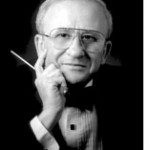
By David Amos
SAN DIEGO –In my enthusiasm and involvement in serious classical music, it really all starts with the work of the composer. One of the Twentieth Century’s most important composers of symphonic music, Paul Creston, very correctly said that for music to take place, three elements must take place in this sequence: The composition by the composer, the interpretation by the performer (s), and the listening public.
In my early years, I was fascinated by the music and stories of composers long gone. As I started my serious studies, I awakened to the fact that there were such people as living composers, and after listening carefully to the wonderful creations of some of them, I developed the desire to meet with them, learn about how they compose, and when possible, be a part of Creston’s second phase, the interpretation of their music for others to hear and enjoy.
In the spirit of this mission, I have met many, many living composers, some who were already established and famous, have conducted and recorded dozens of their works, and have received the satisfaction to have contributed, even in a small way the documentation of their music. I am also pleased that I have been encouraged to continue my work in this area by both musicians and non-musicians alike. My specialties have been American, Jewish, and Israeli music.
Here are a few facts, myths, misconceptions, historical perspectives, surprises, and personal observations about composers.
When serious music started to be composed for the purpose of simply listening to its beauty, around 800 years ago, it was totally controlled by the prevailing establishment of the Western World, the Roman Catholic Church. Up to those times, music was for dancing, chanting at religious services, or for the simple folk to entertain themselves. Ending with the Renaissance (1400-1600) and well into the Baroque Period (1600-1750), control of music and the arts in general was in the hands of royalty. Composers were virtual servants of the court, (Such as J.C. Bach), and generally composed what they were ordered to do.
This practice continued well into the early 1800’s, when a few composers attempted to be independent agents. Mozart almost succeeded, but could never live within the limits of his earnings. Beethoven was the real break; he received financial help from royalty, but he was proud to say that he composed what he wanted, offered his compositions to publishers, and named his price.
Obviously with many exceptions, this practice continued throughout the 19th Century, well into the 20th C. In more recent times, composers who live entirely from the music they wish to compose are rare. More than likely, you with find composers affiliated with academia, music education, or commercial music for film and television. Many of them teach. For example, many highly successful film composers whose music you would recognize are grateful for their fame and fortune, but relish in the opportunities to write what comes from their heart, not the requirements and demands of the movie producer.
They work with different motivations: What they feel compelled to write, what the commission stipulates, and what drama or comedy goes along with the background music.
Many compose at the piano. Others can compose anywhere, even while sitting as a passenger in a train. Lately, many have turned to computers and other electronic devices.
And, you can forget about the Romantic concept of the composer, sitting by an open window, seeing the moonlit sky, touching their hearts and be suddenly wildly inspired. This, the “Gift of the Muses” is the stuff of legends and movies. Yes, it happens occasionally, but in most instances, composers get up in the morning, have breakfast, and start composing. This is work, with deadlines, schedules to meet, and commitments. Anyone involved in the arts and in creative writing, can relate to this.
Composers Gian Carlo Menotti and Samuel Barber shared a home for many years (Capricorn). The former told me that by 9:00 a.m., they retired to opposite sides of the house, and went to work on their individual projects.
The late film composer Miklos Rozsa (Spellbound, Ben Hur, Quo Vadis, King of Kings, and 200 more sountracks) gave me very colorful anecdotes of what it used to be for composers during the Golden Age of Hollywood when the movie moguls ruled. Composers were under contract, reported to the studio for work in the morning, (some had to punch a time clock!) went to their private rooms which had a piano and where they kept their notes and sketches, and went to work. Look at the wonderful results that came out of that system. Watch and listen carefully to the award winning film Spellbound, when Alfred Hitchcock’s creativity merged in unforgettable dramatic moments in combination with the music of M. Rozsa!
Today, most composers work from their home.
It is generally a lonely existence, because you need privacy to create. Many composers are quite eccentric, having developed unusual quirks and attitudes. Some whom I’ve met are plain bizarre. Other, lead normal family lives. Some crave for public and critical acceptance; others simply don’t care. At least they tell us so. Aaron Copland used to say that his compositions could be classified into two categories, the ”popular” ones, and the “difficult” ones, and that he didn’t care at all if the public did not accept his “difficult” music.
Some are content to compose in styles pioneered by their predecessors. Others feel obligated open new vistas, explore new paths and experiment, even at the cost of popularity or acceptance. Many find a happy medium and compromise, but usually, these are the ones destined to historical mediocrity.
There are composers, such as Alan Hovhaness, who told me before recording sessions of his music to “use the score as a guide; I composed what’s on paper. From that point, you are free as a conductor and interpreter to do as your heart dictates.” Other have been far less accommodating, telling me to “adhere religiously to every indication in the score; this is what I wrote and what I want. Don’t interpret anything or take any liberties. It is all there!” Naturally, I followed their wishes.
After all, we are the servants of the composers’ creations, whether they are alive or of the past.
After all, serious composers have the very necessary and admirable gift of obsessiveness to make sure that each individual note follows another in just the right way. Attention must be given to rhythm, melody harmony, instrumentation, the overall form and effect, and what emotion is brought out. A daunting task, if done correctly.
*
Amos is conductor of the Tifereth Israel Community Orchestra and has guest conducted professional orchestras around the world. He may be contacted at david.amos@sdjewishworld.com