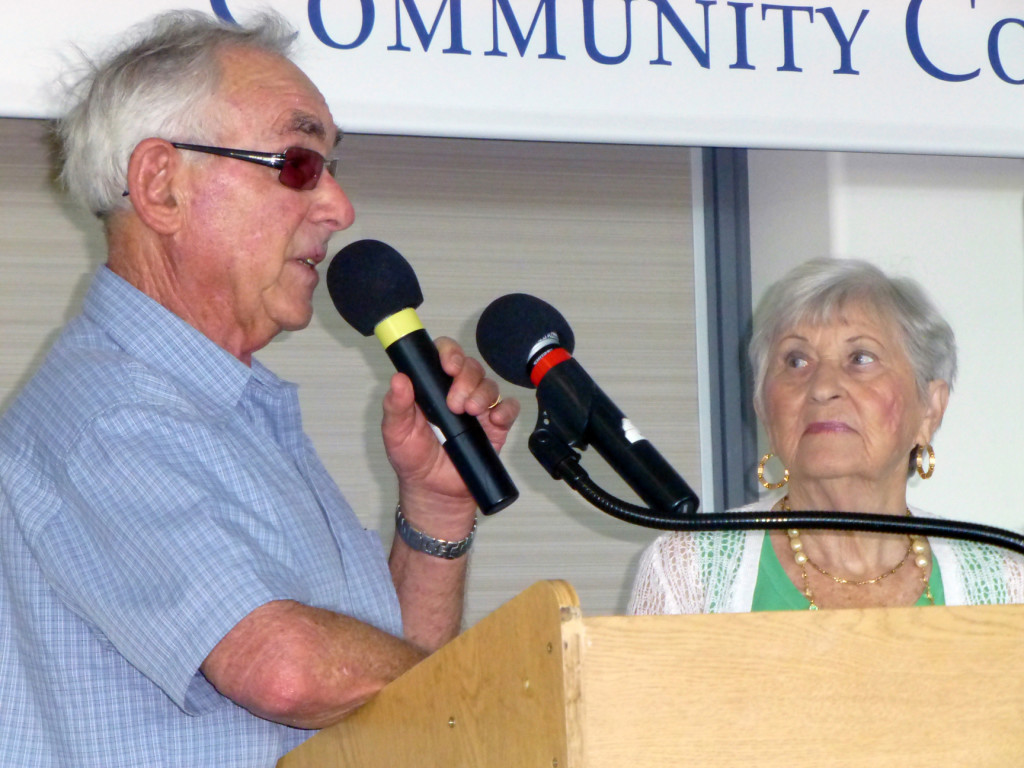
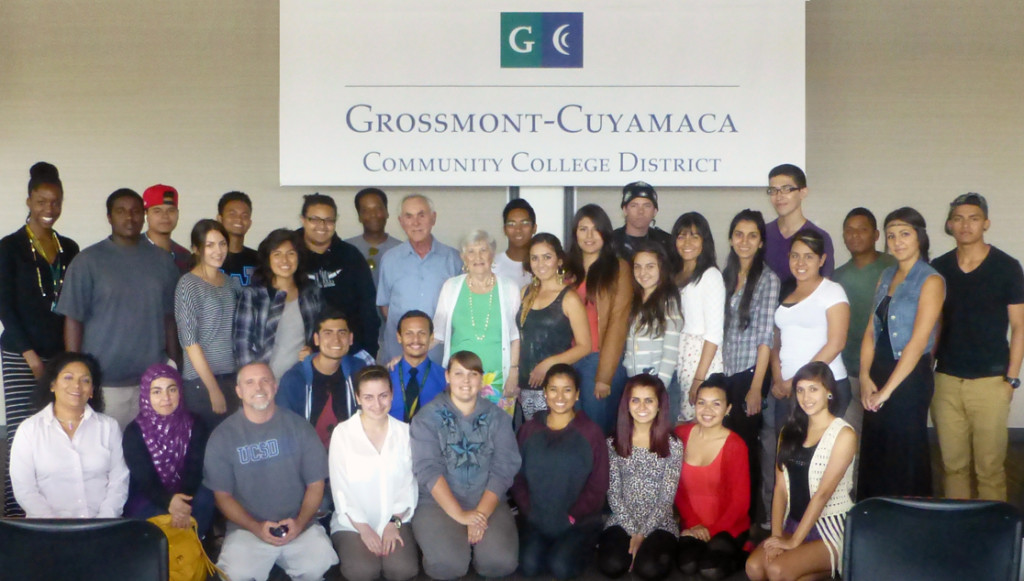
EL CAJON (Press Release) — Holocaust survivors Max and Rose Schindler related to a group of incoming freshmen at Grossmont College on Monday, July 22, that after enduring such horrors as the death of family members, near starvation, and constant humiliation at the hands of the Nazis, they finally were liberated from separate Nazi concentration camps in 1945, when they were still younger than the students in their audience are today.
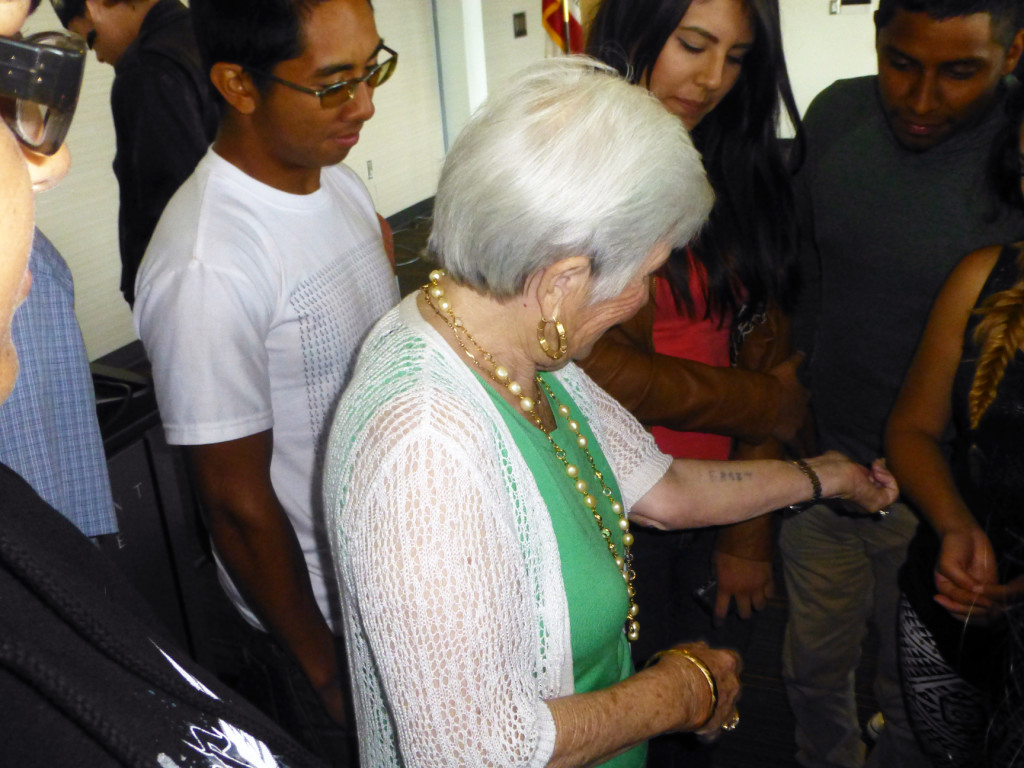
Now both in their 80s, the Schindlers were not yet 16 when Russian troops liberated the former Rose Schwartz of Seredne, Czechoslovakia, and Max Schindler of Cottbus, Germany. Students in the Grossmont College audience, who had read Night by Elie Wiesel as part of their Summer Institute Program and will be traveling later in the week to the Museum of Tolerance in Los Angeles, crowded around the couple to see the numbered tattoo that Rose had received at Auschwitz and the KL (for Konzentrationslager, or “Concentration Camp.”) that had been tattooed on Max’s arm.
Rose said that when the tattoo was administered to her, two people had to hold her down, because she fought so hard against it. She said it was very painful.
The students also asked such questions as whether the Schindlers ever can forgive their German persecutors –“No,” responded Rose—or whether they had ever taken revenge. Max said after he was sent in a youth transport to England, he one day saw some German prisoners being transported in a lorry by British soldiers. He said he followed the truck and took satisfaction in yelling at the soldiers. But other than that, he said, no revenge.
Another student asked if, as victims of persecution, they had been particularly empathetic to the Civil Rights Movement of the late 1950s and 1960s. Max responded that while they were aware what was going on—and knew that many fellow Jews were aiding African Americans in Freedom Rides and other actions – they themselves were too preoccupied with trying to rebuild their shattered families to personally participate.
The students asking the questions were either first-generation Americans, in some instances whose families were refugees from war-torn countries, or were the first students in their economically disadvantaged families to attend college. The Summer Institute Program is designed to give such students an introduction to college life as well as a head start on their studies.
Rose and Max for the most part were unemotional while telling of the hardships that they endured and their separation from murdered members of their families. But emotion occasionally broke through as when Rose told of returning to Seredne after her liberation, and finding in a hiding place in her old home a small cache of jewelry that her father had hidden. She converted a thin gold chain—as might be used for a watch – into a necklace, and, pointing to her neck, she said she has worn it almost every day since in memory of her murdered father.
Max recounted how he had been forced to work in a German factory in Dresden, and how after surviving the Allied fire bombing of that city, was ordered on a “death march” to Theresienstadt, with Nazi officers telling him and other frozen prisoners to keep moving or be shot. With quavering voice, he told the students that he and his fellow Survivors are dying—and with people today trying to deny that the Holocaust ever happened – it was the students’ responsibility for the sake of history to remember what they heard and saw.
Because they were minors and orphans, Rose and Max separately had the opportunity to be transported to Great Britain to begin a new life. Although one went initially to Scotland and the other to England, they met as youth hostels for the young refugees were consolidated. According to Rose, they immediately fell in love. The British philanthropist who had made the rescue of the orphans possible – Leonard Montefiore—walked Rose down the aisle in a 1950 wedding held in London.
One year later, the Schindlers immigrated to the United States, spending five years in New York City before moving onto San Diego, where he worked on General Dynamics programs. The couple, now living in the Del Cerro area of San Diego, have four grown children and nine grandchildren.
Noting that many of his contemporaries are dying, and that is only a matter of time before all Holocaust survivors have passed on, Max urged the students to remember their meeting with two Survivors and to recount what they heard and saw if anyone in the future should try to deny that the Holocaust had occurred.
Besides students, some faculty members, staff and administrators of Grossmont College sat in on the talk, which was held in the Griffin Gate meeting room. –DHH