By Eric George Tauber
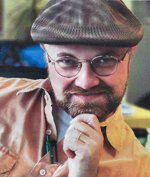
SAN DIEGO — I first saw Rhona Gold in a staged reading of The Jewish King Lear at the REP. Then, more recently in a reading of Jewish Shorts at the JCC in which she was particularly memorable as the teacher of a tongue-in-cheek conversion class, Jewish 101. After I saw Rhona in Skinless –now playing at the Moxie Theatre thru Dec 8th – we made a date for coffee. Here are parts of our conversation…
EGT: When we spoke, you said that Yiddish was actually your first language. Not many people can say that today.
RG: That’s true. And fewer and fewer as it turns out. My parents were Polish immigrants to Montreal. And they came before the war.
EGT: Thank God.
RG: Yeah. They left a lot of people behind, but they were here before the war. So they spoke Polish when they didn’t want me to understand. But Yiddish was the language of the household and I didn’t learn English until I went to public school.
EGT: Okay. Now what brought them to Montreal before the war?
RG: There was a very strong and vibrant Yiddish community in Montreal to rival that of New York and they were part of a left-wing labor movement, the UJPO, the United Jewish People’s Order. Besides being a labor movement, it had a very strong cultural component that produced theatre. There was a choir that traveled nationally and was held in very high esteem. During the blacklist of the 50s here, when people like Pete Seeger and Paul Robeson couldn’t get a gig, they would come up to Montreal and perform for the UJPO. They had a very vibrant theatre as well. So I was acting with them.
EGT: Nice. Were your parents religious, or not really?
RG: No. They were left-wing …
EGT: Mensheviks.
RG: Mensheviks. Although there was a great deal of culture and Yiddishkeit, there wasn’t much religion. They did send me to a parish school where I was taught religion, but if I wanted to go to shul, I had to go with a friend’s parents. They’re not going. And that’s an interesting kind of thing because when you tell someone that you’re Jewish, it means that you are not Gentile. But it doesn’t necessarily mean religiosity. I went to parochial school and I went to shul when I wanted to go, but we didn’t go as a family.
EGT: In your bio, you said that you performed in the Yiddish theatre when you were three, so tell me about your big break.
RG: Well, it was for the UJPO. My memory of that time is not great. It was a long time ago. But it was kind of Vaudevillean that nobody does anymore. But it was like the stuff going on in the Catskill Mountains. So it was that kind of thing. Also, I studied at a very early age with a woman who taught Children’s Theatre classes at the Jewish Public Library. Her name was Dora Wasserman. … And I can’t imagine better training because she her tradition was very much one of story telling and her characters were larger than life. And Yiddish theatre is very larger than life.
EGT: I really wish I had met you about fifteen years ago when I was in grad school writing my term paper on the Yiddish theatre. What a wonderful primary source you are. … Now, it’s one thing to be a child in drama club and it’s another thing to try to make a career of it. So, how supportive was your family?
RG: Not very. I wish I could say I have made a career of it, but for years, I’ve always had to do something else. … But no, my father died when I was quite young. But my mother … that was not what she had in mind.
EGT: What did she have in mind?
RG: She had in mind a husband.
EGT: Most mothers do.
RG: When I would go back to visit, she would always tell me about children of friends of hers who still lived in the neighborhood. Some of them went to college. Some didn’t. But a lot of them stayed in the neighborhood, whereas I couldn’t get away far enough or fast enough.
EGT: So that was not a big pull.
RG: No, it wasn’t. And so I started being involved in University theatre in Montreal while I was still in high school. Most of my friends were older. And there was a director who would come in from McGill University, and he could clearly see that I had the bug bad. So he involved me and I was a production assistant and did makeup and things like that.
EGT: So what was it about the theatre that spoke to you. How did you get that bug bite?
RG: You know, I think it was … as a child, I think I just liked to show off. But later on, it had to do with a sense of community and ritual. It seemed to me, in my life anyway, something that demanded all my resources. I had to bring it ALL in order to accomplish what I wanted.
EGT: It filled a void that normally religion might fill, that sense of community and ritual.
RG: Exactly. Interestingly, later on I did guerrilla theatre in Toronto in the 70s. There was this one guy who was quite mad, but very talented. During some breathing exercises, he mentioned that the word “conspire” literally means “to breathe together.” And when people come together to create a piece of theatre, they enter a conspiracy. And that just thrilled me on all kinds of levels. But it’s true. You agree to breathe together to create something where there was nothing…. Our major drive was the Women’s Movement, which was a very big deal in Toronto.
EGT: What have been some of your more challenging roles?
RG: Well, this one is extremely challenging. It requires a certain kind of “shark” mentality, which is really not mine. I just love working with Moxie and particularly working with Delicia [Turner-Sonnenberg] because she doesn’t pull any punches or take any prisoners. She is ruthless. And she doesn’t let up on my in particular at all. And she has no time for nonsense, so you have to snap to it. And she doesn’t want you to pretend to go there. She wants you to go there. It’s very good work for an actor. Because after you’ve been doing it for as long as I have…
EGT: You get on auto-pilot.
RG: You do. And quite frankly, I know that if I get on a stage, I’m pretty much going to be okay. And that’s not how you want to be. So unless someone’s going to offer me a lot of money, it has to be work I really want to do.
EGT: So do you have any future projects coming up?
RG: I will play the role of Yenta in Lamb’s Players remount of Fiddler on the Roof in January when they do it at the Lyceum. I understudied when they did it the last time. I agreed to understudy last summer quite frankly because I had done the role of Hodel when I was 13 at the UJPO in Yiddish. It wasn’t Fiddler then, it was Tevye der Milchiger. So I’ve always had an affinity for it. I was heart-broken that I wasn’t going to play the role. Then they asked me to understudy it. And I couldn’t imagine sitting at home while they were rehearsing this thing, and I wasn’t a part of it. So I went to all the rehearsals and I was kind of their “go-to Jew.” The fellow who played Tevye, an actor named Sam Zeller, wanted to know Yiddish. He said, “You know, I have a tendency to throw these words out and I want them to be right.” So I taught him maidlach for girls, mishpocha for family …etc. He was very grateful and I was grateful to be a part of it. And now I’m actually going to get the role.
EGT: Did they give any kind of credit as a creative consultant?
RG: No.
EGT: They should.
RG: Oh.
EGT: Why not? One little line: Special thanks to Rhona Gold, Creative Consultant. How hard is that
Well, whether she gets the recognition or not as the “go-to Jew” in Fiddler, Rhona Gold is certainly making her mark on the theatre scene in San Diego. Please take the time to check out this charming and delightful lady in Skinless now playing at Moxie thru Dec. 8th, and definitely come to Fiddler on the Roof playing at the Lyceum in January.
*
Tauber is a freelance writer based in San Diego. He may be contacted at eric.tauber@sdjewishworld.com