 NEW YORK (Press Release)–Tu B’Shevat, the 15th of Shevat on the Jewish calendar—celebrated this year on Thursday, January 16, 2014—is the day that marks the beginning of a “new year” for trees. This is the season in which the earliest-blooming trees in the Land of Israel emerge from their winter sleep and begin a new fruit-bearing cycle.
Legally, the “new year” for trees relates to the various tithes that are separated from produce grown in the Holy Land. These tithes differ from year to year in the seven-year shemittah cycle; the point at which a budding fruit is considered to belong to the next year of the cycle is the 15th of Shevat.
We mark the day of Tu B’Shevat by eating fruit, particularly from the kinds that are singled out by the Torah in its praise of the bounty of the Holy Land. On this day we remember that “man is a tree of the field” (Deuteronomy 20:19), and reflect on the lessons we can derive from our botanical analogue.
Some customs for this day:
• It is customary to increase in the amount of fruits one eats on the 15th of Shevat, in order to praise G-d who created all these species of fruits.
The blessing recited on fruit is:
(Transliteration:)
Baruch atah A-donoy, Elo-heinu Melech Ha’Olam borei pri ha-aitz.
(Translation:)
Blessed are You, L-rd our G-d, King of the universe, who creates the fruit of the tree.
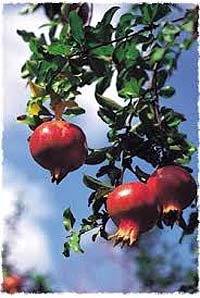
• In particular, one should include among the fruits one eats on this day the species of fruit which the land of Israel is praised for: grapes, olives, dates, figs and pomegranates.1 If one eats a sufficient amount of fruits of these fruits, one recites the special after blessing Al Ha’aretz ve’al HaPeorot.
• One should make an effort to eat at least one fruit which one has not eaten that entire season, and would require the blessing of Shehecheyanu. When eating such a fruit, the Shehecheyanu should be said prior to reciting the blessing of “Haetz.” If he has already partaken of other fruits (at that particular sitting) than he only needs to say the Shehecheyanu upon eating the new fruit.
The blessing of Shehecheyanu:
Transliteration: Ba-ruch A-tah Ado-nai E-lo-he-nu Me-lech Ha-olam She-heche-ya-nu Ve-ki-yi-ma-nu Ve-higi-a-nu Liz-man Ha-zeh.
Translation: Blessed are You, Lord our God, King of the universe, who has granted us life, sustained us, and enabled us to reach this occasion.
• Many also have a custom of eating carob on this day. There is yet another custom which many have and that is to eat the Etrog, either in the form of preserves, sugared slices, etc.
• It was the custom of the famed Kabbalist Rabbi Isaac Luria (“Arizal”) to eat 15 varieties of fruits on the 15th of Shevat.
• On this day Tachnun is omitted from the Shacharit and Mincha (morning and afternoon) prayers as well as from the Mincha prayer on the afternoon beforehand.
*
Preceding provided by Chabad