By Eric George Tauber

SAN DIEGO — How do you put your life back together after a tour of duty? When you’ve survived an environment where anything could explode and anyone could be an enemy, how do you get back to “normal” ? That’s the dilemma faced by our veterans. For many, the journey back to civilian life feels like a mission for which they have not been trained.
This is the world of Elliot Ortiz, played by a rakishly charming Rey Lucas. Ortiz was medically discharged for a wounded foot, but the more painful scar haunts his dreams in the image of the first man he ever killed. His PTSD comes not just from Iraq. His anger and bitterness go deep, back to a combative childhood with scars that never healed.
“Staying clean is like trying to tap dance in a mine field.”
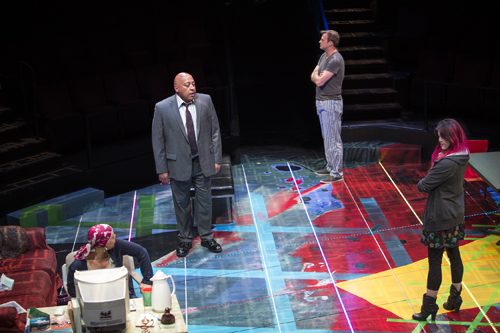
A second plot features Haikumom, the username of a woman who runs an online chat-room for recovering crack addicts. When they log on, Orangutan, Chutes & Ladders and Fountainhead speak from the aisles of the house, connected by lines of colored lights in the floor. Online relationships are peculiar. They don’t know each other’s real names or faces, and yet they share deeply personal details of their lives in the seemingly safe anonymity of the web.
I loved the chemistry of these characters. Robert Eli –as Fountainhead- tries to put on a brave face at first, but the others see right through him and the layers of his facade are stripped away. Marilyn Torres –as Haikumom- was absolutely genuine. She didn’t play a character; she inhabited a personal hell. Ruibo Quian and Keith Randolph Smith really click as Orangutan and Chutes & Ladders. They “get” each other on a level no one else could. This makes them the best of friends.
The music of John Coltrane underscores the play. Himself a coke fiend, Coltrane’s frenetic dissonance captures the chaos of the characters’ minds. This dissonance was also reflected in Ralph Funicello’s set. The floor is an abstract painting of bold colors and strong patterns. To be honest, we found it too strong and rather distracting. It drew attention to itself more than it supported the story.
Water by the Spoonful is a window into a world that most of us will never –and should never- see. But once you look into it, the images are so compelling that you cannot look away.
Written by Quiara Alegria Hudes. who also penned the Tony Award-winning musical In the Heights, Water by the Spoonful won the 2012 Pulitzer Prize for Drama. Touching on issues relevant to veterans and the arts, the Old Globe has reached out to two local organizations, Combat Arts and So Say We All. They hire professional artists to provide visual arts classes to veterans. Above the theatre, they have set up an art gallery with examples of Combat Arts’ work. It’s worth a look. The images are poignant and disturbing, a reflection of wounded souls.
According to the Old Globe’s Artistic Director, Barry Edelstein, “Their innovative approaches to helping veterans express themselves through the visual and narrative arts are very much a complement to what we do. The Globe believes, as they do, that art is a powerful force for civic good… .”
In that spirit, may we all support the arts, our veterans and Tikkun Olam, the mission of repairing a broken world.
*
Eric George Tauber is a freelance writer specializing in the arts. He may be contacted via eric.tauber@sdjewishworld.com … San Diego Jewish World seeks sponsorships to be placed, as this notice is, just below articles that appear on our site. To inquire, call editor Donald H. Harrison at (619) 265-0808 or contact him via donald.harrison@sdjewishworld.com