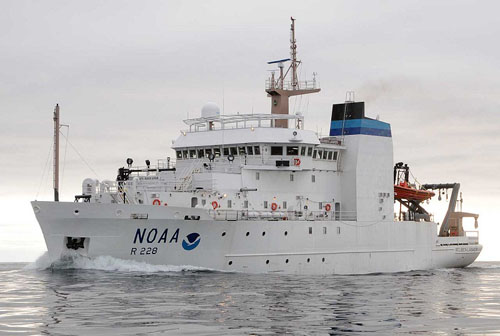
(Photo: NOAA)
SAN DIEGO (SDJW) – The NOAA Ship Reuben Lasker, named for a Jewish scientist who believed the secrets of the ocean would be yielded only through a multi-disciplinary approach, was commissioned Friday, May 2, in San Diego at a ceremony at Navy Pier.
Pam Lasker, whose father died in 1988, was the sponsor of the fast sleek ship that can move so quietly it can sneak up on a school of fish. Among other dignitaries participating in the ceremony were Congresswoman Susan Davis (D-San Diego); Port Commission Chairman Bob Nelson; Michael Devany, deputy undersecretary for operations of the National Oceanographic and Atmospheric Administration (NOAA), and Cmdr. Keith Roberts, who is the vessel’s first skipper.
Dr. Roger Hewitt, assistant director for ships and infrastructure at the Southwest Fisheries Science Center, who considered Lasker a friend and mentor, commented that “the fisheries survey vessel Reuben Lasker is inspired by its namesake, a renown and well-loved fisheries scientist with a passion for his research and those who worked with him. Reuben conveyed a sense of joint purpose, that the mysteries of the sea could only be addressed by a multi-disciplinary team. The design of Reuben Lasker embodies this spirit. Reuben would be proud, even if he got a bit sea sick.”
Lasker was credited with building “a renowned research group that focused on the recruitment of young fish to the adult population – a topic with implications for fisheries management throughout the world,” according to NOAA officials. Besides serving as director of the Southwest Fisheries Science Center’s Coastal Fisheries Division, Lasker also was a member of the faculty at the Scripps Institution of Oceanography.
Commissioning ceremonies mark the moment when ships officially come into the service of the U.S. Navy, the Coast Guard or the NOAA Corps. Numerous representatives of the Armed Services were on hand to watch and to provide musical accompaniment for the ceremonies putting the 208.7-foot-long Reuben Lasker (R-228) into service for surveying the Eastern Pacific, replacing the retired NOAA vessel David Starr Jordan.
The Reuben Lasker has advanced navigation systems, multi-frequency acoustic sensors, high tech sampling gear, and laboratories. It is able to hold to a fixed position in the ocean and collect a variety of samples to determine ecological factors in the oceans. It will collect data on fish, mammals and amphibians.
The ship, with a breadth of 49.2 feet, carries 15 scientists in addition to a crew of 14. When its centerboard is retracted, it has a draft of 20 feet, and when it is extended its draft is 29.7 feet. Weighing 2,524 metric tons fully loaded, it can sustain speeds of 14 knots, and has a range over 40 days of 12,000 nautical miles. It was built by the Marinette Marine Corporation of Marinette, Wisconsin
*
Preceding based on material provided by the Southwest Fisheries Science Center