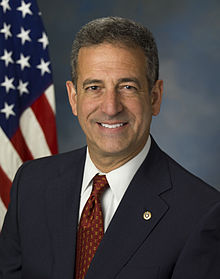
KINSHASA, Congo (SDJW) –Russell Feingold, D-Wisconsin, was known in the U.S. Senate as a campaigner for good government, reaching across the aisle to Republican Senator John McCain of Arizona to produce a bipartisan bill to regulate how political campaigns are financed.
After his defeat for reelection in 2010, Feingold taught law until he was appointed in 2013 by President Barack Obama as a special envoy to the Democratic Republic of the Congo (DRC) and to the African Great Lakes region, an area that encompasses such central and East Afrian nations as Burundi, Rwanda, Kenya, Tanzania and Uganda.
At a news conference on Sunday, May 4, in this Congolese capital preparatory to a visit there by Secretary of State John Kerry, a former Senate colleague, Feingold’s love for government reform issues was again on display.
Noting that the DRC President Joseph Kabinda had been elected in 2006 and reelected in 2011, Feingold expressed the opinion that the DRC’s chief executive should stick by that country’s Constitution and not seek a third term.
“We believe that it is very important for the future of this country and its stability that that constitution be respected,” said Feingold, who had chaired the Subcommittee on Africa of the Senate’s Foreign Affairs Committee.
“We also believe that everyone should work together – the Congolese Government, the opposition party members, the international donors – to make sure that a clear schedule for the elections is agreed to, a timeline that it is held to, and that the budgeting for it is transparent, and that those elections proceed and be finished, including the presidential election, in 2016 without any change in the constitution,” Feingold told news media.
“That is our belief with regard to all of the countries in the region and all across the world, that it is better to adhere to such a constitutional provision and to not endeavor to change it for any individual – that that is a formula for instability, not stability.”
Feingold quoted a statement made by President Obama during a visit to the region in 2013: “What Africa needs is not strong men, but strong institutions. And one of those strong institutions is a credible method of executive succession, executive term limits. And in most cases, things have gone much better in those countries that have followed that, particularly in Africa…”
The former senator said the two-term limit in the Congolese constitution has a key difference from the one in the American constitution.
“The constitution here provides for two terms. As I’d like to say, it’s not as tough a provision as the one in the United States. Bill Clinton can’t run for president again. This provision (in the Congo) actually is only two terms in a row. This is more like the – many other countries. … That provision should be respected.”
A reporter asked if it was unusual for the United States to “take a position on countries’ internal constitutional processes of term limits.”
Feingold responded: “The United States has consistently said throughout the world and, in particular, in Africa – and I was involved in this on many occasions as a member of the Senate – where we would suggest to leaders directly that it is our experience and our thought that it is far better for your country to maintain term limits for the executive if it is in your constitution, that it is as a destabilizing influence, and it’s reputationally damaging to a growing nation to change that. I personally delivered that message to many African leaders. It’s not the most fun thing to do.”
He added that “we respect the sovereignty of countries, we understand they can create their own constitutional provision. We (the U.S.) didn’t always have executive term limits. But it is our judgment that stability and democracy and growth of the governance, democratic governance of countries, is best served by following those provisions.”
Asked whether he thought Congolese presidents should be elected by a direct vote of the people, or by some indirect process, Feingold responded:
“We have not taken a formal position on this. I can tell you that I spent nine days just listening to people all over this country, particularly in the east. There was almost unanimous opposition to the idea of indirect election of provincial governors.
“As a personal matter, if somebody in the United States knows the history of our indirect election of United States senators, that was a terrific way to have horrible corruption that led to the direct election of United States senators. We had even an interesting moment in Illinois not too long ago that had to do with this issue.
“So I think – I personally think it would be something they might want to avoid. I think it could be destabilizing as well, just as a personal viewpoint. But I’m not speaking here that this is our official U.S. Government view. But it seems to me the popular election of officials is better. But this is not of the same status, frankly, as the executive term limits.”
*
Preceding based on State Department transcripts