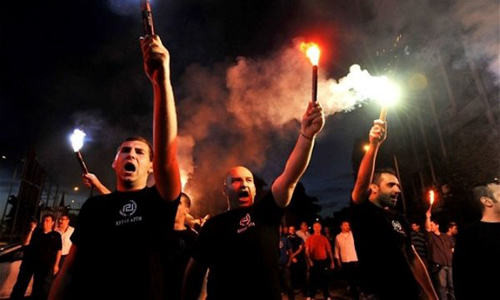
(Photo via World Jewish Congress)
BRUSSELS (WJC) – “The surge of far-right and anti-Semitic parties in a number of countries is a shock and a reason for great worry. European leaders must address this problem urgently and come up with a strategy to fight extremism. The future of European Jewry is a stake if these forces are not reined in. Extremists must not be allowed to set the agenda in Europe,” World Jewish Congress (WJC) President Ronald S. Lauder said in reaction to the results of EU-wide elections for the European Parliament. He urged European governments to enter into a constructive dialogue with the WJC on this issue.
The poll in the 28 EU member states saw a strong showing of xenophobic and anti-Semitic groups in a number of countries, including in Austria, France, Greece and Hungary. Several heads of European Jewish communities shared Lauder’s view.
“Jews cannot be expected to remain silent when radical or extremist parties that used to be on the margins of politics make it into the top three in several countries, and in the case of France even come out on top,” said Ronald S. Lauder, adding: “Even if they remain a minority in the new European Parliament, these parties will be able to influence the European agenda, unless they are completely isolated. In the wake of the Brussels and Toulouse murders of Jews, it is high time the EU leaders came up with a credible plan on how to combat anti-Semitism, racism and xenophobia on the continent, and how to ensure that Jews and other minorities are protected effectively. In this, the voice of the Jewish communities must be heard and concerns about their safety taken seriously.”
WJC Vice-President Roger Cukierman, the head of the Jewish umbrella organization CRIF in France, where the far-right National Front (FN) of Marine Le Pen polled 26 percent of the vote and became the strongest party, declared: “This weekend, we witnessed the deadly attack in Brussels, the anti-Semitic incident in Créteil, and the result of the European elections. We are very worried. While the strong result of the FN can be explained with the economic crisis in France, which must be overcome, it is also of critical importance that the mainstream republican parties reestablish trust with French citizens.”
In Hungary, the extreme-right Jobbik party received 15 percent of the vote nation-wide and again became the third largest political force in the country. In Germany, the extremist NPD polled 1 percent and will send a lawmaker to the Strasbourg-based EU assembly for the first time. The neo-Nazi Golden Dawn party, which is openly anti-Semitic and whose leaders have denied the Holocaust, became the third-largest party in Greece and got its best nation-wide result ever, polling 9.4 percent.
WJC Vice-President Benjamin Albalas, the head of the Central Board of Greek Jewish Communities (KIS), declared: “It is not only very disappointing that Golden Dawn saw a significant rise in its share of the vote, winning three seats in the European Parliament, but also that other extreme-right parties in Greece and beyond did so well in the elections. A great number of European citizens seem to have forgotten what happened during the Holocaust and World War II. Racism and anti-Semitism are again hitting Europe. It is time for immediate action.”
*
Also in Brussels, The American Jewish Committe’s Transatlantic Institute expressed its great concern over the success of extremist parties in a number of member states in the European Parliament elections.
While the center-right European People’s Party projected to finish first with 214 seats, followed by the center-left Socialists & Democrats with 189 seats, several parties that promote hatred had strong support.
Jobbik became the second biggest Hungarian party in the European Parliament with 14.3% (4 seats). Despite being under criminal investigations and with several party leaders in prison, Golden Dawn entered the European Parliament for the first time, coming in third place in Greece with about 9% of the vote (projected 3 seats). In France, the far-right National Front became the strongest party with 25% (projected 25 seats) and the far-right FPÖ in Austria came in a notable third with 20.5% (4 seats).
“The extent to which these parties will be able to unite to influence European policy remains to be seen,” said Daniel Schwammenthal, Director of the AJC Transatlantic Institute. “Nevertheless, their mere presence in the legislature for the next five years will, at a minimum, provide a soapbox from which to propagate their vile hatred.”
Golden Dawn and Jobbik are openly racist, blaming the economic ills of their countries on minorities like Jews, Roma or immigrants. Their anti-Semitism also often spills into vicious attacks against the state of Israel.
“These radical parties have been able to grow in their respective home countries for quite some time and are now cementing their presence also at the European level,” said Schwammenthal. “They must be confronted head-on or the danger will only continue to grow.”
Jobbik’s European success follows an even stronger showing in April’s national election, where it received 20% of the vote (up from 16% in the previous poll) and 23 of the 199 seats in the Hungarian parliament, making it the third largest party. Other parties, like France’s National Front and the FPÖ in Austria, are hoping to use the momentum from the European elections to increase their presence on the national political scene.
“MEPs from the shrinking pool of mainstream parties in the coming legislature will face the challenge of standing up firmly to any statements of hatred in the European Parliament,” said Schwammenthal. “Some European leaders, like Greek Prime Minister Antonis Samaras, have already taken courageous stances, but only a strong, unified voice against hatred can truly stem this dangerous tide.”
*
In New York, meanwhile, in response to Saturday’s shooting at a Jewish museum in Brussels that left four dead, followed by the severe beating of two Jews leaving a Paris synagogue, Jewish Council for Public Affairs Chair Susan W. Turnbull and President Rabbi Steve Gutow issued the following statement:
“We deplore the cold-blooded murder of four innocents at the Jewish museum in Brussels and the vicious assault on two individuals as they left a Paris synagogue last Saturday; and we pray for their swift and full recovery as well for those injured in the museum attack. These heinous crimes come against the documented backdrop of a disturbing escalation of anti-Semitic violence and intimidation against Europe’s Jews. The prompt responses of Belgian and French government officials are encouraging, but they must be followed up with systematic and intensive efforts to address the hatred that gives rise to such wanton violence. Meanwhile we stand in solidarity with the Jewish communities in Belgium and France, and throughout Europe.”
*
The Anti-Defamation League (ADL) also voiced concern: “There is no doubt that political extremism is on the rise in Europe, and along with it anti-Semitism is rising as well,” said Abraham H. Foxman, ADL National Director. “The success of extremist political parties, both on the far-right and far-left, has never been good for democracy or for Jews and other minorities. The continuing trend in Europe toward support for these parties is cause for heightened concern.”
ADL’s Global 100 Index of Anti-Semitic Attitudes, released earlier this month, showed that, on average, 27 percent of the adult population in the E.U. harbors anti-Semitic attitudes. In Greece the figure is a shocking 69 percent, and in France, 37 percent.
“The atmosphere for Jews in Europe is deteriorating,” said Foxman. “The murderous attacks in Brussels this past weekend and two years ago in Toulouse, and the rising number of assaults on Jews, such the attack in Paris on Saturday, are stark examples of the very real dangers facing Jews.”
“The alarming electoral successes of the extremists will only contribute to increasing that sense of insecurity,” Foxman added. “If Jewish life in Europe is to continue and thrive, it will require a serious commitment from all European governments and E.U. institutions to turn the tide. The choice is theirs and the time is now.”
The strong sense of insecurity among European Jews was revealed in the disturbing results of polling in Jewish communities throughout the E.U. by the E.U,’s own Fundamental Rights Agency, which highlighted the sense of fear.
Preceding combines news releases of the World Jewish Congress, American Jewish Committee, Jewish Council for Public Affairs, and the Anti-Defamation League