Editor’s Note: The Vatican Information Service (VIS) has been providing step-by-step coverage of Pope Francis’s visit to Israel on Sunday, May 25, and Monday, May 26. Following is Part 2 of the VIS coverage:
Meeting With Grand Mufti
Meeting on Monday morning with the Grand Mufti of Jerusalem, Muhammed Hussein, Pope Francis pointed to the fraternal dialogue and exchange between Christians and Muslims which, he said “offers new strength to confront the common challenges before us”.
Address of His Holiness Pope Francis
Visit to the Grand Mufti of Jerusalem
Jerusalem, 26 May 2014
Your Excellency,
Dear Muslim Faithful, Dear Friends,
I am grateful for the opportunity to meet with you in this sacred place. I thank you for the courteous invitation you have extended to me and, in particular, I wish to thank the Grand Mufti and the President of the Supreme Muslim Council.
Following in the footsteps of my predecessors, and in particular the historic visit of Pope Paul VI fifty years ago, the first visit of a Pope to the Holy Land, I have greatly desired to come as a pilgrim to the places which witnessed the earthly presence of Jesus Christ. But my pilgrimage would not be complete if it did not also include a meeting with the people and the communities who live in this Land. I am particularly happy, therefore, to be with you, dear Muslim faithful, brothers.
At this moment I think of Abraham, who lived as a pilgrim in these lands. Muslims, Christians and Jews see in him, albeit in different ways, a father in faith and a great example to be imitated. He became a pilgrim, leaving his own people and his own house in order to embark on that spiritual adventure to which God called him.
A pilgrim is a person who makes himself poor and sets forth on a journey. Pilgrims set out intently toward a great and longed-for destination, and they live in the hope of a promise received (cf. Heb 11:8-19). This was how Abraham lived, and this should be our spiritual attitude. We can never think ourselves self-sufficient, masters of our own lives. We cannot be content with remaining withdrawn, secure in our convictions. Before the mystery of God we are all poor. We realize that we must constantly be prepared to go out from ourselves, docile to God’s call and open to the future that he wishes to create for us.
In our earthly pilgrimage we are not alone. We cross paths with other faithful; at times we share with them a stretch of the road and at other times we experience with them a moment of rest which refreshes us. Such is our meeting today, for which I am particularly grateful. It is a welcome and shared moment of rest, made possible by your hospitality, on the pilgrimage of our life and that of our communities. We are experiencing a fraternal dialogue and exchange which are able to restore us and offer us new strength to confront the common challenges before us.
Nor can we forget that the pilgrimage of Abraham was also a summons to righteousness: God wanted him to witness his way of acting and to imitate him. We too wish to witness to God’s working in the world, and so, precisely in this meeting, we hear deep within us his summons to work for peace and justice, to implore these gifts in prayer and to learn from on high mercy, magnanimity and compassion.
Dear brothers, dear friends, from this holy place I make a heartfelt plea to all people and to all communities who look to Abraham: may we respect and love one another as brothers and sisters! May we learn to understand the sufferings of others! May no one abuse the name of God through violence! May we work together for justice and peace! Salaam!
*
The Pope at Ha Kotel
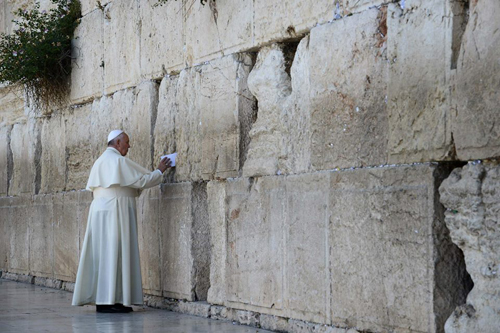
 At 8 a.m. the Pope transferred from Temple Mount to the Western Wall, or “Wailing Wall”. Fifteen metres high, this wall is a place of worship for the Jews for historical and religious reasons, and is linked to numerous traditions such as that of leaving prayers written on small pieces of paper between the blocks of the wall. Francis was received by the Chief Rabbi, who accompanied him to the wall. The Pope prayed in silence before the wall and, like his predecessors, left a piece of paper on which he had written the Lord’s Prayer; he said, “I have written it in Spanish because it is the language I learned from my mother”.
He then proceeded to Monte Herzl where, in accordance with protocol on official visits and assisted by a Christian boy and girl, he left a wreath of flowers in the Israel national cemetery at the tomb of Theodore Herzl, founder of the Zionist movement. The Holy Father also strayed slightly from his itinerary to pray at a tomb for the victims of terrorism in Israel.
He then traveled by car to the Yad Vashem Memorial, a monument built in 1953 by the State of Israel to commemorate the six million Jewish victims of the Holocaust. Along with the president and director of the Centre, the Pope walked around the perimeter of the Mausoleum before entering the Remembrance Hall, where he was awaited by the president, the prime minister, and the Rabbi president of the Council of Yad Vashem. Inside the Hall there is a monument with an eternal flame positioned in front of the crypt, which contains several urns with the ashes of victims of various concentration camps. The Pope lit the flame, placed a yellow and white floral wreath in the Mausoleum and, before his address, read from the Old Testament. He then spoke briefly about strength and the pain of man’s inhuman evil and on the “structures of sin” that oppose the dignity of the human person, created in the image and semblance of God.
*
Meeting with President Shimon Peres
Pope Francis and the president of the State of Israel, Shimon Peres, met Monday morning (May 26) in the Presidential Palace. It was a very cordial private meeting during which the Holy Father commented that he would like to invent a new Beatitude, “one I can apply to myself today: ‘Blessed is he who enters the house of a wise and good man”. They then left the building for the palace gardens to plant an olive tree together as a symbol of peace. This was followed by the public meeting, which took place on a specially installed stage, in the presence of around a hundred children of various religions.
“I am grateful to you, Mr President, for your kind and sage words of greeting and your warm welcome”, said the Holy Father. “I am happy to be able to meet you once again, this time in Jerusalem, the city which preserves the Holy Places dear to the three great religions which worship the God who called Abraham. The Holy Places are not monuments or museums for tourists, but places where communities of believers daily express their faith and culture, and carry out their works of charity. Precisely for this reason, their sacred character must be perpetually maintained and protection given not only to the legacy of the past but also to all those who visit these sites today and to those who will visit them in the future. May Jerusalem be truly the City of Peace! May her identity and her sacred character, her universal religious and cultural significance shine forth as a treasure for all mankind! How good it is when pilgrims and residents enjoy free access to the Holy Places and can freely take part in religious celebrations”.
“Mr President, you are known as a man of peace and a peacemaker,” he continued. “I appreciate and admire the approach you have taken. Peacemaking demands first and foremost respect for the dignity and freedom of every human person, which Jews, Christians and Muslims alike believe to be created by God and destined to eternal life. This shared conviction enables us resolutely to pursue peaceful solutions to every controversy and conflict. Here I renew my plea that all parties avoid initiatives and actions which contradict their stated determination to reach a true agreement and that they tirelessly work for peace, with decisiveness and tenacity”.
“There is likewise the need for a firm rejection of all that is opposed to the cultivation of peace and respectful relations between Jews, Christians and Muslims. We think, for example, of recourse to violence and terrorism, all forms of discrimination on the basis of race or religion, attempts to impose one’s own point of view at the expense of the rights of others, anti-Semitism in all its possible expressions, and signs of intolerance directed against individuals or places of worship, be they Jewish, Christian or Muslim”.
He recalled that “a variety of Christian communities live and work in the State of Israel. They are an integral part of society and participate fully in its civic, political and cultural affairs. Christians wish, as such, to contribute to the common good and the growth of peace; they wish to do so as full-fledged citizens who reject extremism in all its forms and are committed to fostering reconciliation and harmony. The presence of these communities and respect for their rights – as for the rights of all other religious groups and all minorities – are the guarantee of a healthy pluralism and proof of the vitality of democratic values as they are authentically embodied in the daily life and workings of the State”.
“Mr President”, he concluded, “you know that I pray for you and I know that you are praying for me, and I assure you of my continued prayers for the institutions and the citizens of the State of Israel. I likewise assure you of my constant prayer for the attainment of peace and all the inestimable goods which accompany it: security, tranquility, prosperity and – the most beautiful of all – fraternity. Finally, my thoughts turn to all those afflicted by the continuing crises in the Middle East. I pray that their sufferings may soon be alleviated by an honorable resolution of hostilities. Peace be upon Israel and the entire Middle East! Shalom!”.
The Pontiff, following the meeting, continued his visit at the Pontifical Institute “Notre Dame of Jerusalem Centre”, a centre of the Augustine Fathers of the Assumption of France, which welcomes pilgrims to the Holy Land and is considered as an ecumenical centre and territorial prelature, whose prelate is the Apostolic Delegate in Jerusalem and Palestine. Here he received in private audience the prime minister of Israel, Benjamin Netanyahu.
*
*
Pope’s Meeting with two Chief Rabbis
 Pope Francis on Monday told the two Chief Rabbis of Israel that Christians and Jews together “can make a great contribution to the cause of peace and firmly oppose every form of anti-Semitism and all other forms of discrimination”.
During his meeting with leaders of the Chief Rabbinate of Israel which consists of two Chief Rabbis – the Ashkenazi rabbi, David Lau, and the Sephardi rabbi, Shlomo Amar – the Pope reflected on the significance of the Jewish roots the Christian faith and on the spiritual bonds that unite Jews and Christians, and he called for a common commitment to work together for peace and understanding “in a rapidly changing world”.
Please find below the full text of the Pope’s discourse:
Address of His Holiness Pope Francis
To the Two Chief Rabbis of Israel Jerusalem, 26 May 2014
Distinguished Chief Rabbis of Israel,
I am particularly pleased to be here with you today. I am grateful for your warm reception and your kind words of welcome.
As you know, from the time I was Archbishop of Buenos Aires, I have counted many Jews among my friends. Together we organized rewarding occasions of encounter and dialogue; with them I also experienced significant moments of sharing on a spiritual level. In the first months of my pontificate, I was able to receive various organizations and representatives from the Jewish community worldwide. As was the case with my predecessors, there have been many requests for such meetings. Together with the numerous initiatives taking place on national and local levels, these testify to our mutual desire to know one another better, to listen to each other and to build bonds of true fraternity.
This journey of friendship represents one of the fruits of the Second Vatican Council, and particularly of the Declaration Nostra Aetate, which proved so influential and whose fiftieth anniversary we will celebrate next year. I am convinced that the progress which has been made in recent decades in the relationship between Jews and Catholics has been a genuine gift of God, one of those great works for which we are called to bless his holy name: “Give thanks to the Lord of lords, for his love endures forever; who alone has wrought marvelous works, for his love endures forever” (Ps 135/136:3-4).
A gift of God, yes, but one which would not have come about without the efforts of so many courageous and generous people, Jews and Christians alike. Here I would like to mention in particular the growing importance of the dialogue between the Chief Rabbinate of Israel and the Holy See’s Commission for Religious Relations with the Jews. Inspired by the visit of Pope John Paul II to the Holy Land, this dialogue was inaugurated in 2002 and is already in its twelfth year. I would like to think that, in terms of the Jewish tradition of the Bar Mitzvah, it is just coming of age. I am confident that it will continue and have a bright future in years to come.
We need to do more than simply establish reciprocal and respectful relations on a human level: we are also called, as Christians and Jews, to reflect deeply on the spiritual significance of the bond existing between us. It is a bond whose origins are from on high, one which transcends our own plans and projects, and one which remains intact despite all the difficulties which, sadly, have marked our relationship in the past.
On the part of Catholics, there is a clear intention to reflect deeply on the significance of the Jewish roots of our own faith. I trust that, with your help, on the part of Jews too, there will be a continued and even growing interest in knowledge of Christianity, also in this holy land to which Christians trace their origins. This is especially to be hoped for among young people.
Mutual understanding of our spiritual heritage, appreciation for what we have in common and respect in matters on which we disagree: all these can help to guide us to a closer relationship, an intention which we put in God’s hands. Together, we can make a great contribution to the cause of peace; together, we can bear witness, in this rapidly changing world, to the perennial importance of the divine plan of creation; together, we can firmly oppose every form of anti-Semitism and all other forms of discrimination. May the Lord help us to walk with confidence and strength in his ways. Shalom!
*
The Pope at Yad Vashem
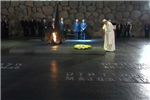
Pope Francis honored Jewish victims of the Holocaust and terrorist attacks in a solemn visit Monday to Jerusalem’s Yad Vashem memorial. The Pope prayed before a crypt containing ashes of victims and laid a wreath of yellow and white flowers in the “Hall of Remembrance.”He then kissed the hands of a half-dozen Holocaust survivors and heard personal stories of loved ones killed by the Nazis during World War II.
In his remarks, Pope Francis cried “Never agfain, Lord, never again!” “Here we are, Lord, shamed by what man, created in your own image and likeness, was capable of doing.”
*
The Pope at the Church of All Nations
Pope Francis met with the priests, religious men and women, and seminarians of the Holy Land on Monday afternoon, in the church of Gethsemane, which is built around a slab of bedrock on which tradition says that Our Lord knelt and prayed in the Garden of Gethsemane before He was arrested. Below, please find the full English text of the Holy Father’s remarks.
Address of His Holiness Pope Francis
Meeting with Priests, Religious and Seminarians
Church of the Nations, Garden of Gethsemane
Jerusalem, 26 May 2014
“He came out and went… to the Mount of Olives; and the disciples followed him” (Lk 22:39).
At the hour which God had appointed to save humanity from its enslavement to sin, Jesus came here, to Gethsemane, to the foot of the Mount of Olives. We now find ourselves in this holy place, a place sanctified by the prayer of Jesus, by his agony, by his sweating of blood, and above all by his “yes” to the loving will of the Father. We dread in some sense to approach what Jesus went through at that hour; we tread softly as we enter that inner space where the destiny of the world was decided.
In that hour, Jesus felt the need to pray and to have with him his disciples, his friends, those who had followed him and shared most closely in his mission. But here, at Gethsemane, following him became difficult and uncertain; they were overcome by doubt, weariness and fright. As the events of Jesus’ passion rapidly unfolded, the disciples would adopt different attitudes before the Master: attitudes of closeness, distance, hesitation.
Here, in this place, each of us – bishops, priests, consecrated persons, and seminarians – might do well to ask: Who am I, before the sufferings of my Lord?
Am I among those who, when Jesus asks them to keep watch with him, fall asleep instead, and rather than praying, seek to escape, refusing to face reality?
Or do I see myself in those who fled out of fear, who abandoned the Master at the most tragic hour in his earthly life?
Is there perhaps duplicity in me, like that of the one who sold our Lord for thirty pieces of silver, who was once called Jesus’ “friend”, and yet ended up by betraying him?
Do I see myself in those who drew back and denied him, like Peter? Shortly before, he had promised Jesus that he would follow him even unto death (cf. Lk 22:33); but then, put to the test and assailed by fear, he swore he did not know him.
Am I like those who began planning to go about their lives without him, like the two disciples on the road to Emmaus, foolish and slow of heart to believe the words of the prophets (cf. Lk 24:25)?
Or, thanks be to God, do I find myself among those who remained faithful to the end, like the Virgin Mary and the Apostle John? On Golgotha, when everything seemed bleak and all hope seemed pointless, only love proved stronger than death. The love of the Mother and the beloved disciple made them stay at the foot of the Cross, sharing in the pain of Jesus, to the very end.
Do I recognize myself in those who imitated their Master to the point of martyrdom, testifying that he was everything to them, the incomparable strength sustaining their mission and the ultimate horizon of their lives?
Jesus’ friendship with us, his faithfulness and his mercy, are a priceless gift which encourages us to follow him trustingly, notwithstanding our failures, our mistakes, also our betrayals.
But the Lord’s goodness does not dispense us from the need for vigilance before the Tempter, before sin, before the evil and the betrayal which can enter even into the religious and priestly life. We are all exposed to sin, to evil, to betrayal. We are fully conscious of the disproportion between the grandeur of God’s call and of own littleness, between the sublimity of the mission and the reality of our human weakness. Yet the Lord in his great goodness and his infinite mercy always takes us by the hand lest we drown in the sea of our fears and anxieties. He is ever at our side, he never abandons us. And so, let us not be overwhelmed by fear or disheartened, but with courage and confidence let us press forward in our journey and in our mission.
You, dear brothers and sisters, are called to follow the Lord with joy in this holy land! It is a gift and also a responsibility. Your presence here is extremely important; the whole Church is grateful to you and she sustains you by her prayers. From this holy place, I wish to extend my heartfelt greetings to all Christians in Jerusalem: I would like to assure them that I remember them affectionately and that I pray for them, being well aware of the difficulties they experience in this city. I urge them to be courageous witnesses of the passion of the Lord but also of his resurrection, with joy and hope.
Let us imitate the Virgin Mary and Saint John, and stand by all those crosses where Jesus continues to be crucified. This is how the Lord calls us to follow him: this is the path, there is no other!
“Whoever serves me must follow me, and where I am, there will my servant be also” (Jn 12:26).
*
Homily in the Cenacle
Vatican Radio) Pope Francis celebrated Mass in the Upper Room – the cenacle – in Jerusalem on Monday afternoon, on the final day of the three-day pilgrimage to the Holy Land. Below, please find the full text of the Holy Father’s homily.
Address of His Holiness Pope Francis
Meeting with Ordinaries of the Holy Land
Upper Room, Jerusalem, 26 May 2014
Dear Brothers,
It is a great gift that the Lord has given us by bringing us together here in the Upper Room for the celebration of the Eucharist. Here, where Jesus shared the Last Supper with the apostles; where, after his resurrection, he appeared in their midst; where the Holy Spirit descended with power upon Mary and the disciples. Here the Church was born, and was born to go forth. From here she set out, with the broken bread in her hands, the wounds of Christ before her eyes, and the Spirit of love in her heart.
In the Upper Room, the risen Jesus, sent by the Father, bestowed upon the apostles his own Spirit and with this power he sent them forth to renew the face of the earth (cf. Ps 104:30).
To go forth, to set out, does not mean to forget. The Church, in her going forth, preserves the memory of what took place here; the Spirit, the Paraclete, reminds her of every word and every action, and reveals their true meaning.
The Upper Room speaks to us of service, of Jesus giving the disciples an example by washing their feet. Washing one another’s feet signifies welcoming, accepting, loving and serving one another. It means serving the poor, the sick and the outcast.
The Upper Room reminds us, through the Eucharist, of sacrifice. In every Eucharistic celebration Jesus offers himself for us to the Father, so that we too can be united with him, offering to God our lives, our work, our joys and our sorrows… offering everything as a spiritual sacrifice.
The Upper Room reminds us of friendship. “No longer do I call you servants – Jesus said to the Twelve – but I have called you friends” (Jn 15:15). The Lord makes us his friends, he reveals God’s will to us and he gives us his very self. This is the most beautiful part of being a Christian and, especially, of being a priest: becoming a friend of the Lord Jesus.
The Upper Room reminds us of the Teacher’s farewell and his promise to return to his friends: “When I go… I will come again and will take you to myself, that where I am you may be also” (Jn 14:3). Jesus does not leave us, nor does he ever abandon us; he precedes us to the house of the Father, where he desires to bring us as well.
The Upper Room, however, also reminds us of pettiness, of curiosity – “Who is the traitor?” – and of betrayal. We ourselves, and not just others, can reawaken those attitudes whenever we look at our brother or sister with contempt, whenever we judge them, whenever by our sins we betray Jesus.
The Upper Room reminds us of sharing, fraternity, harmony and peace among ourselves. How much love and goodness has flowed from the Upper Room! How much charity has gone forth from here, like a river from its source, beginning as a stream and then expanding and becoming a great torrent. All the saints drew from this source; and hence the great river of the Church’s holiness continues to flow: from the Heart of Christ, from the Eucharist and from the Holy Spirit.
Lastly, the Upper Room reminds us of the birth of the new family, the Church, established by the risen Jesus; a family that has a Mother, the Virgin Mary. Christian families belong to this great family, and in it they find the light and strength to press on and be renewed, amid the challenges and difficulties of life. All God’s children, of every people and language, are invited and called to be part of this great family, as brothers and sisters and sons and daughters of the one Father in heaven.
These horizons are opened up by the Upper Room, the horizons of the Risen Lord and his Church.
From here the Church goes forth, impelled by the life-giving breath of the Spirit. Gathered in prayer with the Mother of Jesus, the Church lives in constant expectation of a renewed outpouring of the Holy Spirit. Send forth your Spirit, Lord, and renew the face of the earth (cf. Ps 104:30)!
*
Preceding provided by Vatican Information Service