By J.J. Surbeck

SAN DIEGO — I was asked recently by a Presbyterian friend to write something explaining how I became involved in Israel advocacy and to describe what I thought were the main problems in that area. This is my response.
I. Introduction
By way of introduction, I’ll start with a quick bio and how I became involved in this activity, which was largely by accident. This narrative will also allow me to describe the different obstacles and problems I faced along the way, which culminate in my conclusions regarding where we are today and what still needs to be done if we ever are to defeat the massive pro-Palestinian propaganda machine at work in this country and the world.
First the quick bio: I was born 64 years ago in what was at the time the Belgian Congo. I lived there until I was 15, when my family moved to Geneva, Switzerland, following the insurrections and civil war that erupted after independence in 1960. I received my Law Degree from the University of Geneva Law School and immediately went to work for the International Committee of the Red Cross (a.k.a. ICRC), the famed Swiss institution that gave the world the Four Geneva Conventions of 1949 on the Protection of the Victims of War. In that capacity, I did 10 years of legal work in Geneva and 6 more as the ICRC’s PR representative for North America out of New York. After deciding to stay in the US and become a US citizen, I left the ICRC, moved to Tucson, AZ, where I lived a few unproductive years in semi-retirement from which I was saved by meeting the woman who became my wife. Because she lived in San Diego where she had just landed the job of a lifetime, I’m the one who moved, which is how I ended up in Southern California.
Here I need to insert the fact that while born and raised Catholic, I was never much of a practicing one. My wife, who is Jewish, is also light on the observance side, but thanks to her, I was introduced to – and warmly welcomed by – the San Diego Jewish community, and thus started my progressive involvement in pro-Israel activities. There were several distinct phases.
Phase 1 was the age of innocence. Not knowing anything yet about Judasim and Jewish communities, I came with some assumptions which turned out to be only partially accurate at best. My first such false assumption was that since Jewish people excelled to my knowledge in every field known to mankind, there was no doubt in my mind that they must have figured out a way to fight the constant slander and disinformation campaign that I could read in the papers, hear on the radio or watch on tv. It didn’t take me that long to realize, much to my surprise and chagrin, that this was a field where, for some unknown reason, the Jewish community was not on top of the problem, to put it mildly.
Phase 2 came when, following this realization, I approached several of the most prominent Jewish organizations in San Diego (ADL, AIPAC, AJC, Hillel) to present my ideas about the need to train squads of well-informed public speakers at the ready to counter the ongoing anti-Israel information campaign, only to be surprised again when I received from all of them an astonishingly similar response: “Great ideas, J.J., but don’t worry, we have everything under control”.
Phase 3 was the time it took me to digest this information, at first not doubting what I had been told since I was not Jewish and didn’t know what was really going on, and then realizing that essentially I had been lied to… and given a hint of what the core of the problem was, even though I didn’t quite grasp its magnitude at the time. That came later, in Phase 5. After a few months, when I finally understood that no one was really interested in what I had to offer, I decided to do it myself. I was still convinced that with my experience in international affairs, diplomacy and law, in particular the Geneva Conventions, plus my ability to speak in public, I could make a difference, even on my own. That’s when I went on a fruitless Internet search for clear and objective presentations on the Middle East conflict, and finally concluded that I would have to put together my own, which is exactly what I did in a matter of weeks.
Phase 4 covers the two years I started giving these lectures on a regular basis in synagogues and at the Lawrence Family Jewish Community Center on a volunteer basis, followed by the five years – to this day – when it became obvious that this was going to be more than just an avocation and was turning into a full-time job. That’s when a friend of mine and I decided to create a non-profit in order for me to be able to earn a modest salary while continuing this activity for as long as there would be donors willing to support it. Thus was born T.E.A.M. (Training and Education About the Middle East).
Phase 5 is the age of awareness, where I have finally been able to piece together the reasons why the Jewish community, while far from inept, is so ineffective at countering the crude but effective campaign of slander and delegitimization under way for many years now. With this awareness have also come relatively clear ideas of what needs to be done if we want this unacceptable state of affairs to end.
2. The heart of the problem.
In the last seven years, given my naïveté (and maybe also vanity), I couldn’t quite understand why a) the validity of my ideas was not recognized, b) my services, offered free of charge, were shunned, in particular by Hillel on our campuses and by several local synagogues, and c) when I expressed my analyses and opinions, based purely on facts and legal scrutiny, they were met with covert and sometimes overt hostility. Call me slow, but that’s how long it took me to figure out that the heart of the problem is in fact, like a real heart, made of two ventricles: a. the competition between Jewish organizations, and b. the political divide between left and right over Israel.
a. Competition between Jewish organizations.
When one contemplates the history of Jewish communities in general, but particularly North American ones, there is no denying a well-deserved feeling of admiration on the part of non-Jews (as well as its opposite, envy, tinted with or stemming from antisemitism). Every time a major problem or need was identified, an organization was created to tackle it. Thus was born over time the alphabet soup of organizations that we know today. Alas, for all its successes and accomplishments, this structure had one major built-in flaw from the start: they all depended and still depend on the same limited pool of donors to survive. And survive they did rather well for the most part as long as their respective missions and roles remained distinct and easily distinguishable from each other. That did not diminish the built-in problem of competition for the same sources of money, but it was manageable as long as each focused on what it was created for. The problem became more difficult to handle when some of them started bleeding over into each other’s role, thus sharpening their competition against each other even more. This has been the case mainly over Israel hasbara efforts since no single national organization existed for that specific purpose (the creation of StandWithUs 12 years ago in Los Angeles, and more modestly of our own T.E.A.M. in San Diego seven years ago, are illustrative of the fact that there was a need left unmet by mainstream Jewish organizations, including the Federation system).
With the increased visibility of anti-Israel campaigns in the media and on campuses, donors became alarmed and started asking who was doing what to confront that problem. What followed was a stampede between AJC, ADL, Hillel, AIPAC, and several others to reassure their donors that they were in charge and had, as I was told years ago, “everything under control.” The fact that none of them has actually much under control is so painfully obvious that it’s almost embarrassing to read their glowing reports about impressive accomplishments, aimed squarely at their donors to ensure their continued financial support, irrespective of whether these accomplishments have really made a difference in the big picture, in particular when correlated with similar if disparate efforts from other organizations with which there has been no coordination.
b. The political divide.
This was another shocker. Assuming from the start – wrongly again – that all members of every Jewish community were united as one behind Israel no matter what, I was flabbergasted to discover how many of them were, inexplicably (and masochistically in my view), more preoccupied with flagellating themselves for not being beyond any reproach than with demanding parity from the Palestinians in order to reach peace. This self-imposition of impossibly high standards is one big mystery that probably only a psychiatrist steeped in Jewish history could explain, but it made no sense to me. And it got worse, as if that wasn’t bad enough already. As my knowledge of the myriads of facts surrounding the conflict expanded, in particular its legal aspects, I came to the logical conclusion that Israel was, to put it simply, not the bad guy in this story, but very much the aggrieved party. As such, it had every right to not only occupy the West Bank, but also annex if it wanted to – which it doesn’t, or at least didn’t until recently given the intransigence of the Palestinians and their refusal to make the slightest concession. Well, that didn’t go well in some Jewish quarters where voicing such opinion is anathema and leads to being labeled irrevocably as a “right-wing extremist.” So much for tolerance and the much-vaunted talent for “civil discourse” demanded ad nauseam by pro-Palestinians voices – as long as it serves their goals, that is, not meant for anyone who holds views different than theirs.
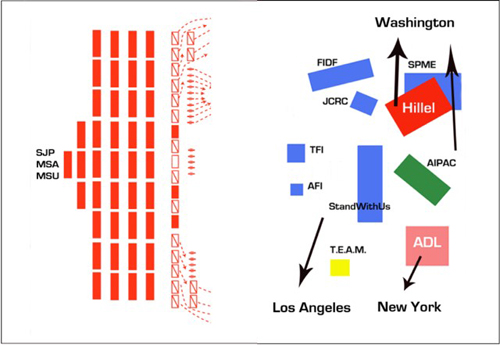
This deep political divide has far-reaching consequences and makes the creation of a united front among Jewish organizations exceedingly difficult. In particular, it has prevented the pro-Israel side from agreeing on a common strategy and the use of common tactics. Two years ago I came up with what I believe is the perfect illustration: imagine a battlefield with two armies facing each other. Imagine furthermore that this battlefield is depicted as it is in history books where you see little squares of different colors and arrows depicting the respective positions of all units (see below). Here on the left we have the pro-Palestinian army, with a chain of command, well-structured units supporting each other, united in their message, ideology and goals. The paradox here is that this is the one area where the Palestinians, who have accomplished pretty much nothing since they were invented in the 60s, have been remarkably successful. Now, if we look at the other side, what do we have? A hodge-podge of units with different labels, different uniforms, different schedules and different motivations and goals. Worst of all, there is no united command and every unit refuses to take orders from anyone but their immediate leader. Worse yet, for large units such as ADL, AJC, AIPAC and ZOA, they take their orders only from places that are far away like New York, Washington or Los Angeles. Who do you think is going to win this battle? The answer is obvious, even if, yes, by some sort of miracles, this motley crew of divided components has managed to contain many offensives coming from the pro-Palestinian side. It boggles the mind to think of what could be accomplished if they were willing to actually work together instead of separately, if not against each other.
3. What can be done?
This title actually should say in full “What should be done, but can’t, so let’s be realistic and focus instead on what can be done.” What should be done is pretty much impossible to achieve since it would require a complete agreement between a slew of organizations whose culture is known for, and is eminently proud of, its argumentative tradition, steeped as it is in millennial disputes over the meaning of every line in the Torah. This is repeated ad nauseam by Jewish people themselves as the famous quip “two Jews, five opinions,” usually uttered in a fatalistic tone belied by a smile that betrays an undeniable sense of pride. I used to find this amusing, but in the context of the war of ideas and systematic delegitimization campaign Israel is subjected to, I don’t find anything comical in this line any more since in this case it can translate very tangibly in life or death situations for many Israelis. In other words, it’s fine to argue for the sake of arguing when you can afford that luxury, but there are times when circumstances demand that disagreements be put aside in order to better face a common enemy. Alas, Jewish history is replete with tragic examples that show how poorly this lesson has been learned, to this very day.
And yet we don’t need not look far to find a shining example of a quintessentially Jewish institution that has managed to graduate from childishly argumentative behavior to an adult and responsible one: the Israel Defence Forces. The IDF, made up as it is primarily with Jews of all persuasions, has managed to keep disagreements in check because, quite simply, not operating as a professional army would mean suicide by self-induced defeat.
So, can a bit of IDF behavior be infused in Jewish communities in North America? The answer is clearly yes, although there are as of yet few if any examples of such transformations. Given the fact that, as mentioned above, it is pointless to try to bring order in this chaos at the national level, the solution lies in applying this formula at the local level.
This means that each community willing to go there must meet a certain number of requirements.
a. The first requirement is that, no matter which group they belong to, they accept the premise that the overall goal of their coalition is to fight the propaganda war, waged so skillfully by the pro-Palestinian forces for so many years already that they have taken up solid vantage positions on the battlefield where they are deeply entrenched and from which only equally skillful collective action can remove them. The key requirement here therefore is that there has to be a shift from an organization-centric focus to an Israel-centric one.
b. The corollary of this shift, so crucial that it deserves to be identified separately, is the willingness to accept some form of central command. By definition, local representatives of national organizations bow to instructions received from their national bosses, if only because their position depends on it. Unfortunately, this state of affairs means that if a local issue needs the involvement of any of these organizations, they will respond only if their NHQ approves. Some national organizations give their local representatives a lot of room, while some others are very controlling. There is little that can be done on that front except invite all to participate to the extent that they can, but there has to be a quid pro quo: participating in collective action is a prerequisite for participation in collective decisions. Dead wood made of organizations who participate with the sole intention of taking advantage of each situation for their own selfish purposes is not needed here.
c. Next, there must be an audit of each participating organization’s strengths and weaknesses to determine how each one’s strengths can contribute to the collective effort, if only to mitigate their respective weaknesses. To pursue the military analogy, the model here is the different units that make an army: each one serves a specific purpose. Infantry, artillery, armored units, air force, navy, paratroopers, special forces, etc, all are united towards the same purpose in mutual support. It would be absurd for each one to delude itself into thinking that it can win the war alone, and yet that is the surrealistic situation we have in the Jewish community.
d. Once the resource inventory is in place and everyone knows who can do what, another inventory needs to be established, i.e. the long list of incidents that happen year round in many places in each community, from the screening of grotesquely one-sided anti-Israel movies to pro-Palestinian speakers appearing at campuses, churches, libraries, and myriads of other places, to anti-Israel demonstrations in the streets, etc. This is important because each can be met with a specific response decided in common rather than what we have today, which is, at best, some groups deciding to devise their own response without coordinating with the others, and at worst nobody paying attention because no one knows if anyone is really responsible, let alone in charge. For each type of event, a protocol must be developed that takes into account the most effective form of response and the best resource to implement this response. This strategy would have the added advantage of avoiding waste by unneeded duplication and, last but not least, burn-out among activists, which is not uncommon if not watched carefully.
e. Finally, with all these tools in place, a global strategy needs to be devised with clear objectives for each target. This approach implies ideally – again – a flawless and selfless cooperation among all local players, all focused on reaching these objectives. In a short time, this would have the non-negligible advantage of turning a community from a reactive posture to a proactive one, making it clear to our adversaries that no matter what they try, they will always find supporters of Israel facing them, robbing them in the process of their ability, otherwise unchallenged in too many cases, to mislead innocent people who don’t know enough about the Middle East conflict to realize that they are lied to and manipulated. If this model can be implemented and successfully held for as many years as needed, the ultimate goal of discouraging pro-Palestinian propaganda operatives and encouraging them to look for other pastures is a very real possibility.
A lot can be done, but it will require a sizeable amount of work to overcome the institutional, psychological and political obstacles described above. This process is also likely to take a lot of time. And yet, there is no need to wait for perfect harmony to dawn on all of us before plunging into action. This is Phase 6, where a coalition of the willing is being built within which participating organizations focus on coordinating their strategies and actions to maximize their respective strengths and mitigate their weaknesses. All other organizations are welcome to join in the effort, provided they leave their logo at the door.
*
J.J. Surbeck is executive director of T.E.A.M. (Training and Education About the Middle East)
Thank you for taking the time to write this, B.B. You are indeed pointing to one important aspect that I didn’t include: how to befriend people and keep them as your friends. Most people don’t want to go there, either because it’s too much work, too much trouble to the extent that it implies possible confrontations, or because they feel inadequate in refuting the inevitable accusations turned into slogans. That’s why we developed our lectures, listed here: http://www.sandiegoteam.net/lectures/.
Excellent article!
From a (former) grassroots perspective: Pro-Palestine understands how to attract grassroots by bringing people to their side in increments.
For example, when the Iraq war started, a group called A.N.S.W.E.R. was the host for the massive anti-war rallies. People like myself had no idea A.N.S.W.E.R is a pro-Palestine organization, as most there were only protesting the Iraq war, which to many, by looking at the banners and signs, had nothing to do with Palestine. These events are where recruiting takes place, but it doesn’t feel like recruiting, rather, one is made to feel they are part of something bigger and greater than themselves, doing good works by supporting the events. I met NICE people, was invited to other events, parties, and got to know VERY NICE/ KIND, generous, beautiful, happy people, as the issue of Palestine is brought up, one is seduced. “We’re all in this together”, with statements such as, “Look even Jews hate Israel”, given examples galore. As connections/”friends” are made, and as you pointed out, especially on the left, as long as one sings “Kumbaya”, and not asking questions, it’s a good time. Free tee shirts, posters, offers to help work future parties and events, and meet more KIND people. It’s all great until you ask questions, and then it turns dark very quickly, with guilt trips and even blackmail, being shunned, and losing “friends” one has known many years. It’s not worth it to most to wake up to the reality of what is Palestine (a lie) and Israel (a struggle) when one finds themselves alone supporting Israel. The Pro-Palestinian groups have excellent reach out, gifting people, commardarie, where the Jewish community is broken, as J Street was a prefect example. People/grassroots, want to feel they belong, and Pro-Palestine does an excellent job, “Welcome one and all, we have a place for you, even the Jew (who hates Israel). Here’s a tee shirt, here’s an invitation to parties, here’s friends. Very hard to leave that for, “send your money and shut up, we’ve got it under control”.
I have been pondering the issues your article addresses for about a year while reaching out to Jewish organizations. There are no events where grassroots is engaged (poor people donate time not money). There are no invitations to meet people, to “party”, to get a free tee shirt.
There is no way to win the propeganda war without engaging the youth with grassroot events. Palestines act like “Pals”.. while those who support Israel act like elites, which turns off the majority of poor youth labor and students. While the Pro-Palestinian is a fraud, they come off very humble and inclusive, reserving their ugly side for Israel’s supporters. Israel supporters respond to the “Pals” in kind (ugly) and that leaves us losing the grassroots because they feel confirmed in being pro-Pal, being that they want to belong, to believe they are on the right side. They want serindipity, to feel good, not a mirror of ugliness and insulted.
Another example: Recently a messianic temple had it’s flag of Israel burned. The rabbi didn’t want to report it because he doesn’t want propblems. If it was a flag of Jordan sans the star, there would have been demonstrations, editoial write ups about hate crimes from the entire community. The act of vandalism was a hate crime, but no one will know, so how can they care?
Another example: When I began asking questions about Israel and turned to the net, it took me over a week before I found positive information. I found myself having to scroll past 430 anti-Israel links to find a positive link. So I have come to the conclusion that most people are not as driven or interested to learn what is positive about Israel because it’s not fun. It’s work. But to be fair to myself, I had to find something positive about Israel, and when I did, my world view changed, and I saw the lie that is Palestine and the awesome, outstanding contributions to humanity by Israel. It was my own work, as with you, it was your own work, not the work of the groups who claim represent Israel.
I hope my comment helps you.
Again, Thank you for the excellent article.
Yo, Mo (since you’re not courageous enough to sign with your real name), don’t assume anything: my wife never told me a thing. I did it all by myself, thank you very much. As for the “oppressive military occupation”, maybe you need a little bit of the education I provide: there is an occupation for only two reasons: 1. the Arabs tried to destroy Israel in 1948, 1967 and 1973, and each time they were beaten back (Israel ended up occupying the West Bank and Gaza in 1967 while defending itself, which makes the occupation and even annexation perfectly legal), and 2. despite several attempts by Israel to unload the West Bank and Gaza to the Palestinians against peace, the latter never agreed to a formal peace, so the occupation continues. End of story. Not very complicated. You can’t make peace with people who don’t want to make peace and vacate territory without guarantees that attacks are not going to come from them (example: Gaza). And you can’t “free Palestine” because “Palestine” does not exist. It’s a figment of your delirious imagination.
The diagram you posted doesn’t make much sense and the various shapes are not defined. Nevertheless, where are Jewish Voice for Peace and JStreet?
Hello “User”. The shapes don’t matter, it is their positioning that is important, and if it doesn’t make sense, that’s precisely the point. There is next to no coordination, everyone is operating more or less independently from the others in pursuit of their own objectives rather than a collective one. That makes no sense indeed. As for JVP and J Street, they don’t belong on the Jewish side of the battlefield but are squarely part of the enemy’s. They don’t deserve to be shown anywhere.
Yo J.J., ma man, let take you straight to phase 7 and save you time and effort. You already know no one cares about what you say. In fact, I’m not quite sure why I just wasted 15 minutes of my precious time that I’ll never get back reading this nonsense. So ya, phase 7, it begins with your hopes and ambitions crashing on the waves of reality, which is that these orgs and the causes they represent are morally bankrupt. That is when you remember that life is short and not worth being spent fighting for an unsustainable, oppressive military occupation (despite what your wife tells you). At that point you are left with only one sad choice: to gather your platoon because the rest of your imaginary army never showed up, and walk away after you raise a tall, massive white flag. Actually, it doesn’t have to be white, you could use some green, black and red and, perhaps, decorate it with a big, fat FREE PALESTINE 😉