By Joe Spier
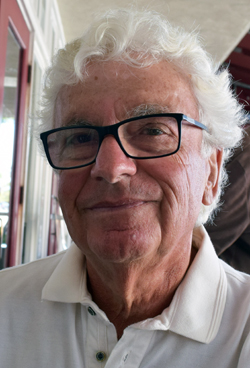
CALGARY, Alberta, Canada — On December 23, 2008, U.S. President George W. Bush, about to leave office, exercised his right of forgiveness by pardoning 19 Americans convicted of crimes. One pardon, granted posthumously, went to Charles Winters, Irish Protestant from Boston who in January 1949, pleading guilty to a felony before a Federal Court in Miami, was fined $5,000 and sentenced to 18 months imprisonment.
When Charles Winters passed away in 1984, his funeral was adorned with Israeli flags and blue and white flowers and Israeli dignitaries attended the service. Winters’ wife flew his ashes to Israel where she buried half in the ancient Christian Knights Templar Cemetery in Jerusalem and scattered the other half from the top of Mount Tabor.
Years earlier Golda Meir, then Israel’s Foreign Minister, issued a special invitation to Winters to attend the inauguration of the new Haganah Museum in Tel Aviv in recognition of, “Your contribution to this magnificent effort (the struggle for the defense of the Yishuv and independence) of the Jewish people”.
What had Charles Winters done to make him a criminal in the United States and a hero in Israel?
On May 14, 1948, the State of Israel came into existence. By next dawn, armed forces from five neighboring Arab countries attacked her. The beginning of the conflict pitted the Israeli forces with not one modern artillery piece, not one tank, not one military aircraft, against the well-equipped Arab forces. While Britain continued arming the Arab States in accordance with existing treaties, virtually no country, with the notable exception of Czechoslovakia, was prepared to sell weaponry to Israel.
The United States supported Jewish nationhood by voting for “partition” at the United Nations and was first to recognize Israel, but support ended there. The U.S. imposed a total embargo on the shipment of armaments to the Middle East. The U.S. was awash with arms, surplus from World War II, but the “Neutrality Act” made it illegal to export or transport military equipment to Israel. At a critical moment in history, there were those U.S. citizens who as a moral imperative were prepared to defy U.S. laws and put their lives, their future, their freedom at risk for a just cause, the survival of the Jewish State. Charles Winters was one of them.
On July 1, 1945, wealthy New York industrialist, Rudolf Sonneborn sat in his living room with his invited guests, 16 Americans and 1 Canadian. The group had been carefully chosen because they were Zionists, had influence and above all were discreet. There they heard David Ben-Gurion, Chairman of the Yishuv (the Jewish Community in Palestine), tell them that the destiny of Palestinian Jewry would depend upon armed struggle and that confrontation with the Arabs was inevitable. The fully committed group left the meeting expecting some day to be called upon to do an undefined service for the Yishuv. The 18 would become known as the “Sonneborn Institute”.
As Jewish statehood neared, the call went out and the 18 men of the “Sonneborn Institute” mobilized. They contacted trusted friends, held meetings and formed alliances all outside formal Zionist organizations, their mission to raise funds for the purchase and transport of equipment and material to Israel. The exact purpose for which the money was used could not be publicized or fully disclosed and no receipts could be given, for while much of the purchased equipment was “white”, goods that could be legally transported to Israel, some were “black”, on the U.S. list of banned war material. The “Sonneborn Institute” became financier to the Haganah.
At the same time, young men and women from the United States, Canada, South Africa and elsewhere were volunteering to fight for the Jewish State. A few because of special skills were put to use in their home countries. One of these was Al Schwimmer who walked into a secret New York recruiting office suggesting that, “airplanes might make a difference.” Schwimmer had been a World War II U.S. Army Air Corps flight engineer, now employed as a flight engineer with Trans World Airlines. Tasked with procuring aircraft for Israel, Schwimmer quit his job with TWA and using funds supplied by the “Sonneborn Institute” went to work.
Schwimmer, at first purchased Constellations and Curtis C-46s being sold as Government surplus. As these were transport planes, they were not on the U.S. list of banned war material and could be legally exported without licensing. Most of these aircraft ended up in Czechoslovakia ferrying weaponry into Israel.
But Israel had no long range bombers. Bombing runs were made by rolling bombs out of open doors or hurling grenades and other small ordnance from cockpits, even dropping empty bottles because of the tremendous shriek they made falling from the sky. Schwimmer was sent out to see if he could acquire some bombers. What he had in mind was the four engine Boeing B-17 Flying Fortress, the mainstay of U.S. precision bombing in Europe.
Where was Schwimmer going to find B-17s? Charles Winters had two. Winters, rejected by the American military because of a limp left by polio, worked during World War II as a government purchasing agent. Following the war, he bought two decommissioned B-17s stripped of all their armaments and went into the produce shipping business flying between Miami and Puerto Rico. Schwimmer approached Winters with an offer to buy the two aircraft. Originally reluctant, Winters soon agreed to sell the planes for $15,000 dollars each. Not only that but Winters agreed to help smuggle the aircraft, which were military and therefore “black,” out of the U.S. and to actually fly one of the B-17s himself. According to Charles Winters’ son, his father and Schwimmer were friends and his father, though not Jewish, was sympathetic to the Jewish cause and was motivated to help.
On June 12, 1948, the illegal run began in Miami, where Winters’ two B-17s were joined by a third B-17 purchased by Schwimmer in Tulsa. Winters, paying in advance, arranged for a fuel company to supply aviation gas at each stop along the route and then the three B-17s with skeleton crews, Winters piloting the lead aircraft, flew from Miami to Puerto Rico, a route well traveled by Winters. As Puerto Rico was within U.S. territorial jurisdiction, no special documentation was required. Schwimmer did not join the flight.
In Puerto Rico, after gassing-up, Winters filed a flight plan showing that the three B17s were to make an aerial survey of the Azores. As this meant only leaving U.S. jurisdiction for a short time, they were cleared for takeoff. Winters knew from experience that customs officials in Puerto Rico would be lax. The three B17s landed in the Azores, refueled and then immediately took off.
Meanwhile, the U.S. State Department had become suspicious and in order to throw them off the scent a false announcement was issued that the planes had landed in Corsica. The ploy worked for a few days and then the press reported that the B17s had mysteriously disappeared. In fact, the bombers flew directly from the Azores to Zatec, Czechoslovakia.
Upon landing at Zatec, Winters was astonished to find a secret Israeli base behind the Iron Curtain manned by foreign volunteers, mostly American. Not only were the Czechs selling armaments to Israel but they also permitted her to operate an airbase within their country for refurbishing, training and ferrying. There, the B-17s were refitted with bomb racks, machine gun turrets and prepared for war.
On July 14, 1948, the three B-17s were ready to fly to Israel but it seemed a pity to squander the flight. The aircraft now manned by foreign volunteer crews with flight combat experience took off to bomb the enemy on behalf of a country they had yet to see. Overseas volunteers comprised the greater part of Israel’s Air Force. Two of the aircraft bombed Egyptian bases in Sinai and one bombed King Farouk’s palace in Cairo before landing safely in Israel.
By the end of the war, the three B-17s flew about 200 sorties playing an important part in all major Israeli operations. Charles Winters’ B-17s represented two-thirds of Israel’s total strategic bomber fleet. The B-17s continued to see action in the Suez War of 1956 after which they were retired from service
As for Charles Winters, he returned from Zatec to the U.S. and found himself in big trouble. The State Department, furious that the B-17s did not return to American soil, had him arrested “for conspiracy to export and the exportation of military aircraft to a foreign country” a violation of the “Neutrality Act.” Winters pled guilty, was fined $5,000 and sentenced to 18 months imprisonment. As a convicted felon, Winters could never again vote in a U.S. election.
With the end of Israel’s War of Independence, the smuggling operation quietly disbanded. The only recognition for Rudolf Sonneborn was a letter of thanks from David Ben-Gurion. Al Schwimmer, in a different illegal exploit, was convicted of breaching the “Neutrality Act, and fined $10,000. He later made aliyah to Israel becoming head of Israel Aircraft Industries. Bill Clinton pardoned Schwimmer in 2000. A handful of others were also convicted of violating the “Neutrality Act” but Charles Winters was the only American to go to prison for helping Israel. Following his release, he went back to the produce hauling business, married, raised a family and later retired in Miami.
In support of the petition for pardon, Steven Spielberg wrote to President Bush, “There are probably many unsung heroes of America and of Israel, but Charlie Winters is surely one of them.”
*
Spier is a retired lawyer with a keen interest in Jewish history. You may contact him via joe.spier@sdjewishworld.com. Comments below MUST be accompanied by the letter writer’s first and last name and his or her city and state of residence (city and country for those outside the U.S.)