By Donald H. Harrison
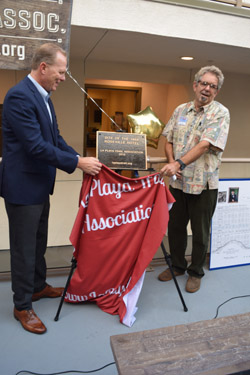
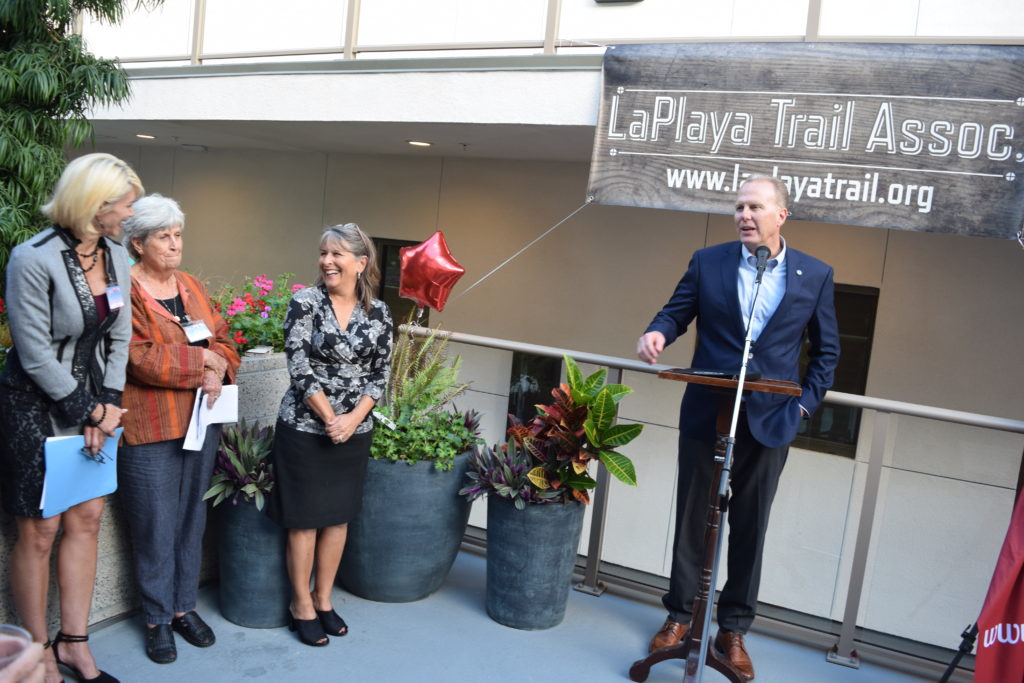
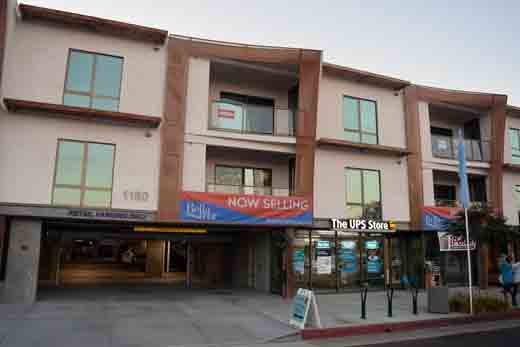
SAN DIEGO – The new 16-unit Bellamar Point Loma condominium at the corner of Rosecrans and Byron Streets in the Roseville section of the Point Loma neighborhood gained some additional luster on Tuesday, Oct. 9, when Mayor Kevin Faulconer, City Councilwoman Lorie Zapf, and members of the La Playa Trails Association and the Ocean Beach Historical Society unveiled a plaque that will be placed on the Rosecrans side of the property.
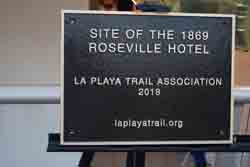
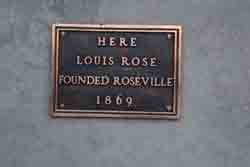
The plaque, sponsored by the La Playa Trails Association, declares the property at 3025 Byron Street/ 1180 Rosecrans Street to be the “Site of the 1869 Roseville Hotel.” The plaque will be mounted above another, smaller plaque on the Rosecrans Street side of the property, which states: “Here Louis Rose Founded Roseville 1869.”
The historical record is not clear whether the hotel actually was completed in 1869, but it is apparent that construction began that year, the very same year that Rose recorded the map for the Roseville subdivision, which was approximately 30 blocks long and about eight blocks wide.
Jen Schmidt, a realtor who chaired the public relations committee for the event, noted that the 1869 date indicated that the hotel, long since demolished, had its origins 149 years ago, and that 2019 will be its sesquicentennial. This proved a perfect segue for Mayor Faulconer, who noted that 2019 also will mark the 250th birthday, or sestercentennial of the City of San Diego. Other terms for 250th anniversaries are semiquincentennial and quarter-millennial. Whichever term becomes more popular next year, the occasion promises to be well marked as the 250th anniversary of Father Junipero Serra celebrating the first mass on what later became called the Presidio.
“Why this plaque is important is because it is always great to remind people of where we came from as a city, where we came from as Roseville,” Faulconer said. “Our city constantly changes… What makes Point Loma unique, as all of us who live here know, is that we treasure that history. Point Loma is the story of California,” a story “not only for ourselves, but for our kids, and our kids kids.”
The mayor was followed to the microphone by City Councilwoman Zapf, who commented that she loves preserving history. She added that is why she constantly takes her daughter to Old Town San Diego State Historic Park and to the Presidio. Noting that the La Playa Association
has been marking various spots along the Point Loma Peninsula, Zapf suggested that La Playa Trail is “a modern-day Freedom Trail [of Boston] where you can visit the sites.” She thanked the organization “for keeping history alive.”
Klonie Kunzel, the chair of the La Playa Trail Association, said that keeping history alive in fact was part of the mission of the organization, which was founded in 2005 and since has installed six markers and built two monuments along the trail that led from the San Diego Mission to Old Town San Diego to the tip of Point Loma.
Eric DuVall, president of the nearby Ocean Beach Historical Society, shared the honor of unveiling the plaque with Mayor Faulconer. Telling some of Louis Rose’s biography, he noted that Rose was one of the earliest Jewish settlers in San Diego, having arrived in 1850. He went on to serve on the first Grand Jury, as a member of the City Board of Trustees, and the County Board of Supervisors. He purchased property in Old Town, Roseville, La Playa (another neighborhood on the Pt. Loma Peninsula) and in the area that became known as Rose Canyon, where he had cattle, horses, and operated the region’s first tannery. In Roseville, he built both a hotel and a wharf.
In Old Town San Diego, Rose owned the house that became known as the Robinson-Rose House and which today serves as a visitor’s center for San Diego Old Town State Historic Park, and also purchased the Pear Garden from landowner Lorenzo Soto, which later became known as Rose’s Garden. Today the property, including the Casa de Carrillo, is the site of the Presidio Golf Course.
Rose was twice married. Divorced from his first wife, Caroline, in the 1850s, he married his second wife, Mathilde, in 1869, the same year that he started Roseville, when he was already 62 years of age. Louis and Rose had two daughters, one of whom died in infancy. The other, Henrietta, went on to be a longtime teacher, serving as the first schoolmarm at Roseville Elementary School, and later spending much of her tenure teaching Spanish at Roosevelt Junior High School adjacent to Balboa Park. She never married, and Rose has no descendants.
Rose died in 1888, the year prior to Congregation Beth Israel’s first year in its own temple, a building that today has been relocated from Uptown to Heritage Park in the Old Town area. Rose was a member of a predecessor roving congregation, Adath Yeshurun, which held services in hotels and people’s houses, including the Robinson-Rose House. He helped to found San Diego’s Hebrew Benevolent Society, and donated the first Jewish cemetery to the community. It was located in Roseville, on ground below the building now housing the Education First facility at 3455 Kenyon Street.
*
Harrison is editor of San Diego Jewish World. He may be contacted via donald.harrison@sdjewishworld.com