By Donald H. Harrison
SAN DIEGO – Soille San Diego Hebrew Day School honored two Holocaust survivors at a Memorial Day gala on Monday, May 27, with keynote speaker Elizabeth Robbins, a retired Army lieutenant colonel, spelling out the connection.
“I think Rabbi [and Headmaster Simcha] Weiser picked the best possible day to honor Fanny Krasner Levobits and Edith Eger because in 1945, it was America’s military that liberated them from certain death,” said Robbins, a former American Israel Political Action Committee (AIPAC) spokesperson who now advises the U.S. State Department.
Americans were able to liberate the prisoners of Nazi concentration camps “by raising 12 million troops – nearly 40 percent of whom were volunteers – and suffering more than a million wounded and dead to wipe out evil,” she added in what she made clear was a personal speech and not one representing the State Department. “America then poured itself into helping the displaced and restoring dignity and economic life to Europe and Asia. Can you think of another country on earth that would do that?”
Robbins, whose mother Marilyn Williams is a longtime member of Hebrew Day School’s board of directors, told her “American story” and urged approximately 250 attendees of the dinner held in the social hall of Congregation Beth Israel to share their own American stories with their children.
She said her maternal grandmother escaped the German Nazi regime in 1939 when she immigrated alone to the United States. Her great-grandparents however were trapped: the Nazis revoked their citizenship, confiscated their property and their basic rights, and later murdered them. “Safe in America, my grandmother picked up the pieces of her life, worked incredibly hard, and met and soon married a Jewish doctor newly arrived from Berlin,” Robbins continued. “Together they raised two daughters, doted on grandchildren and today they rest under a headstone in San Francisco inscribed ‘God Bless America.’”
Her paternal grandfather, an Army colonel with the 10th Mountain Division, led his troops to victories across Europe. “You can only imagine how emotional it was at my parents’ wedding, as my maternal grandfather in his thick German accent rose to offer a toast to thank my paternal grandfather – thank you, thank you for fighting with our American forces to save the world.”
Robbins suggested that Judaism and America have many attributes in common.
“Both have a difficult history, a crucible that yielded ideology that recognizes a key relationship with God and the inherent rights of the individual,” she said. “Both have a unique mission to benefit the world for the benefit of all mankind. And both understand that they are chosen by God – with enormous blessings coupled with extra responsibilities.”
The mother of three children who attend Jewish day schools back East, Robbins commented, “As Jewish day school parents we seek to pass on Judaism through action—by educating our children about the value and worth of our faith, and devoting time together to Torah and the stories of our people.”
She called to mind the V’havata prayer, “which specifically exhorts us to teach God’s instructions to our children, and to bind them to our doorposts.” So, it should also be with America’s values, she said. “I have two urgent suggestions: The first, to speak to your children about America and your family’s American story. And the second is to fly an American flag on the doorposts of your house.”
‘Tonight,” she added, “I ask you to share with your children your appreciation of how America supports our free exercise of religion as well as our pursuit of science, literature and the arts, and a free market economy that sustains the highest standard of living for the greatest number of people in the history of the world.”
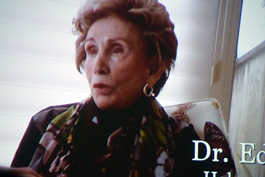
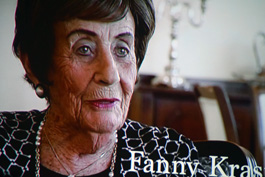
Video messages from Dr. Edith Eger, a Hungarian born psychologist and survivor of Auschwitz, and from Fanny Krasner Lebovits, who survived the Libau ghetto and five concentration and labor camps, were equally positive.
Eger said it never occurred to her during the Holocaust that she wouldn’t get out alive. She said positive thinking, and cooperation rather than competition with other prisoners, helped her live through the ordeal. Although she came to this country penniless and speaking no English, she was able to succeed, eventually earning a doctorate in psychology. She said “rejection” by others is not a real inhibitor, adding, “No one can put me down but me.”
Lebovits counseled that “hate is never good and love is never bad.” She offered the credo, “If you have faith, you have hope and if you have hope, you are strong.”
Jennifer Eilemberg, a granddaughter of survivors, said school children need to learn the lessons of Jewish hope, resilience and survival taught by Eger and Lebovits, who are both nonagenarians. Like the honorees, Eilemberg said, her own grandparents “did not carry bitterness about the past, but didn’t forget their history.” She said she was inspired by their perspective on life. After the came to America, they saw hope, and recognized that “only in America, anything is possible.”
About their experiences, Eger recently authored The Choice and Lebovits has just published Miracles, Memories and Meaning.
*
Harrison is editor of San Diego Jewish World. He may be contacted via donald.harrison@sdjewishworld.com