
Other items in today’s column include:
*Jewish American Heritage Month
*Political bytes
*Recommended reading
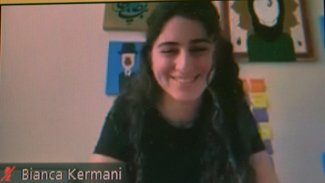
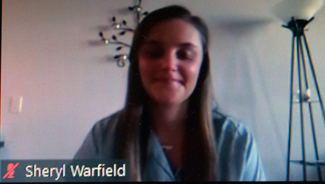
SAN DIEGO — During what Hillel of San Diego described as a webcast report from the front lines on Monday, May 4, UC San Diego student Bianca Kermani posed a question to San Diego State University graduate Sheryl Warfield, who is now working as a nurse in the intensive care unit of the Mayo Clinic in Phoenix, Arizona.
“What flaws have you noticed in the system?” she asked.
Warfield spoke of the possibility of health care workers becoming overwhelmed. “In the ICU we do a lot of things to save lives,” she said. Sometimes, the question is at what cost to the health care workers themselves. “Should you have health care workers becoming infected, possibly dying?” she asked. And while the unit has nine heart-lung machines (ECMO), “what happens if more patients need them?”
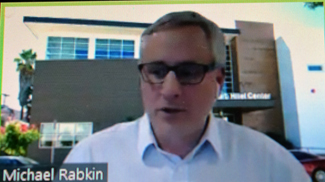
Michael Rabkin, interim executive director of Hillel of San Diego, suggested Warfield’s response was a good segue to a presentation by Rabbi Scott Meltzer of Ohr Shalom Synagogue, who would weigh in with some of the ethical issues raised by the coronavirus pandemic.
Meltzer paraphrased the Mishna, in which it is taught that each individual life if of value to the entire world. He said some people watching television programs in which the number of cases and deaths are tallied each day might become insensitive to the situation, forgetting that these numbers represent real people. Imagine if just one of those deaths were a member of your own family, he said.
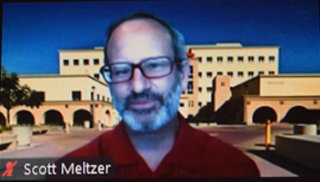
Often, when reporting a death, news organizations may also pass on the information that the person had “an underlying health condition,” Meltzer said. However, underlying health issues are not the reasons people are dying, he said. We need to recognize that every person was created in the divine image, and we cannot allow the information that the victim had another health problem to diminish the recognition of our society’s loss.
Meltzer told of Rabbi Moise Bergman, who served Congregation Beth Israel of San Diego in the early part of the 20th century. He had experienced the Spanish Flu epidemic during which society asked some of the questions that we hear now about saving lives versus saving the economy. Meltzer paraphrased Bergman as saying that someone who has suffered great economic losses during a pandemic will be “hard to answer.” However, “it will be impossible to answer” the parent who has lost a child. “The loss of a human life in irreparable, irreplaceable,” Meltzer said.
*
Jewish American Heritage Month
*EMET (Endowment for Middle East Truth) saluted Sheldon and Dr. Miriam Adelson of Las Vegas for their philanthropy on today, Giving Tuesday. The owner of casinos, a large contributor to Republican party candidates, and the owner of the daily Israel Hayom newspaper, Sheldon Adelson tends to be far more controversial than his Israeli-born wife, Miriam, a medical researcher who has given time and millions of dollars for cancer research.
*
Political bytes
*Sara Jacobs, a candidate in the 53rd Congressional District from which Susan Davis is retiring, has released a plan to help small businesses during the coronavirus pandemic. “Small businesses are the backbone of our economy, and now more than ever we need to do everything we can to preserve them. While the CARES Act was an important first step, I’ve heard from too many small businesses in CA-53 that haven’t received the assistance they need. We need to take additional steps to make sure that our small businesses are taken care of. That’s why today, I’m releasing my Plan to Help Small Businesses Through the Pandemic Recession. I look forward to continuing the conversation with small business owners here in CA-53, and building on this plan with their input.”
*
Recommended reading
*The American Jewish Congress reports that health care workers celebrated when Holocaust survivor Jack Holzberg, 94, recovered from his battle with the coronavirus.
*Chaya Gilboa and Jessica Kort of the Leichtag Foundation reflect on the time of the counting of the Omer as one of transition — especially during this time of the coronavirus pandemic.
*
Donald H. Harrison is editor of San Diego Jewish World. He may be contacted via donald.harrison@sdjewishworld.com