By Robert Lerner
VALLEY CENTER, California — The future of Rancho Lilac, Valley Center’s historic and culturally-significant ranch, has been up in the air since 2011 when it was purchased by Caltrans in what is known as an environmental mitigation land exchange program. There had been concern that the site could be permanently closed to public access. That apprehension appears to have been abated, at least for the present due to governmental action taken last week.
During much of the past decade, historians, specialists in biological resources, and local residents have repeatedly expressed concern over the future of the property which once welcomed a veritable who’s who of political figures, celebrities, and dignitaries. Also of concern was whether the property would remain open to public access or locked and gated, or if any of the 46 known historic landmarks on the ranch would be preserved. Undisputed was the fact that Rancho Lilac is widely heralded as being rich in history and an environmental jewel.
The answer came last Friday when representatives of the Valley Center Trails Assn. and the Valley Center Historical Society, joined by multiple local individuals and organizations, spoke at an online meeting before a countywide body that was prepared to vote on the future of the sprawling ranch on Lilac Road.
The San Diego Assn. of Governments (SANDAG), whose Board consists of the mayors of every city in San Diego County as well as County supervisors, was asked to approve a staff recommendation to award a contract to own Rancho Lilac to the San Diego Habitat Conservancy. Instead, the SANDAG board rejected that recommendation and voted 14-5 to cancel the proposed award and reopen negotiations with SDHC and any other potential candidates, among them the County Department of Parks & Recreation.
The Valley Center Historical Society and the Trails Assn. had lobbied extensively for that outcome. District 5 Supervisor Jim Desmond made the initial motion to cancel the contract and restart negotiations, and Poway mayor Steve Vaus, chairman of the SANDAG board, made poignant remarks supporting the position of Valley Center speakers.
The fear among Valley Center residents was that the Conservancy would deny public access to the historic ranch or that public trails might never come to pass. The latter concern was of special apprehension for the Valley Center Trails Assn. which had lobbied and argued repeatedly for public trails.
The Historical Society was concerned that the public would never again see the historic site. Several years ago, the Valley Center History Museum hosted a day-long tour of the 900-acre ranch and its historic buildings and homes. The event, a fund-raiser for the museum, drew more than 600 people. In written pleadings to SANDAG, History Museum president William Boyett and vice-president Earl Brown had repeatedly stated that if the public were to be denied access, it was recommended that a proposal from County Parks should be considered. They pointed out that the County Parks system already includes 64 parks, open space preserves, several registered historic sites, and 350 miles of trails.
Speaking on behalf of the Trails Assn., president Fred Wollman said it was gratifying that the SANDAG board was willing to listen to the community concerns. “The original RFP (Request for Proposal) was silent on the matter of public access,” he said, and this was a critical error. The future owner/manager will be required to restore and preserve natural habitat as well as protecting all cultural sites, and include a management plan for trails,” he said.
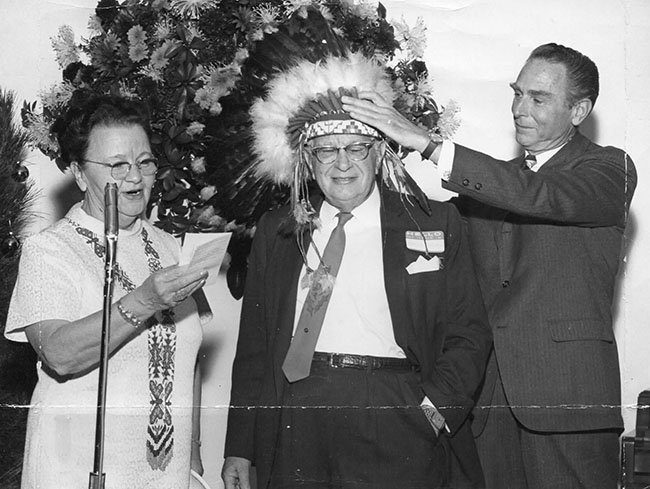
Lilac Ranch, as the property was originally called, dates to 1865 when it covered 2,300 acres and was an early cattle ranch. Its prominence was elevated in 1945 when the ranch was purchased by industrialist Irving Salomon who made significant improvements to the property and began breeding herds of prize-winning Herefords, Hampshires and quarter horses. He renamed the site to the more romantic Rancho Lilac.
The ranch began to attract international attention in 1953 when Col. Salomon was appointed to the United Nations as an Ambassador and Undersecretary. House guests included the likes of First Lady Eleanor Roosevelt, President Dwight D. Eisenhower, Prince Aly Khan, Nobel Peace Prize Winner and U.N. official Ralph Bunche, along with many other dignitaries, celebrities, authors, and artists. Salomon also was known as a major philanthropist. Salomon was Jewish and was a benefactor of many ecumenical causes. At the University of San Diego, run under Catholic auspices, a lecture hall is named for him and at Point Loma Nazarene University, a theater is named in his honor.
Ambassador Salomon died in 1979, but the Salomon-Wolfsheimer family continued to maintain the ranch until is was acquired by Caltrans in 2011. Salomon’s daughter, former San Diego City Councilwoman Abbe Wolfsheimer Stutz and her first husband, Louis Wolfsheimer, donated much of the family’s memorabilia, mementos, photos, letters and documents to the Valley Center Historical Society which maintains the Salomon Archive. The family also provided $250,000 in 2002 to underwrite the cost of the Valley Center History Museum which was dedicated to the memory of Col. and Mrs. Irving Salomon.
For more information, contact the Valley Center History Museum by mail, email at museum@vchistory.org or by phone at (760) 749-2993. The museum is temporarily closed due to the pandemic, but a volunteer is on site and responds to all inquiries. For information on the Trails Assn., visit vctrails.org.
*
Robert Lerner is the historian of the Valley Center Museum.