By Donald H. Harrison

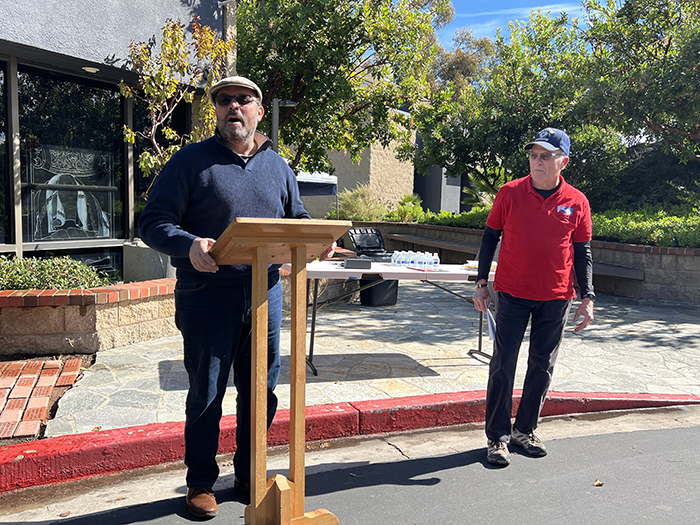
SAN DIEGO — At 11:11 a.m. on November 11, or what might be written as 11:11/11/11, former South African non-commissioned officer Norman Kort blew taps on a World War II bugle that he had purchased at an estate sale in England. As he did so, David Schlichtman raised the U.S. flag at Tifereth Israel Synagogue in honor of America’s Veterans Day. The occasion marked 104 years since the Nov. 11, 1918 Armistice that brought World War I to a close.
More than a dozen Navy and Army veterans who belong to the Conservative congregation shared memories of their military service, with three of them — Stephanie Siegel, Bill Friedel, and Bill Sperling — endorsing the idea of instituting mandatory universal service in the United States. The event was sponsored by the synagogue’s Men’s Club, whose members wear special red shirts.
Rabbi Mathew Marko in a short address prior to the ceremony commented, “In Judaism, freedom implies a much greater obligation than just ‘free to be me and you are free to be you.’ The people who have sacrificed and served make it possible for us to maintain our freedom. That freedom, I think, comes with a responsibility on all of us, whether we are veterans or not to use our freedoms for the good of everyone. I have never served, but I thank you all for doing so. God bless all the people who sacrificed their time and made sure that we can still live in the greatest country in the world. With all its problems, with all its warts and pimples, it is my opinion this still is the greatest country on the face of the earth, and you are a large part of it. Thank you.”
Siegel, who served in the Navy Hospital Corps for more than 20 years, commented that even before she had enlisted, “I was an advocate for universal mandatory service.”
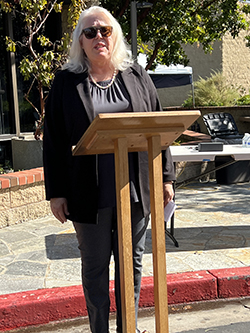
“I know that this is politically charged,” she added. “This would include men and women and people with disabilities because they still bring knowledge, skills, and abilities. And it could take in AmeriCorps, Peace Corps, planting saplings in the Sierras with the Forestry Service; there are a lot of things that people can do for our country and contribute.”
She said the idea of universal service is at least 2,000 years old. She quoted the ancient Greek biographer Plutarch that “rich as well as poor, plebians and patricians, should be mingled again in the same army and in the same camp and engage in one common service for the public. It would mutually dispose them to reconciliation and friendship.”
Bill Friedel, who was an Army doctor with the rank of captain during the Vietnam War, commented that “I am also a big fan of universal service, at least a year or two for everyone. To me it is a ‘no-brainer,’ and it would be wonderful for our country.” He added that “the bravery and fortitude of our fighting men is unbelievable, and it is inspirational.”
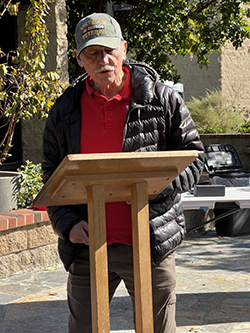
Bill Sperling, who was a Navy doctor and a lieutenant commander assigned to the 1st Marine Division during the 1960s, echoed Siegel and Friedel. “I feel very strongly that everybody should spend time in the military, like they do in Israel,” he said. “I think that it changed your quality of life.” He said his late brother-in-law “was lost, could not find himself; he went into the Navy, and it made a different person out of him. He came out a mensch and had a great job, so I strongly favor everybody going into the Navy.”
Kort, who blew the old British bugle, said that in South Africa –from which he immigrated to become a citizen in the United States — military service was “100 percent call-up.”
“I served in 1967 for nine months continuous training and ten years for non-continuous training, where we did camps,” he added. “I served in an antiaircraft battalion.”
Other speakers briefly related anecdotes from their military service during the gathering that lasted a little more than a half hour.
*
Donald H. Harrison is editor emeritus of San Diego Jewish World. He may be contacted via donald.harrison@sdjewishworld.com