The Pessimist’s Son: A Holocaust Memoir of Hope by Alexander Kimel and Martin Kimel; Newton, Massachusetts: Cherry Orchard Books; © 2025; ISBN 9798887-198019; 291 pages including index and end notes; $20.

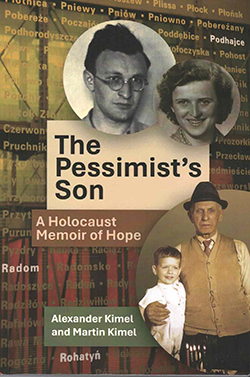 SAN DIEGO – Many Holocaust memoirs, through no fault of the memoirists, have an all-too-familiar ring to them. That is because the Nazis had a consistent playbook for conquered towns and cities. First, put restrictions on Jews, what they could wear, where they could work, where they could live, what amenities they would be denied.
Then, pack them into a ghetto. Appoint Jewish notables to councils (Judenrats) to help the Nazis carry out their master plan. Then roundups and deportations to the killing centers (eg, Auschwitz, Treblinka) or work camps, depending on the needs of Germany; and finally, the last action, the extirpation of all Jewish life and culture in that locality.
While these steps are contained in The Pessimist’s Son, the memoir is substantially different from most other memoirs. Alexander Kimel, who survived the Holocaust, initially wrote a memoir brimming with anecdotes. To this work, his son, Martin Kimel, appended extensive annotations compiled from histories, oral testimonies, and contemporary memoirs. The result is a grander work that has academic rigor and a personal touch.
Alexander writes about the March 1942 “action” in Rohatyn in which 3,400 Jews were executed by the Nazis and their Polish and Ukrainian allies. It was the first such mass killing. Emerging from a hiding place, Alexander saw some fellow Jews pushing a corpse-filled wagon. He “grabbed the wooden railing of the wagon, and to my horror, I recognized the face of one of the corpses. It was Arnold, a classmate of mine. Oh my God! This is Arnoldek! I just kidded him yesterday. I felt a tremor passing through my body. Arnoldek was a heavy-set, good-natured boy. At school he had sat next to me, on the same bench. He loved candy and his rustling of crushed candy wrappers used to drive me crazy. Now he was dead. I couldn’t believe it. Arnoldek’s head stuck out from the spikes of the side ladder. I gently pushed it back. I was astonished at my own calmness. No feelings, just emptiness. Limitless emptiness.”
A confession several pages later was subtitled “My Burning Shame.” At a quarry where he was assigned to work, “I spent a whole day crushing boulders with a twenty-pound hammer. The work was exhausting and, worst of all, I was burning lots of precious, irreplaceable calories. As a result, I was always ready to eat and devoured any piece of food I could get my hands on. One day, during the lunch break, a neighbor of mine, an older man who had lost his family in the March action, approached me and asked me to share my bread…. I could not, physically or emotionally, part with the food, and I refused. I refused, and the image of the old man walking away from me like a beaten dog stayed with me all my life. I was ashamed of my refusal then, and I am ashamed of my actions now.”
Alexander’s memories are vivid and poignant contrasted with the relatively flat recitation by Martin of his mother Eva’s life and death culled from contemporary accounts and histories. While interesting, this section of the book was not as riveting as the one co-written with his father, devoid as it was of comparable personal anecdotes.
If your interest is specifically what happened in the Polish localities of Podhajce, Radom, and Rohatyń, then this book is essential reading. If you are curious about the emotions victims felt during that terrible time, I can recommend this account heartily.
*
Donald H. Harrison is publisher and editor of San Diego Jewish World.