By Alex Gordon

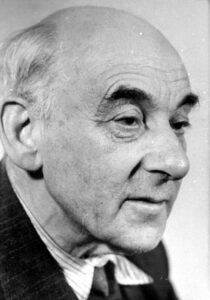
HAIFA, Israel — Victor Klemperer was a German philologist, writer, and researcher of totalitarian thought and the language of Nazi Germany.
Klemperer was born in 1881 in the Prussian town of Landsberg into a rabbi’s family. He studied at a French gymnasium in Berlin, but in 1899 he left it and became an apprentice at a trading firm. In 1902, he took the maturity certificate exams externally. From 1902 to 1905, Klemperer studied Romance and Germanic philology at the universities of Berlin, Munich, Geneva, and Paris.
After 1905, he worked as a journalist in Berlin and began publishing prose. In 1906, he married the pianist and artist, the German, Eva Schlemmer. In 1912, Klemperer converted to Protestantism. Later, he confessed: “Now I knew more clearly that I fully shared the desire to be German. From experience, I was no longer convinced that Jews and Germans could get along with each other under all circumstances. […] The Germans came to mean everything to me, while the Jews meant nothing.”
In 1912–1914, he resumed his studies at the University of Munich, defended his doctoral dissertation (about Montesquieu) in 1912, and in 1914, his habilitation thesis in philology. Having received the title of associate professor, he taught at the University of Naples, and in November 1915, he volunteered to go to the front. In the army, he served in the artillery, and then worked in an administrative capacity at the military censorship office. Since 1920, having received the title of Professor of Romance Languages, Klemperer taught at the Dresden University of Technology.
After the establishment of the Nazi regime, Klemperer began keeping a diary about the “language of the Third Reich” – Lingua Tertii Imperii (Latin titles). After the war, based on these diaries, he compiled a book dedicated to LTI, which he called The Philologist’s Diary. This book brought him fame and became a “monument of Holocaust literature.”
In 1935, the Nazi authorities dismissed Klemperer from the Technical University. He was stripped of his position because, notwithstanding his conversion to Protestantism, Nazis still considered him a Jew. Then he was banned from publishing. Then they took away his beloved cat: Jews were not allowed to keep pets.
Then they were forbidden to engage in science, use libraries, and keep “non-Jewish” books at home. Then they banned the purchase of new goods in stores – from now on, one could only receive used goods through special cards. Then they banned visiting cafes and cinemas. Then they forced Jews to wear a yellow star. Then they were evicted from their own home to one of the “Jewish houses.”
Then they sent him to work as a laborer at the envelope factory, then at the tea factory. Then they banned him from riding the tram: “And I have the right to board only from the front platform, and only if I am going to work, if the distance from my house to the factory is more than six kilometers, and if the front platform is securely separated from the middle of the tram.” The only thing that saved the professor was that he had converted to Protestantism in 1912 and had married a German woman. As a “non-Aryan Christian,” he was not subject to extermination – as long as he did not violate anti-Jewish laws.
In these inhumane conditions, Klemperer maintained his German identity and endured the gross distortions of his beloved German language by the Nazis. But the Germans forbade Klemperer from being a German.
A professor of Romance philology, a European-educated person, a patriot of Germany, a Christian, was forcibly thrown into Judaism for 20 years. A German by spirit was separated from Germans by blood. Victor Klemperer was artificially identified with his ancestors. A yellow star was pinned to a jacket indistinguishable from other German jackets. He thought that no one could dispute that Germany was in his blood, yet he kept coming across the slogan: “When a Jew writes in German, he lies.”
Thanks to his marriage to an Aryan woman, Klemperer avoided deportation to a concentration camp; however, in 1940, the couple was relocated to a “Judenhaus” – a Jewish ghetto house. In the 1930s, deprived of the opportunity to give lectures, publish, visit libraries, and subscribe to newspapers and magazines, Klemperer continued to work in secret and write his diary.
After February 13, 1945, when the Nazi authorities decided to deport all remaining Jews, including those in “mixed marriages,” Klemperer and his wife, taking advantage of the chaos caused by the Allied air raid on Dresden (during which a large number of both ghetto residents and Gestapo and SS officials perished), fled and took refuge in Upper Bavaria, an area soon occupied by Allied forces. In the village of Unternbernbach, they hid until the end of the war.
After 1945, Klemperer taught, gave lectures, wrote books and articles, and actively participated in the cultural and political life of East Germany. He lectured in Berlin and Halle, was a member of the ruling (only) East German party, the Socialist Unity Party of Germany, and was a member of the Academy of Sciences of the GDR. He published A History of French Literature in the 19th-20th Centuries and a two-volume work on the French Enlightenment (Diderot, Voltaire).
By 1945, Klemperer had lived in three different Germanys: the Kaiserreich, the Republic, and the Hitler regime—and when they began to build the fourth, “socialist” Germany, he noticed that the beloved “renewed” Germany began to resemble the old, Nazi one. Klemperer moved from the totalitarian state of the Third Reich to the totalitarian state of the German “democratic” republic.
The son of a rabbi, who was baptized at the age of 31 to defend his dissertation and obtain a professorship, did not know the Jewish mourning prayer “Kaddish.” In The Philologist’s Diary, he condemns Zionism as “an Austrian affair,” not a German one. In his opinion, in a multinational state (like Austria-Hungary), a Jewish nationality can exist, but not in a “mononational” Germany.
Klemperer is alien to the nationalism of Jews and Nazis. For 12 years of Nazi rule, he discussed in his diaries the alien dilemma of “Zionism” or “Germanness.” “I am engaged in a most difficult internal struggle for my German identity,” wrote Klemperer in May 1942. – I must adhere to the belief: it is spirit that matters, not blood. […] Zionism would have been a comedy for me, but my baptism was not a comedy.” He died in 1960. In the last 15 years of his life, he gladly freed himself from the Jewish question, but a metamorphosis occurred in his views.
In the book The Language of the Fourth Reich, he saw the phraseology of the communists as “pure Nazism.” He was against censorship and totalitarian rule in the GDR, but he kept quiet about it. After his trip to China, he wrote: “Communism is equally suitable for pulling primitive peoples out of their primitive filth and pushing civilized peoples back into their primordial filth… I finally became an anti-communist.” To his anti-Nazism, he added anti-communism, but remained an opponent of Jewish national consciousness, stubbornly preserving his German identity.
*
Alex Gordon is professor emeritus of physics at the University of Haifa and at Oranim, the Academic College of Education, and the author of 11 books.