By Alex Gordon
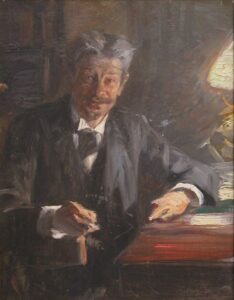
(Sketch: P.S. Krøyer via Wikipedia)
HAIFA, Israel — Georg Morris Cohen Brandes, a Danish literary scholar, publicist, theorist of naturalism, and Nobel Prize in Literature nominee, was born in Copenhagen on February 4, 1842, into a wealthy assimilated Jewish family.
At the local university, he initially studied law, then philosophy and aesthetics (1859-1864). In 1862, he received the university’s gold medal for the essay The Idea of Nemesis in the Ancients. In 1866, Brandes published the essay Dualism in Modern Philosophy against the reconciliation of science with religion. This work made Brandes a spokesperson for the ideas of Danish writers who opposed Romanticism and traditional aesthetics.
After graduating from university, Brandes interned in France (1866–1867 and 1870), in England (1870–1871), in Germany and Italy (1868). In Paris, he became close to the French philosopher and art critic Hippolyte Taine, and in London, to the philosopher John Stuart Mill. His doctoral dissertation is dedicated to the views of Hippolyte Taine, “French Aesthetics in Our Day. Treatise on I. Taine” (1870).
In the autumn of 1871, Brandes began delivering lectures in Copenhagen on the chapters of his work Main Currents in Nineteenth Century Literature in six volumes (1872–1890). At the age of 30, Brandes formulated the principles of new realism and naturalism, condemning hyper-aesthetic writing as well as fantasy in literature. Naturalism is a philosophical and artistic movement that asserts that nature is the only reality and the source of all phenomena. In literature and art, naturalism strives for the most realistic depiction of reality. His literary goals were shared by some other authors, including the Norwegian playwright “realist” Henrik Ibsen.
In his books and lectures, Brandes revealed himself as a thinker and artist possessing depth of thought, subtlety of analysis, elegance of writing style, and the ability to capture the attention of readers and listeners. In Brandes’s opinion, understanding is not enough for a critic; they need a special intuition, an “intuitive” penetration into the depths of the life they are studying. Brandes was opposed to aestheticism in literature and the theory of “art for art’s sake.” He saw literature as an organ for expressing “great thoughts about the freedom and progress of humanity.”
The characteristics of Brandes’s critical talent brought him immense success and one of the top places among literary historians. Brandes’s popularity is largely explained by his captivating style of presentation—a style more akin to that of a novelist than a scholar—his narrative sprinkled with paradoxes, characteristic anecdotes, and vivid examples that often illuminate the essence of social phenomena more brightly and deeply than detailed studies.
But in the conservative camp, Brandes’ lectures caused discontent among the chauvinists, as they were universal rather than Danish national. He was reproached for a lack of patriotism. He was showered with antisemitic insults. The conservatives managed to prevent Brandes from being elected as a professor of aesthetics, which led him to move to Berlin. There, he actively published in the German periodical press.
In 1882, Brandes returned to Copenhagen, where he resumed giving lectures at the university. His critical article on Nietzsche (1888) was published in German translation in Germany and marked the beginning of Nietzsche’s global fame. In May 1902, Brandes was awarded the title of professor in Copenhagen. In recent years, he changed his worldview: a fervent supporter of the doctrine of “intellectual aristocratism,” he now placed personality above environment in the history of progress.
Under the influence of this change, he published the following works: Søren Kierkegaard (1877), Shelley and Lord Byron (1894); William Shakespeare (1896); Wolfgang Goethe (1915), Voltaire (1916–1917), Gaius Julius Caesar (1918), Michelangelo Buonarroti (1921). In one of his last works, The Story of Jesus (1925), Brandes attempted to refute the historical foundations of Christianity.
When World War I began, Brandes, being a staunch pacifist, decided to maintain neutrality, which led to the severing of friendly ties, including with Georges Clemenceau. This war meant a catastrophe for Brandes. He wrote: “What is Europe? Divided into hundreds of battlefields, thousands of cemeteries and hospitals, a giant bankrupt, a huge madhouse.”
Brandes wrote literary works on Jewish themes as well. He published the book Job and articles on The Song of Songs and Ecclesiastes, which were included in the Annual of Jewish History and Literature (1901). His books on Jewish political figures, Lord Beaconsfield (1879) and Ferdinand Lassale (1877), are among the best works of this kind.
Brandes’s attitude towards the Jewish question can be judged by his letter to the editorial office of the Frankfurter Zeitung (1908). “If I were not constantly reminded of my Jewish origin,” he wrote, “I might even forget about it. Amazing! I have heard a thousand times that I am Jewish, and yet every time this statement is news to me.”
The story of Brandes’s conversation with Vladimir Solovyov, a Russian religious philosopher, is well-known. The conversation turned to biblical reminiscences. Brandes said, “I remember this place, give me the Bible, I’ll show you…” and felt somewhat embarrassed when the Orthodox Solovyov, who was seriously engaged in theology and knew Hebrew, handed him the Tanakh in Hebrew, while Brandes, who knew several European languages, did not know the language of his ancestors.
His stubborn and strange rejection of Judaism is explained by the fact that, as a “Hellenist” in his worldview, Brandes considered Judaism to be the opposite of Hellenism and saw one of his tasks as fighting against “Judaism, modified by some admixture of Christianity, which permeates Denmark and Finland.” Brandes defended Dreyfus and in 1918 acknowledged the reality of Zionism in the article New Judaism.
Brandes died in Copenhagen on February 19, 1927.
*
Alex Gordon is professor emeritus of physics at the University of Haifa and at Oranim, the Academic College of Education, and the author of 11 books.