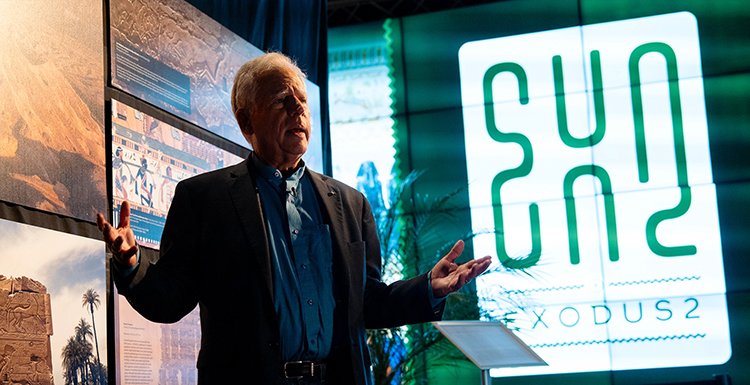
“The Exodus means many things to many people,” says Tom Levy, co-director of the Center for Cyber-Archaeology and Sustainability at the UC San Diego Qualcomm Institute and distinguished professor in the university’s Graduate Division. (Photo: Hana Tobias)
By Mika Elizabeth Ono
LA JOLLA, CALIFORNIA — When you hear “the Exodus,” what do you think of? Does your mind go to the second book of the Hebrew Bible/ Old Testament, a powerful symbol of God’s deliverance, redemption, and covenant with His people foreshadowing the Messiah in Christianity, or the narrative contained in the Koran? The story of the Israelites’ liberation from slavery in Egypt marked at every Passover in Jewish homes around the world? Creative interpretations such as the African American spiritual “Go Down Moses” or the 1956 epic Hollywood film The Ten Commandments? Social media items such as #Exodus on X or a TikTok on if Moses had an iPhone? Or a symbol of freedom for oppressed people everywhere?
“The Exodus means many things to many people,” said Tom Levy, co-director the Center for Cyber-Archaeology and Sustainability (CCAS) at the UC San Diego Qualcomm Institute (QI), distinguished professor in the university’s Graduate Division, and inaugural holder of the Norma Kershaw Chair in the Archaeology of Ancient Israel and Neighboring Lands. Levy is also a member of the board of directors at American Friends of University of Haifa.
“The multiplicity of meanings is precisely what makes the Exodus so compelling for transdisciplinary study. It exists simultaneously as religious text, historical claim, archaeological puzzle, anthropological phenomenon, inspirational quest for freedom and political metaphor.
“Whether we approach this story as believers or skeptics, as historians or theologians, as archaeologists or from other fields of science,” he continued, “we encounter fundamental questions about freedom, community and hope that remain as urgent today as they were over 3,000 years ago.”
That’s why Levy and CCAS hosted a two-and-a-half-day transdisciplinary conference on the Exodus at the UC San Diego Qualcomm Institute (QI) last month. The event, which was built on a conference held at QI 12 years ago, offered an opportunity for over 30 scholars from half a dozen countries, from the USA to Israel and China, to explore and share some of the richness of the topic from multiple perspectives.
The range of talks reflected the multiple points of view brought together at the event. Titles included “Archaeology, the Exodus, and the Bible: The State of Their Union” (by keynote speaker Richard Elliott Friedman of the University of Georgia); “‘Tremble, thou Earth’: How Real can these Exodus Marvels be?” (by Amos Salamon of the Geological Survey Israel); “Exodus: Rethinking Nomadic Polities and the Limits of Archaeology” (by Erez Ben-Yosef of Tel Aviv University); “Mapping the Cultural Metaphors of Exodus: A Cross-Cultural Semantic and Data Science Analysis” (by Shlomo Dubnov of UC San Diego [Departments of Music and Computer Science and Engineering at Jacobs School of Engineering]); “Miracle Babies: Moses and the Other Children in Exodus Tradition” (by Caterina Moro of Università Roma Tre, Italy): and “Mount Sinai: What Type of Evidence Counts as Evidence? An Historical Geographical Approach” (by Chris McKinny of Lipscomb University).
Following the example set by the first Exodus conference, the scholarship presented at the gathering will be collected in a peer-reviewed volume of papers to be published by Springer Publishing.
Conference speakers used traditional and contemporary methods to explore Exodus, including 21st century tools such as generative AI, data analytics and machine learning. Some participants considered themselves to be part of the broader field of cyber-archaeology, which unites archaeology, computer science, engineering and the natural sciences.
An exhibit in QI’s Theater space featured a journey through aspects of the Exodus, beginning with desert origins in 12th century BCE Egypt (complete with goat hair tent) to possible routes through the wilderness and an examination of geoscience’s insights into phenomena such as tsunamis and floods that may play a part in the story.
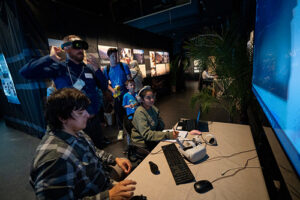
The exhibit also featured augmented reality demonstrations, offering participants a more vivid grasp of how things might have looked in the past. These demonstrations were developed by CCAS Co-Director and QI Research Scientist Neil Smith and his students, who used video game platforms like Unreal Engine 5 to create immersive visualizations.
Ramesh Rao, director of QI, noted: “Going back to the founding of this institute … in 2000, we set out to create an environment that would promote and nurture interdisciplinary work. While that was an abstract formulation at some level, the engagement with Tom and his team actually demonstrates that to be a good teacher, anthropologist and archaeologist, you had to have a mastery of many things — from physics, chemistry, astronomy, geology.”
Larry Smarr, the founding director of California Institute for Telecommunications and Information Technology (CalIT2), the parent organization of QI, and distinguished professor emeritus at the UC San Diego Jacobs School of Engineering, agreed, noting: “The Exodus conference is one the most highly transdisciplinary conferences we host, and it is the paradigmatic example of what this institute was set up to enable.”
For Levy, the conference – and the Exodus story itself – demonstrate how differing viewpoints can not only co-exist but also enrich each other as scholars work together to address important questions with respect for both “the rigor of evidence and the richness of interpretation.”
“The Exodus demonstrates how ancient stories can build bridges between civilizations,” noted Levy. “Jewish, Christian and Islamic traditions all honor this narrative, providing common ground in an often-divided world. The archeological work presented in this conference from Egypt, Israel, Jordan and throughout the region brings together scholars from many nations, creating international partnerships that transcend political tensions, as we face contemporary global challenges, pandemic, recovery, climate change, economic inequality, political polarization.”
In addition to the continuing evolution of a transdisciplinary and multinational approach, Levy hopes the future of the field will include the establishment of a national center for marine archeology in the Port of Haifa, Israel, based on these same principles. He is currently working with University of Haifa to make this vision a reality.
“[The center] will serve as an international hub to explore the changing history and environments of the Mediterranean basin along its coast and under the sea,” Levy said. “Working with all the nations that border this crucible of civilization, we will help promote archaeo-diplomacy.”
For more information on the conference, including videos of the talks (also available on YouTube), see the Exodus 2 website. For more information on the Center for Cyber-Archaeology and Sustainability and the UC San Diego Qualcomm Institute, see their websites. For more information on Levy, see his bio or new graphic memoir, “The Boomer Archaeologist” illustrated by Lily Almeida and published by Equinox.
If you are interested in purchasing “The Boomer Archaeologist,” the e-book is available for a 25% discount at https://equinoxonlinelibrary.com/book/58293/the-boomer-archaeologist with code 2893-25. Print version pre-orders are available for a 25% discount at https://www.isdistribution.com/BookDetail.aspx?aId=187523 with code 2893-25 for North American buyers; UK and Worldwide-based buyers can visit https://www.equinoxpub.com/home/boomer-archaeologist and use code 2893-25.
*
This story was initially published by the UC San Diego Qualcomm Institute.