Divrei HaLev: Thoughts of Rabbi Professor David Weiss Halivni by Rabbi Ronald D. Price; Gefen Publishing House; (c) 2025; ISBN 9789657-801543; 450 pages; $29.95
Bu Rabbi Dr. Michael Leo Samuel

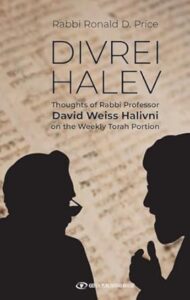 CHULA VISTA, California — Rabbi Professor David Weiss Halivni (1927-2022) was one of the most significant Talmudic scholars of his time, whose immense intellect and spiritual depth profoundly influenced modern Jewish thought.
There are so many outstanding works that immediately come to mind. In his Revelation Restored, R. Weiss Halivni provides the historical and textual foundation for this theology. In this seminal work, the author introduces the theory of a “maculate” (flawed) Torah, suggesting that the text we have today is not the perfectly preserved original given at Sinai. Instead, he argues that the Torah was corrupted during a period when the Israelites neglected their faith and was later “restored” imperfectly by the prophet Ezra. This theory helps Halivni reconcile traditional Jewish faith with the findings of modern biblical criticism.
In his Broken Tablets, he argues that the history of the Jewish people is marked by two opposing revelations: the presence of God at Mount Sinai and the “revelation of absence” at Auschwitz. He contends that after the Holocaust, we can no longer see suffering as a punishment from God but must understand it as a withdrawal of the Divine Presence, leaving humanity with complete free will to commit evil.
Rabbi Ron Price, a devout student of Weiss Halivni, has assembled a massive work of the master based on his understanding of the weekly Torah portions. It is in collections like Divrei HaLev: Thoughts of Rabbi Professor David Weiss Halivni that readers gain a more intimate and accessible glimpse into the soul of this extraordinary figure. This book is neither a systematic theological treatise nor a dry academic text; rather, it is a mosaic of sermons and reflections that reveal his personal and spiritual insights.
As a child of a Holocaust survivor, I have always been fascinated by how people like R. David Weiss Halivni and men like my father managed to hold on to their faith despite witnessing one of the darkest chapters of human history.
The strength of “Divrei HaLev” lies in its ability to make Rabbi Professor David Weiss Halivni’s complex thought accessible through a collection of sermons and personal reflections. The book captures his deep struggle with the nature of Torah, where he balances a belief in its divine origin with an honest acknowledgment of the complexities introduced by its human transmission. This nuanced perspective, which sees the Torah as God’s word even in its “imperfect transmitted form,” is a hallmark of his thought.
Shaped by his experiences during the Holocaust, Halivni’s reflections on faith and doubt do not offer easy answers but instead articulate a hard-won conviction forged in immense pain, treating intellectual inquiry itself as an act of devotion. He presents a model of scholarship that is both intellectually courageous and profoundly pious, and his insights on Jewish law encourage a dynamic, responsible engagement with tradition. Ultimately, “Divrei HaLev” reveals the personal wisdom and warm humanity behind his formidable intellect, making his profound ideas relatable on a personal level.
The book poignantly captures his faith as a hard-won conviction forged in the crucible of immense pain, shaped by his experiences during the Holocaust. This same intellectual honesty extends to his understanding of Torah and tradition; he believed in the Torah’s divine origin but unflinchingly confronted the complexities introduced by its human transmission. Halivni posited that even in its imperfect form, the Torah remains God’s word, demanding our intellectual and spiritual engagement. He emerges as a model of a scholar whose rigorous honesty is always tempered by deep reverence for tradition, viewing the pursuit of knowledge as a spiritual quest and advocating for a dynamic, responsible approach to Jewish law (Halakha) in the modern era.
The primary strength of “Divrei HaLev” is its unique insight into how Rabbi Professor David Weiss Halivni’s rigorous academic inquiry was inextricably linked to his profound piety, demonstrating that critical questioning can deepen faith rather than undermine it. While the book offers a powerful and accessible model for navigating the challenges of modern Jewish identity, its discursive nature means it is not a linear argument, and some sections may require a degree of familiarity with Jewish concepts to be fully appreciated. Ultimately, this book is an invaluable contribution to contemporary Jewish literature, serving as a testament to the intellectual honesty and unwavering faith of a master who lived at the crossroads of tradition and modernity.
Structured around the weekly Torah cycle, “Divrei HaLev” presents Rabbi Professor David Weiss Halivni’s profound insights in accessible, bite-sized portions. Halivni’s personal experiences, particularly his survival of the Holocaust, infuse the book with a raw authenticity, as he grapples with theodicy by reinterpreting passages on suffering not as punitive, but as lessons in resilience. This approach reflects a hallmark of his scholarship, which navigates the tension between peshat (plain meaning) and derash (interpretive expansion). He applies this methodology to draw parallels between ancient texts and contemporary issues, using stories like Abraham’s journey or the binding of Isaac as metaphors for modern spiritual and moral struggles. Ultimately, the book advocates for a Judaism that is both rooted in tradition and willing to evolve, encouraging readers to engage with their heritage with both intellectual humility and profound reverence.
Interesting examples of his exegetical insight include:
· Regarding Parsha Noah, David Weiss Halivni drew a profound and devastating parallel between the flood and the Holocaust by distinguishing between two types of human depravity. He explained that the flood was not a punishment for ḥamas (robbery or lawlessness) alone, which is a sin committed for personal gain and for which there is a path to repentance (teshuvah). Instead, the flood’s annihilation was necessary because the generation had progressed to hishḥit—a deeper, more viral state of corruption where the society had not only committed robbery but had actively justified its lawlessness. This state, where evil is institutionalized and deemed righteous, leaves no hope for repentance, necessitating a complete end. Halivni saw in the perpetrators of the Holocaust a similar level of moral depravity, a society that had reached the incurable stage of hishḥit and justified its acts of extermination, making it a modern analogy for the biblical justification for the flood’s destruction.
· I found this passage especially relevant to Tisha B’Ab: In his theological reflection on the Holocaust, David Weiss Halivni grapples with the haunting question of why God did not intervene in the Shoah. He dismisses the idea that the event was a punishment for sin, arguing that the scale of destruction was disproportionate to any conceivable transgression. Instead, Halivni connects the Holocaust to the concept of beḥirah ḥofshit (free will) and a historical shift in divine presence. He notes that God’s direct intervention, common during the era of prophecy, ended during the early rabbinic period with the declaration of lo ba’shamayim hi (“it is not in the heavens”). This turning point, Halivni suggests, marked the beginning of an era where humanity was left with complete free will, unrestrained by divine intervention. The Holocaust is therefore understood not as a punishment, but as a catastrophic manifestation of human evil in a world where God’s miraculous hand had been withdrawn..
In another passage (p. 396), David Weiss Halivni explains that a living, meaningful religion must exist as a continuous bridge between the past, present, and future. He argues against two extremes: a new religion without a history is meaningless, while a religion that is only rooted in the past is irrelevant and unsatisfying for contemporary life. The solution lies in active, intergenerational engagement. God’s divine revelation is a historical event that cannot be repeated, so our connection to it depends on memory and its transmission. The present generation is responsible for learning the tradition from their elders and then applying it to their lives. This ongoing process ensures that the future of the religion is secure, as the next generation will be able to “ask your father and he will tell you” (She’al avikha v’yagedkha), linking the past to the present for a viable future.
Ultimately, Divrei HaLev: Thoughts of Rabbi Professor David Weiss Halivni is an outstanding and essential work that deserves a place in every Jewish home. The questions and interpretations he offers are not for the faint of heart, as they unflinchingly confront the most challenging aspects of faith, tradition, and modern life. Halivni grapples honestly with the spiritual crisis of the Holocaust, the complexities of the Torah’s transmission, and the delicate balance between academic rigor and profound piety. Far from providing simple answers, the book offers a powerful and inspiring model for navigating doubt and maintaining a deep commitment to tradition in a world filled with paradox.
*
Rabbi Dr. Michael Leo Samuel is spiritual leader of Temple Beth Shalom in Chula Vista.