By Alex Gordon
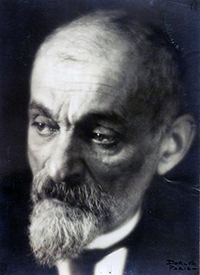
HAIFA, Israel — Lev Shestov (real name – Yehuda-Leib Schwartzman; 1866, Kiev, Russian Empire – 1938, Paris, France) was a Russian religious philosopher, existentialist, and literary critic. He was born on February 5, 1866, in Kiev, into the family of a large manufacturer, second-guild merchant Isaac Schwartzman and his wife Anna.
Located in the Kiev Podol district, the “Isaak Schwartzman Manufacturing Partnership” with a turnover of three million rubles was known for the quality of the English fabric it purchased. The firm was founded by the Schwartzman spouses in 1865, and since 1884 owned the largest store in the city, since 1892 – a branch in Kremenchug.
Lev’s father was a great connoisseur of ancient Hebrew literature, a free-thinking person, and had quite progressive views and a broad outlook. He wanted his children to continue his work, but he never insisted on it. Leo had two younger brothers and four sisters. He studied at the 3rd Gymnasium in Kiev, but was forced to transfer to Moscow. He studied at the Faculty of Mathematics at Moscow University, then transferred to the Faculty of Law at the Imperial University of Saint Vladimir in Kiev, which he graduated from in 1889 with the title of Candidate of Law. The dissertation On the Condition of the Working Class in Russia was banned from publication and confiscated by the Moscow Censorship Committee, which is why Shestov never became a Doctor of Law.
For several years, Schwarzman lived in Kiev, where he worked at his father’s firm while simultaneously intensively engaging in literature and philosophy. However, combining business and philosophy turned out to be difficult. In 1895, Schwarzman fell seriously ill (nervous disorder), and the following year he went abroad for treatment. Subsequently, his father’s commercial enterprise became a family curse for the thinker: he was repeatedly forced to leave his family, friends, and beloved work to rush to Kiev to restore order to the firm’s affairs, which had been disrupted by his aging father and careless younger brothers.
In 1896, in Rome, Lev Shvartsman began a relationship with Anna Berezovskaya, who was studying medicine at the time; two years later, they moved to Bern together, and in 1898, they returned to Russia. Shestov never accepted baptism; he did not convert from Judaism, even after entering into a de facto marriage with an Orthodox Russian woman, but he kept this marriage hidden from his father for many years.
In 1898, Shestov’s first book, Shakespeare and His Critic Brandes, was published, in which he outlined problems that later became central to the philosopher’s work: the limitations and inadequacy of scientific knowledge as a means of “orienting” a person in the world; distrust of general ideas, systems, and worldviews that obscure reality in all its beauty and diversity; the prioritization of specific human life with its tragedy; and the rejection of “normative,” formal, enforced morality, universal, “eternal” moral norms. Following this work, a series of books and articles appeared, dedicated to analyzing the philosophical content of the works of Russian writers—Fyodor Dostoevsky, Leo Tolstoy, and Anton Chekhov.
In 1905, a work was published that sparked the most heated debates in the intellectual circles of Moscow and St. Petersburg, eliciting the most polarizing evaluations (from admiration to outright rejection), and became the philosophical manifesto of Shestov — The Apophysis of Groundlessness (An Essay on Nondogmatic Thinking). According to Shestov himself, “My entire task was precisely to rid myself once and for all of all kinds of beginnings and ends, which are so stubbornly imposed on us by the founders of both great and not-so-great philosophical systems.”
Shestov criticized the rationalist approach to understanding the world and humanity, which, in his opinion, could not explain the irrational aspects of human existence.
He found in the Jewish religious tradition, particularly in the teaching of God as transcendent, beyond the limits of reason, the possibility to overcome the limitations of rational thinking. He referred to biblical narratives, such as the stories of Abraham, Job, and others, to illustrate his philosophical ideas. He interpreted these narratives not in a literal, but in an existential sense, showing how biblical heroes face life’s hardships, questions of faith, and despair. Shestov found in the Jewish tradition, especially in the Book of Job, that suffering is an inherent part of human existence and that attempts to rationally explain evil often lead to new suffering.
Shestov criticized religious dogmatism and formalism, which, in his opinion, often distort the true meaning of faith. He argued that true faith cannot be based on rational evidence or adherence to dogmas, but must be connected to personal existential experience. The Jewish question in Shestov’s work was not a matter of national or political identity, but rather a philosophical issue related to the understanding of human nature, one’s place in the world, and one’s relationship with God.
Shestov admitted that “he was not lucky with Jews.” He repeatedly tried to find his place within the Jewish community, but with bitterness he noted that “those at the head of the Zionist and generally Jewish movement do not really understand cultural work, especially philosophy, which is far from them.”
In 1915, Lev Shestov’s illegitimate son Sergei (1892–1915) died at the front. The February Revolution of 1917 did not particularly excite Shestov, although the philosopher had always been an opponent of autocracy. He called the October Revolution “reactionary and despotic.” In 1920, Lev Shestov left Soviet Russia with his family, spent a short time in Switzerland, and in 1921 settled in France, where he lived until his death.
The subject of his philosophical interest in France included the works of philosophers such as Parmenides, Luther, Pascal, Kierkegaard, as well as his contemporary Husserl (a Jew). Shestov was part of the elite of Western thought at that time: he interacted with Husserl, Lévi-Strauss, and Heidegger. He also gave lectures at the University of Paris, many of which were dedicated to Dostoevsky, Tolstoy, and Russian philosophical thought in general.
In 1936, with his sister Fanya and her husband Herman Lovtsky, at the invitation of the cultural department of the Histadrut, Shestov made a two-month trip to Mandatory Palestine, where he gave a series of lectures in Jewish settlements, including in Haifa, Tel Aviv, and Jerusalem.
Lev Shestov passed away on November 19, 1938, in Paris. at a clinic on Boileau Street.
*
Alex Gordon is professor emeritus of physics at the University of Haifa and at Oranim, the Academic College of Education, and the author of 11 books.