By Alex Gordon
HAIFA, Israel — According to Marxism, the proletariat is the class leading the “progressive” transformations of the world. But many prominent socialists were not of proletarian but of bourgeois origin, and often they came from wealthy families that no one exploited. These Jews, who had themselves recently been subjected to national and religious oppression, sought to become the vanguard of society. Such were Ludwig Börne, Ludwig Bamberger, Ferdinand Lassalle, Alexander Parvus, Rosa Luxemburg, Victor Adler, Léon Blum, Leon Trotsky, Kurt Eisner, Ernst Toller, Erich Mühsam, Eugen Levine, Karl Radek, György Lukács, Egon Erwin Kisch, Béla Kun, and many others.
Material well-being did not restrain their radicalism; rather, it possibly intensified it, as it created a sense of shame for their prosperity against the backdrop of the plight and oppression of the working class. Socialist activities for the benefit of the working class allowed Jewish socialists to hide the “narrow,” “selfish” interests of Judaism behind the curtain of the struggle for the rights of all workers.
However, it is possible that one of the reasons why Jews, upon starting to participate in general politics, became radical socialists in the overwhelming majority of cases, is related to the tradition of social criticism stemming from the Bible.
As historian Paul Johnson writes in the book A History of the Jews, “Their break with the past, with family and community, often combined with self-hatred, promoted among them a spirit of negation and destruction, of iconoclasm, almost at times nihilism – an urge to overthrow institutions and values of all kinds – which gentile conservatives were beginning to identify, by the end of the nineteenth century, as a peculiarly Jewish social and cultural disease.”
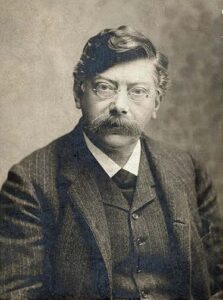
One of such liberators of humanity was the Austrian Jew Victor Adler, who was born on June 24, 1852, in Prague. He was the eldest of five children of the Jewish family of the merchant Markus Salomon Adler and his wife Johanna (Herzl). Adler’s father was a successful and wealthy merchant. When the family moved to Vienna, Victor was sent to study at the Schottenstift monastery gymnasium. After graduating from Schottengymnasium, he enrolled in the Faculty of Chemistry at the University of Vienna in 1871, and then transferred to the Faculty of Medicine, where he studied from 1872 to 1881, almost concurrently with Freud (1873-1881).
Freud and Adler were members of the Reading Union of German Students of Vienna, whose ideology was radical Pan-Germanism and German nationalism, shared by many Austrian Jews raised in German culture.
After becoming a doctor of medicine, Adler practiced medicine for some time, but soon fully dedicated himself to politics. As a wealthy man, he organized a medical practice for the poor (1879), soon earning the nickname “doctor of the poor.” One of his biographers wrote that Adler could “receive the poor and needy completely free of charge; moreover, he provided his patients with medications and food.”
In 1874, Adler met Freud’s high school friend Adolf Braun, whose sister Emma he married in 1878. Brown introduced Adler to prominent German social democrats—Karl Kautsky, August Bebel, and Friedrich Engels. With the latter, Adler met twice (in 1883 and 1889) and, from the time of their second meeting until Engels’ death (in 1895), they corresponded. At first, he was a radical, then, in the mid-1880s, he became a social democrat.
Adler became one of the founders of the Social Democratic Party of Austria and one of its leaders; in this capacity, he headed the party’s central organ published in Vienna, the Arbeiterzeitung (Workers’ Newspaper), one of the leading socialist publications.
When the question of dividing the previously unified Austrian Social Democratic Party by nationalities—into a German-Austrian, Czech, Polish, and other parties united by a federal bond—was raised at the 1897 Vienna Congress, Adler emerged as the main opponent of this project. The project was approved, and since then Adler became one of the leaders of the German-Austrian Social Democratic Party, while also playing a prominent role at the general congresses.
He was considered one of the most remarkable orators in Europe. Each of his speeches was unique: when he spoke, he reflected. Adler’s most powerful tool was his irony—deep, imbued with moral content, yet at the same time accessible and pointedly practical. If he discussed a political opponent, that person would feel as if they were being roasted from all sides on a spit.
In personal conversations, Adler listened more and heard not only the words but also the thoughts of his interlocutor. “Perhaps it was precisely the fact that I learned to deal with the inhabitants of psychiatric hospitals in a timely manner that prepared me for communication with Austrian political figures,” noted Adler, a psychiatrist.
Since the late 1890s, Adler became the recognized and undisputed leader of Austrian social democracy. His main strength was a deep connection with the masses, which he valued highly. “I agree,” said the politician, “it is better to be wrong together with the workers than to be right against them.” He knew how to compromise and believed that it was possible to set aside some of his convictions in order to unite the party.
In 1907, the Social Democratic Party became a major parliamentary force. From 1905 to 1918, Adler was a member of parliament, a member of the Reichsrat, and in 1918 he briefly served as the Minister of Foreign Affairs in the Austrian socialist government. Being the undisputed head of the party, Adler also became a prominent figure in the Second International and among European pacifists. As a Germanophile, he advocated for the annexation of Austria to Germany.
Adler did not recognize the existence of specific problems of the Jewish proletariat and denied the existence of the Jewish people. Despite his affiliation with socialists and internationalists, he was baptized.
Victor Adler died on November 11, 1918, in Vienna. Victor Adler’s son Friedrich was a doctor of physics, who received his doctorate in 1905 at the same time as Albert Einstein, who was his neighbor in Zurich. Friedrich left physics and engaged in revolutionary and political activities. He became one of the leaders of the Austrian Social Democratic Party and a member of the Austro-Hungarian Parliament, the Reichsrat.
In protest against World War I, he assassinated the Prime Minister of Austria-Hungary, Count Karl von Stürgkh, in 1916. As a result of the dissolution of the Austro-Hungarian Empire, he was released from prison. Thanks to his son, one can learn more about Victor Adler’s views on Judaism.
In 1949, Friedrich Adler wrote: “I, like my father, have always considered the complete assimilation of Jews not only desirable but also possible, and even Hitler’s barbarism did not refute my opinion that Jewish nationalism necessarily leads to reactionary tendencies—namely, to the revival of a language that had been dead for almost two thousand years and the resurrection of an outdated religion.”
*
Alex Gordon is professor emeritus of physics at the University of Haifa and at Oranim, the Academic College of Education, and the author of 11 books.