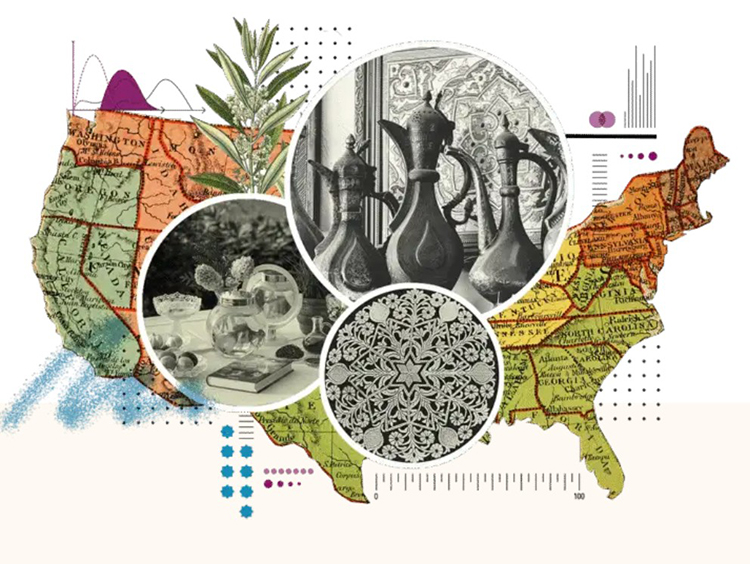
Traditional Sephardi and Mizrachi artifacts and cultural items, clockwise: coffee pots, decorative piece of art and a table setting, grace the cover of the first-ever National Demographic study of Sephardic and Mizrahi Jews in the U.S. (Photo courtesy of JIMENA)
NEW YORK (Press Release) – Sephardic and Mizrahi Jews in the United States have higher rates of Jewish communal participation, a stronger connection to Israel, and are more likely to say that being Jewish is somewhat or very much a part of their daily life compared to Ashkenazi Jews, says a new report released Tuesday, commissioned by JIMENA (Jews Indigenous to the Middle East and North Africa).
The groundbreaking study, Sephardic and Mizrahi Jews in the United States: Identities, Experiences, and Communities, based at NYU, details American Sephardic and Mizrahi identities and experiences, estimates that they are ten percent of the American Jewish population, and offers recommendations for leaders and organizations that want to more deeply engage these communities.
The research, directed by Dr. Mijal Bitton and based at the NYU Wagner Graduate School of Public Research, includes recommendations for community leaders, educators, and researchers to better include Sephardic Jews in the community. The myriad specific recommendations in the report are informed by five new recommended frameworks to approach diversity work in the Jewish community:
-
Avoid viewing Sephardic and Mizrahi Jews only through the lens of exclusion, marginalization, and victimhood narratives. Recognize that strong Sephardic and Mizrahi communal identities exist even as barriers and biases exist within Ashkenazi-majority institutional frameworks.
-
Avoid centering Judaism in the U.S. exclusively around European Jewish experiences and Ashkenazi cultural norms as the dominant narrative (i.e. Yiddish as the primary language of Jewish tradition and denominational structures as the only legitimate form of Jewish identity). Understand Judaism in the U.S. as encompassing multiple historical experiences, with diverse cultural expressions and norms across Jewish communities, a range of Jewish languages and religious practices, and multiple forms of communal affiliation and engagement.
-
Avoid creating inclusion projects that assume everyone agrees with a single set of values (e.g., liberal values) or tools for inclusion (DEI frameworks). Create inclusion projects that allow for diverse viewpoints, values, multiple religious perspectives and norms, and a plurality of political views within Jewish spaces.
-
Avoid viewing diversity in Jewish spaces solely through US racial and ethnic categories. Jewish diversity should recognize the central role of family origins and communal networks in shaping Jewish identity; the complex intersections of ancestry, ethnicity, religion, and culture; and the migration patterns and geopolitical histories that shape identities, perspectives, and communal structures.
-
Avoid assuming that universal frameworks and solutions for inclusion will be effective for all and that shared priorities exist across all Jewish communities. Inclusion requires acknowledging complexity and differences, utilizing multiple approaches, and a commitment to ongoing learning is essential for meaningful progress
As part of the research, scholars at the Cohen Center for Modern Jewish Studies (CMJS) at Brandeis University conducted a review of existing quantitative data from national and community studies on Sephardic and Mizrahi Jews in the U.S. Based on these figures, the study’s researchers estimate that approximately 10% of American Jews are Sephardic and/or Mizrahi. The data also shows how:
-
Compared to Ashkenazi Jews, Sephardic and Mizrahi Jews in the US have higher rates of communal participation, a stronger connection to Israel, a higher share of respondents for whom being Jewish is somewhat or very much a part of their daily life, and the lowest intermarriage rates.
-
Sephardic and Mizrahi Jews are more likely than Ashkenazi Jews to be born and/or raised outside the United States, to be politically moderate or conservative, and to be economically vulnerable.
Researchers drew key findings by closely examining four distinct communities—the Syrian community in Brooklyn, NY, the Persian community in Los Angeles, the Bukharian community in Queens, NY, and the Latin Sephardic community of South Florida. Key findings include the following:
-
While historically underrepresented in mainstream Jewish communal life, Sephardic and Mizrahi Jews have built strong, vibrant communities that maintain deep familial, religious, and cultural traditions.
-
Family is core to Sephardic communities, with ongoing family gatherings for Shabbat, holidays, and other celebrations.
-
Sephardic religious practice reflects a strong sense of traditionalism, combining respect for religious laws, customs, legitimations, and authorities with more flexible personal and family religious observance.
-
There is constant negotiation of change and continuity. Community members want to make new lives for themselves in America, while still preferring ethnic connections, especially marriage with other community members and their own cultural traditions, and they maintain abiding connections to their Mediterranean, North African, and Middle Eastern cultures.
-
Most community members exhibit a notable resistance to language that frames race as their primary identity, categorizes them as Jews of color, or positions them as a minority group in need of diversity, equity, and inclusion initiatives.
-
“The research is more than just insights and data; there’s a roadmap here that we hope will be a catalyst for change,” said Sarah Levin, Executive Director of JIMENA. “Jewish communal leaders and educators can include Sephardic and Mizrahi Jews—and our history, traditions, and current customs—in meaningful, equal ways that reflect the diversity of the Jewish people.”
The report paints a detailed picture of the Brooklyn Syrian, the LA Persian, the Queens Bukharian, and South Florida’s Latin Sephardic communities with numerous quotes from community members.
Daniel, a 47-year-old Brookly Syrian Jew shared:
“We don’t use the terms like in the general broader Jewish world… ‘Oh, I’m Orthodox, I’m Conservative, I’m [Reform], I’m Modern Orthodox’… Religion-wise, we’ve always said, yeah, we’re Sephardic. That’s what we are. That’s our religion. We’re Sephardic. Now, we don’t really do the denomination thing of religion. Religion is, do we believe in God? You’re religious…The details, that’s between you and God and you figure that out, but you’re religious right now.”
In the Persian Los Angeles Jewish community, community leaders highlighted tensions between the collective family-oriented values of their and the individualism of American society. As Sol, a 55-year-old man said:
“Family starts with marriage, and marriage is not an easy institution. It takes sacrifice. You have to want it. You have to want to keep it. American society is very self-centered… very individualistic, and that’s in conflict with family.”
Many interviewees expressed immense gratitude for the assistance of the American Jewish community, yet they simultaneously recalled condescension, particularly among the New York Orthodox community. One 63-year-old community rabbi described how Bukharians learned to navigate the more complex religious minutiae that much of the Ashkenazi Orthodox community accepts as a matter of course:
“We were introduced to 17 kinds of kosher…We used to go to the butcher and used to say, this meat is kosher and this meat is not kosher. It was very simple. Over here you come and there is three or four supervisions, and each one says what is good and what is not good…This was messed up for us.”
Several interviewees noted that a lack of knowledge about Sephardic culture and religious practices, traditions, and faith create obstacles to Sephardic Jews’ feeling included in Ashkenazi circles and institutions. Ben, a 31-year-old man born in the US to Colombian parents and living in South Florida said:
“I think in an Ashkenazi world, there’s a dichotomy. Either you’re religious or you’re not, or you’re secular. And in dating Ashkenazi girls in the past, they were always very confused about my approach to religion. Like, oh, you don’t appear religious, but you have this sort of reverence for religion, yet you kind of straddle this secular religious divide in a way that I think is foreign to many in an Ashkenazi world.”
Funding for this research was provided by the Jim Joseph Foundation, Charles and Lynn Schusterman Family Philanthropies, Paul E. Singer Foundation, and Maimonides Fund through the Jewish Community Response and Impact Fund (JCRIF), and by The Diane and Guilford Glazer Foundation, UJA Federation of New York, and the Jewish Federation of Greater Los Angeles.
*
Preceding provided by JIMENA