By Alex Gordon

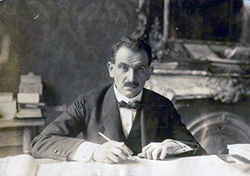
HAIFA, Israel — Otto Bauer was an Austrian politician, revolutionary, and publicist, a theorist of Austrian Marxism, and the general secretary of the Social Democratic Party of Austria.
Bauer was born on September 5, 1881, in Vienna to a family of Jewish immigrants from Bohemia who owned a factory. His father was a textile magnate. As was often the case, wealth repelled him from the rich and attracted him to the protection of the poor. He graduated from the public school and gymnasium in Vienna, and there, at the university, he studied law. The subjects of his study at the University of Vienna were economic and political laws. In 1906, he defended his doctoral dissertation in jurisprudence.
In 1907, the House of Representatives of the Reichsrat was elected for the first time in Austria-Hungary based on universal and equal suffrage for men over 24 years old. Emperor Franz Joseph I decided to expand voting rights, partly under the impression of the 1905-1907 revolution. The Social Democratic Party, first represented in parliament in 1897 with 14 mandates, received 87 seats and formed the second-largest parliamentary group. At the request of the party leader Victor Adler, Otto Bauer became the secretary of the club of Social Democratic members of the Reichsrat.
Bauer was one of the founders and theorists of the national program of the Austrian Social Democratic Party. In the book Die Nationalitätenfrage und die Socialdemocratie (The Nationality Question and Social Democracy, 1907). Bauer, advocating the principle of national autonomy for all national minorities in Austria, denied it to the Jews, believing that it was in the best interest of the Jews not to create a special public-law organization, which essentially had two tasks: managing a national school and providing legal assistance to those who do not speak or poorly speak the language of the courts and institutions.
He wrote: “The question of languages for Jews does not exist at all: living among other nations and being in close economic relations with them, they inevitably have to learn their language.” The demand for separate Jewish schools, in his opinion, “first and foremost contradicts the economic interests of Jewish workers.” Bauer believed that the Jewish school represented an artificial preservation of the old cultural entity, which restricted the freedom of movement and thereby increased the needs of the Jews; it meant the consolidation of their old ideology, their ancient social psychology, so that life, by turning them into fighters for class interests, should break and overcome all of this.
Left without the protection of special national autonomy, the Jews, he argued, would more quickly follow the path imposed by capitalist society, that is, they would be assimilated and denaturalized. However, in the last decade, a movement has begun within Judaism aimed at transforming Jews into an independent historical nation; Bauer attributed the cause of this mainly to the awakening of national consciousness among the lower classes of the Jewish people and posed the question of whether the Jews’ aspiration to rise to the “level of a historical nation” would prevail over the process of their merging with surrounding peoples, which is occurring for economic reasons.
Bauer believed that the imperatives of economic life are stronger than any sentimental wishes, and “from the moment Jews and Christians are parts of the same economic system, the commonality of territory creates such close relations between them that the preservation of Judaism as a nation within this commonality is impossible; the current rise of national sentiment among Jews in Russia may psychologically complicate the process of assimilation, […] but from a historical perspective, the awakening of Eastern Jews to a new cultural life is nothing more than a harbinger of their inevitable assimilation.”
Restrictive legislation hinders it, but the closer Russia gets to the states of Europe, the sooner the conditions ensuring the development of Jewish culture will disappear. The revival of the latter is possible only at the “transitional stage of the country’s socio-economic development.”
During World War I, Bauer was drafted into the army and sent to the Eastern Front. As a lieutenant, he participated in the battles in Galicia, and in November 1914, he was captured, spending three years in Russia before returning to Austria in September 1917.
After the death of Victor Adler in 1918, Bauer became the chairman of the Social Democratic Party of Austria. From November 21, 1918, to July 26, 1919, Bauer served as the Minister of Foreign Affairs in the coalition government of Social Democrats and the Christian Social Party. In 1921, Bauer became one of the organizers of the “Two-and-a-Half” or “Vienna” International. After its merger with the Second (Socialist) International in 1923, he was elected a member of the Executive Bureau of the Socialist International.
On February 12, 1934, anarchists and socialists launched an armed uprising in Linz, which was soon taken up by Vienna and other cities on the same day. Government forces aimed artillery at Vienna to intimidate the rebels. However, a firefight broke out, resulting in the deaths of at least 1,000 people and many more wounded. The uprising was suppressed. Bauer was among the leaders of the workers’ resistance against Chancellor Dollfuss’s government in Vienna. After the workers’ defeat, he fled to Czechoslovakia.
However, Austrian Nazis, supported from Berlin, began a widespread campaign of sabotage and terror, disabling power plants, administrative buildings, and railways, while assaulting and killing supporters of Dollfuss. Previously expelled Austrian Nazis flooded back into Austria from Munich. The conditions were set for a Nazi coup. On July 25, 1934, about 150 members of the SS Standarte 89, disguised in Austrian military uniforms, stormed the Federal Chancellery. During an attempted escape, Dollfuss was shot in the throat. The fatal shot was fired by the SS squad commander. The attackers refused to allow any medical aid and demanded that he hand over power to the Nazi appointee Anton Rintelen.
When the Chancellor categorically refused, the coup plotters left him bleeding out on a couch (he soon died from blood loss). However, the conspirators acted clumsily, and government forces, led by Justice Minister Dr. Kurt von Schuschnigg, managed to regain control. Although the Nazis failed to seize power at that time, their influence in Austria grew, culminating in the Anschluss in March 1938. Austrian Jews faced a deadly threat. In May 1938, Bauer moved to Paris. He died there on July 5, 1938. On that day, his appeal to the international community to save Austrian Jews was published in the United Kingdom.
*
Alex Gordon is professor emeritus of physics at the University of Haifa and at Oranim, the Academic College of Education, and the author of 11 books.