By Jacob Kamaras in La Jolla, California

When Laurie Bernhard thinks about her late brother Paul, she doesn’t begin with his illness. She focuses on who he was: kind, gentle, pragmatic, and effortlessly warm to everyone he met.
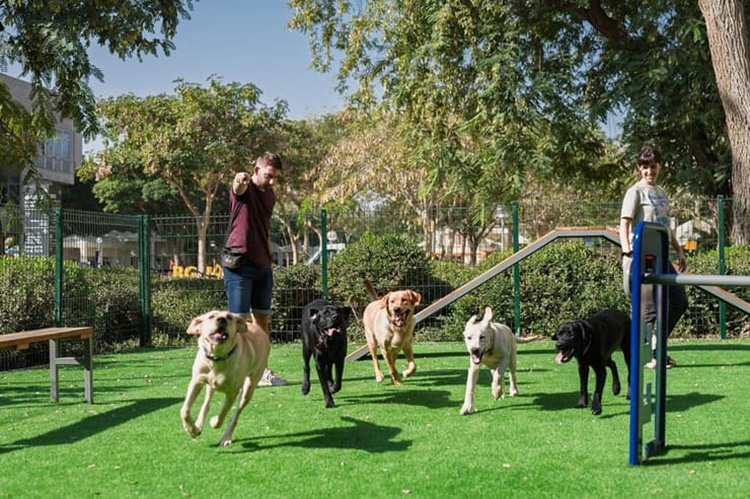
That spirit is now at the heart of a unique and deeply personal gift to Israel: a guide dog training park at Ben-Gurion University of the Negev (BGU), made possible through a donation from Paul’s siblings Laurie, who lives in Los Angeles, and John Bernhard, based in Seattle. The park was created in memory of Paul Stanford Bernhard (1955-2010) of Los Angeles, whose life, joy, and final days were profoundly shaped by the healing presence of dogs.
And while the park supports a growing national initiative in Israel, its roots are unmistakably family-centered: a tribute shaped by love, loss, and the determination to transform grief into healing.
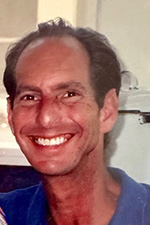
Paul was 54 years old when he died of lung cancer. As Laurie recalls, the emotional weight of his final chapter wasn’t only the illness itself.
“He was very sad when he realized his illness was terminal…that was the end of his lineage. He had no children,” she shares.
After Paul’s passing, their mother made a decision that would define the family’s next steps: She wanted to create a small family foundation that would support causes Paul cared about. He loved the outdoors: sailing, skiing, hiking, camping, gardening. And then there was the joy he found in dogs. Laurie remembers what happened when therapy dogs would visit Paul in the hospital as he fought his battle with cancer.
“We saw Paul’s face light up every time a dog approached his hospital door,” she says.
Those visits were transformative. Laurie describes watching the shift in Paul as something you could almost feel in the room. “They were palpable, the moments of joy and love and happiness and tenderness and connection.”
Ever the connector, Paul would engage not just with the dog but with the person who brought it, learning about their lives with the same genuine interest he offered everyone else.
It’s that image—Paul in a hospital bed, with his mood softened by a dog’s presence—that became the emotional blueprint for the gift Laurie and John would make to BGU.
The project actually began with John Bernhard’s connection to Israel. He lived in Israel twice as a young man—first in 1971 at Kibbutz Ma’ayan Baruch near the Lebanese border, and again in 1973, when he traveled there during the Yom Kippur War to help with the winter harvest in the Jordan Valley.
Those experiences, John says, were among the most significant of his life and helped shape his identity and commitment to Israel.
Over time, John became fascinated by the growth and development of Israel’s South, particularly the Negev—and by BGU’s role in that story.
“It seemed like a great hub of creativity,” he says, pointing to the University’s diverse demographics and technological advancements.
John first discovered BGU about a decade ago. And after the October 7th attacks, as Israel’s trauma deepened and needs multiplied, he began thinking about how their family’s foundation—built in Paul’s honor—could extend its impact to Israel.
Then, a clear idea arrived. Through Americans for Ben-Gurion University (A4BGU), he learned about an initiative BGU hoped to launch connected to dog therapy and guide dog training. John and Laurie agreed that it would be a fitting tribute to Paul’s legacy. They ultimately made their gift to the University not through the foundation, but personally as a brother and sister.
The guide dog training park at BGU is designed as a contained, purposeful space where dogs can be trained—supporting not only mobility needs, but also emotional healing and companionship.
In the aftermath of October 7th, Laurie says she understood the emotional power behind trauma therapy and canine support in a way that mattered more: what a dog can offer someone when the world has become frightening or unbearably sad.
“It helps people to see goodness and see joy and light in the darkest times,” she says.
That belief is grounded not only in memory, but in the Bernhards’ ongoing experience as dog lovers.
“We all grew up having dogs. We all have dogs,” Laurie says.
The family’s foundation has also supported pet therapy programs in Los Angeles, including one at a children’s hospital—where Laurie saw how therapy dogs don’t just change a patient’s day, but uplift everyone around them. She hopes that the same ripple effect will occur at BGU: beyond the individual handler-and-dog relationship, into the student community and wider campus culture.
One of the most surprising parts of the experience for Laurie was how quickly the park came to life.
“Unlike the way things move in the States, that dog park was built in a nanosecond,” she says, adding that BGU is “not just talking the talk, but they’re doing the work.”
At the entrance to the park, a plaque carries the message Laurie and John wanted the world to know: this was created in memory of their brother, not for publicity, but for purpose. The fact that Paul had no children, the family writes, was “a deep sadness in his life”—one that Laurie and John are determined to transform into something meaningful.
“We decided the Dog Training Park could be his legacy, one that would have a continuing positive impact into the future,” they write.
As a proud Jewish American family, they also felt that supporting this initiative at BGU tied them to Israel in a deeply personal way—while offering comfort to people who’ve endured profound trauma.
Supporting the training park, they write, “connects us to our homeland and hopefully provides healing and joy for people who have suffered unspeakable trauma.”
Laurie speaks about the project with humility—but also with certainty about its impact.
“This is a small initiative that makes a huge impact,” she says. “We’re not curing cancer here but we’re changing lives in a different way.”
*
Jacob Kamaras, executive director of J Cubed Communications, is a former publisher and editor of San Diego Jewish World.