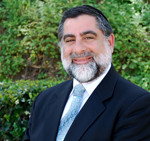
By Rabbi Avraham Bogopulsky in San Diego, California
My Tu B’shvat experience as a child growing up in Brooklyn, N.Y. consisted of a small plastic bag with some raisins and a rock-hard, tooth-breaking piece of bokser, the Yiddish word for dried carob. Part of the tradition of celebrating Tu B’Shevat, the New Year of the Trees, was singing the Tu B’Shvat song while trying to eat the bokser. Bokser is a long, brown, leathery, and often rock-hard seed pod that comes from the carob tree (Ceratonia siliqua). Today, these long, dark brown pods that resemble a twisted “ram’s horn” (from which the German word Bockshorn, or “buxer,” is derived) are most commonly known in Jewish tradition as a staple snack eaten on the holiday of Tu B’Shvat (the 15th of Shvat, the New Year for Trees according to Beis Hillel).
Fast forward fifty years, and our Tu B’Shvat experience is quite different. Here in Eretz Yisrael, not only are the major holidays celebrated throughout the country and across all lines, but even the minor festivals have been transformed into major events. Today, Tu B’Shevat Sedarim/meals are officially designated and highlighted events. It also took me this long to learn the actual lyrics and meaning of the famous Tu’B’Shvat song Hashkediyah Porachat, composed around 1908. Two phrases that really stand out for me are the first and last stanzas:
Hashkediyah porachat – the almond tree is blooming
Veshemesh paz zorachat, – and the golden sun is shining,
Tziporim merosh kol gag – birds atop each roof
Mevasrot et bo hachag – Announcing the arrival of the festival
Hashemesh zorachat – the sun is shining
Vecham me’od hayom – and it is very hot today
Ani mekavah mezeg ha’avir – I hope the weather
Sheyisha’er bahir – stays bright and clear
The sun is the primary focal point of the world. For those who remember, the blessing over the sun, Birkas HaChamah, is said once every twenty-eight years at the time of the completion of the sun’s twenty-eight-year cycle. The next time this bracha will be said is April 8th, 2037. On Shabbos morning, I was intrigued by a prayer we sing every Shabbos, Keil Adon – קל אדון – a well-known piyyut recited on Shabbos morning during the Krias Shema blessing. According to some sources, Keil Adon dates back to the second century, making it one of the oldest Jewish prayers in continuous use. Like many other liturgical poems, it is written without rhyme. Keil Adam is an alphabetical poem: the first line begins with the first letter of the Hebrew alphabet, א, the second line starts with the second letter, ב, and so on. The poem glorifies Hashem through His creations, especially the sun and the luminaries. This tefilla is said on Shabbos to somehow remind us of creation, which is what Shabbos comes to culminate at the end of the week, simulating the first week of creation. I asked myself why this piyyut focuses on what was created on the fourth day, yet does not even mention any of the other five days?” There is no mention of the land masses being formed or the creation of wildlife, only the luminaries and the sun.
The Pshat or simple answer to this musing is that this prayer falls in the midst of the blessing of light. The long bracha (a long blessing has a “Baruch ata Hashem” at the beginning and a “Baruch ata Hashem at the end) after Borchu is the blessing of the creation of the luminaries, so it is an obvious choice to place it within those brachos. I would like to explain it more deeply from a Drash/exposition and connect it to this week’s Torah reading.
In this week’s Parsha, the Torah states in Shmos 18:13 “ויהי ממחרת וישב משה לשפט את העם, ויעמד העם על משה מן הבקר עד הערב” “ – “And it came to pass in the morning, that Moses sat to judge the people: and the people stood by Moses from the morning unto the evening”. Moshe’s father-in-law, Yisro, then tells Moshe how crazy it is for him to judge by himself from morning to evening and suggests making a formal court system. We must point out that Moshe judged the people from morning to night as the law prescribes. We do not convene court cases at night. But perhaps there is a deeper meaning when the expression from morning to night is used. Rashi quotes Gemara Shabbos 10a: Is it possible to say so? From morning until evening. Rather, the explanation is that every judge who judges a case truthfully, even for one hour, is exalted by the scripture (Torah meaning Hashem) as if he had engaged in Torah all day. When one is engaged in the Torah all day long ‘From morning until evening’ it is as if he had become a partner with Kudsha Brich Hu HKB” H, in the first act of Maaseh Bereishis – the creation of the world, of which it is said, “And it was evening and morning”. The Iben Ezra explains the words “from morning to evening” that the morning is as true as the sun rising. Hashem testifies about His most trusted student, “Moshe Emes V’Torahso Emes”- Moshe is truth, and his Torah is all truth.
Moshe, standing all day from morning to night, judging through Hashem’s Torah, gave Moshe the ability to elevate his existence by becoming a partner with Hashem in creation. As the sun rises every day, it reminds each of us of our potential to become a partner with Hashem in the constant creation of the world, just as Moshe Rabbeinu. The warmth of the sun is truly found in the Torah that spreads light and is a fire within. Let us not wait until 2037, when the sun will return to its original position from where it began on the fourth day of the world. We can, if we focus with clarity and sincerity, bring it closer to that point by dedicating ourselves to some Torah study consistently as the sun rises every single day.
P.S. Combining the pshat and drash, the Anshei Knesses Hagedola (the men of the great assembly) who structured our davening came full circle with the second bracha Ahava Rabba, said before the Shema. Ahava Rabbah is highlighted by a form of blessings of the Torah and the manner in which the Torah is learned and transmitted. Hence, we see the connection between the light and the Torah, thereby deepening our appreciation of learning Torah while strengthening our partnership with Hashem in recreating the world every day.
*
Rabbi Avraham Bogopulsky is the emeritus spiritual leader of Beth Jacob Congregation and author of Developing a Torah Personality.