By Alex Gordon in Haifa, Israel
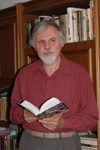
Claude Vigée, French poet and essayist, born Claude André Strauss, was born on January 3, 1921, in Bischwiller, Bas-Rhin, into a family of Ashkenazi Jews who had lived in Alsace for several centuries. In 1937, he enrolled at the University of Strasbourg. His studies were interrupted by the war, and his family moved to Toulouse. Once in Toulouse, Claude began studying medicine and, at the same time, became a member of the secret French Resistance organization Action juive (Jewish Action, 1940-1942). At that time, he began to wonder why Judaism aroused such intense hatred. He immersed himself in the history of Judaism and Jewish law. As a Jewish writer, he tries to embrace and perpetuate the identity conveyed by the Holy Scriptures in his writing, while relating it to his own life. In 1942, he published his first poems in the underground magazine Poésie 42.
Claude described himself as a “Jew and an Alsatian, thus doubly Alsatian and doubly Jewish”. He associated the wanderings of the Jewish people with the suffering of the inhabitants of Alsace, a land of discord between France and Germany. He keenly felt the tragic fate of the Jews and the Alsatians, partly because in his childhood he experienced the drama of misunderstanding in his relationship with his parents, his father, a fabric merchant, and his mother, a musician who was perpetually dissatisfied and prone to depression. But in Toulouse, he was shaken by a new drama, the threat of concentration camps, the threat of the destruction of the entire Jewish community. Forty-three of his relatives were to perish in the Shoah. Claude recalled: “In 1942, I finally realized that we were doomed and that we had to escape from this trap at any cost.” The poet goes on to analyze his situation at the time: “I was snatched from the blissful tranquility of childhood and thrown into the irreversible flow of history, my history: the history of a young French Jew swept up in a storm that destroyed almost all of European Jewry in less than five years.” In an atmosphere of intensified antisemitism and direct police persecution, he and his mother moved to the United States via Portugal in 1943. He worked as a waiter and took on any job he could find. He remembered his immigrant life in the United States as “a complete and utter failure.” In 1947, he defended his dissertation in literature at Ohio State University and got married. Claude taught literature at various universities in the United States. From his first collection, La Lutte avec l’ange (Wrestling with an angel, 1950) he imposes himself by the biblical language of his language. When he began publishing, he took a pseudonym (from the French Vie, j’ai — I am alive). Claude Vigée pursued a career as a professor of French literature in Ohio. At Brandeis University, he met the Jewish philosopher Herbert Marcuse, who was anti-American. In 1960, Vigée finally realized that he had no ties to the United States and moved to Jerusalem to teach literature at the Hebrew University until 1983.
“We didn’t know a word of Hebrew. We knew nothing about the East,” wrote Vigée. He dreamed of returning to Zion and believed in “the rebirth of the Jewish people, the rebirth of what had been destroyed by the legions of Titus and Hadrian.” Once in Jerusalem, at the age of forty, he began to study Hebrew, “the language of his fathers.” Despite the instability of his existence, the heat, and the wars, it was during his time teaching at the Hebrew University that his most famous books appeared: the poetry collection Sun from the Sea, Le Soleil sous la mer, which included poems from 1939–1972 (1972); the series of essays Artists of Insatiability, Les Artistes de la faim (1960) and Winter Moon, La Lune d’hiver (1970). In Israel, Vigée writes poetry and reflects on the fate of the Jewish poet: “To live in Jerusalem is to include an element of constant anxiety in one’s life, but how can one not also see the bubbling desire to live, the innate joy that enlivens this city! Of course, after almost three years of intifada, with no end in sight, these words do not seem so optimistic, but poetic creativity forces one to live life through death. Despite it. In spite of it.” Vigée doubted that all Palestinians “really agree” with the very fact of Israel’s existence. He dreamed that each side would finally stop “cursing the other’s existence.”
The tragedy of this new bloody conflict haunted the poet even in the homeland of the Jewish people. And he concluded that the fates of poets and Jews were similar: “I will not talk about how independent Jewish poetry is, but the Jewish fate itself is poetry. Being a Jew and being a poet are essentially the same thing. A poet always vacillates between two extremes: the celebration of the world and the horror of the world. It is in the internal fusion of these two poles that life lies. In this respect, every poet (if he is truly a poet!) carries within himself something of the Jewish fate.” A Jewish poet is doubly Jewish. This conclusion coincides with the idea of the Russian poet Marina Tsvetaeva in Poem of the End (1924):
Beyond it! Understand? Outside!
That means we’ve passed the walls.
Life is a place where it’s forbidden to live.
Like the Hebrew quarter.
Ghetto of the chosen.
Beyond this ditch.
No mercy.
In this most Christian of worlds, all poets are Jews.
World War II made it clear that behind the “wall” there was a “ditch” and a “Jewish quarter,” but not a place where Jews lived, but ditches filled with executed Jews. The chosen people were chosen for destruction on the sole basis of their blood. The Jews no longer lived, for their “ghetto of chosen ones” was death, chosen for them by others, the local, all-powerful masters of life.
Among Vigée’s last books was the memoir Dans le panier de houblon (In the Hop Basket, 1995). These were the memoirs of an eternal vagabond who wandered between Alsace, France, the United States, and Israel. In 2001, Vigée returned to France. In January 2007, his wife, Evelyn, passed away and was laid to rest in the Jewish cemetery in Bischwiller. He died in Paris on October 2, 2020, at the age of 99.
*
Alex Gordon is professor emeritus of physics at the University of Haifa and at Oranim, the Academic College of Education, and the author of 12 books