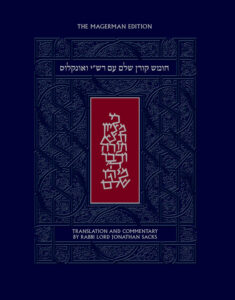
 Koren Shalem Humash with Rashi and Onkelos: Translation and Commentary by Rabbi Lord Jonathan Sacks; Koren Publishers; (c) 2025; ISBN 9789657-765173; 1736 pages; $41.89
By Rabbi Dr. Michael Leo Samuel in Chula Vista, California
For generations, Rabbi Dr. Joseph H. Hertz’s Pentateuch and Haftorahs, first published in 1936 and spanning about 1,067 pages, served as the unifying English Torah edition in Anglo-Jewish and American synagogues across denominations. This is a Chumash I have only grown to love more as I get older. I admire Hertz’s willingness to engage directly with modern issues relevant to biblical criticism and classical English Bible commentaries, drawing from both Jewish and non-Jewish literary sources to defend and illuminate tradition in an era of intellectual challenge.
Over the last several decades, Koren Publishers has captured much of the readership that once gravitated toward more traditional options like ArtScroll’s Stone Edition Chumash. ArtScroll has done a magnificent job introducing seminal thoughts from Rashi, Ibn Ezra, Rashbam, Ramban, and others, while its homiletical insights from modern teachers in the Musar and Hasidic traditions lend the work an existential quality essential for today’s readers.
The new 2025 Koren Shalem Humash stands as a major achievement in this landscape—a substantial 1,736-page volume completed posthumously after Rabbi Lord Jonathan Sacks’ death in 2020. This edition presents Sacks’ own modern English translation of the Torah, a compiled commentary drawn primarily from his Covenant & Conversation series, along with books, lectures, and other writings—with the sections for Shemot through Bo newly adapted for this project. It also includes full vocalized and punctuated Hebrew Rashi in a custom critical edition based on manuscripts (using a newly digitized Rashi script designed for clarity, vocalized and punctuated), the complete Targum Onkelos with Yemenite vocalization and gray highlighting for non-literal renderings, and haftarot according to Ashkenazi, Sephardi, and Yemenite customs, each with brief English notes by Rabbi David Nativ.
This review focuses squarely on the Koren Shalem Humash, assessing it on its own merits while noting how it positions itself relative to predecessors like Hertz and contemporaries such as the Koren Steinsaltz Humash (its peshat-focused sibling from the same publisher) and ArtScroll’s Stone Edition.
The Shalem Humash excels in production quality and user experience. It features exceptional elegance with large, crisp fonts—the Hebrew Torah text on the left page and the English translation on the right across full spreads for effortless side-by-side reading. Rashi and Onkelos appear in clear, dedicated sections below the Torah text, with thoughtful innovations: Rashi draws from a critical edition that removes later corruptions, presented in a unique, legible typeface rooted in Eliyahu Koren’s legacy, while Onkelos follows the Yemenite tradition of public reading. Though the paper is thinner than some competitors, the binding is sturdy, the print size generous, and the overall aesthetic dignified, making it particularly inviting for weekly synagogue use. The multi-custom haftarot add genuine practical utility that many older editions lack.
In translation, Sacks favors dynamic equivalence that illuminates emotional nuance, literary beauty, and poetic flow, producing what reviewers have described as “poetry in prose.” The rendering feels fresh, modern, and highly readable—for instance, the Akedah or the rivers of Eden gain graceful expression while staying faithful to the plain sense. This contrasts with the more formal, occasionally archaic tone of Hertz (with its King James echoes) or the transparent, plain-meaning focus of Steinsaltz.
The commentary is where the Shalem Humash truly distinguishes itself. Sacks’ approach is thematic, homiletic, and philosophical, relentlessly oriented toward “how to live.” It centers on covenant as relationship, ethical leadership, human dignity, and tikkun olam, warmly integrating insights from secular disciplines such as psychology, economics, literature, and environmental science. He employs literary analysis—chiastic structures, character arcs, word repetitions—and sustains a unified, eloquent, optimistic, and morally urgent voice across the compiled material. While he largely sidesteps biblical criticism and historical debates in favor of ethical and existential application, the result is profoundly inspirational and relevant to contemporary life.
The treatment of Rashi and Onkelos, however, defines a central tension. These full Hebrew texts occupy roughly forty percent of the volume—some seven hundred pages—providing rich resources for advanced or traditionally oriented readers. Yet they remain largely inaccessible to those without Hebrew or Aramaic proficiency, contributing to noticeable bulk in an already hefty book. By comparison, the Koren Steinsaltz Humash includes readable Rashi as a complement and references Onkelos selectively in notes, avoiding full separate blocks to keep the emphasis on its own peshat commentary and resulting in less proportional bloat for English-primary users. ArtScroll integrates full Rashi and Onkelos within its anthologized framework more efficiently, without dominating the page count to the same degree.
The Shalem Humash delivers a beautiful and inspirational experience, ideal for synagogue pews, family study, or readers drawn to Sacks’ moral and philosophical depth. It surpasses Hertz in design, translation freshness, and contemporary relevance while offering synagogue practicality that challenges long-standing favorites.
Yet it falls short of becoming an unqualified new standard. The extensive inclusion of full Rashi and Onkelos introduces bulk that could have been used to expand more of Sacks’ unique voice—plenty of material exists in his archives—potentially making the volume more accessible and focused for the average English reader. One suspects the post-2020 publication timeline played a role in the decision to include these traditional elements comprehensively.
For Modern Orthodox communities, it represents a meaningful advancement, echoing the modernity-embracing spirit Hertz pioneered. The Koren Shalem Humash advances the field significantly as a magnificent tribute to Rabbi Sacks, bringing the Torah alive as an urgent ethical guide for the twenty-first century. Whether it displaces older standards in synagogues will depend on what readers value most: poetic inspiration and moral urgency or streamlined accessibility without the added layers of classical Hebrew commentary.
I would recommend that in the next decade Koren consider revising the Sacks’ commentary and give the readers more value for their dollars, with an expanded edition.
*
Rabbi Dr. Michael Leo Samuel is the spiritual leader of Temple Beth Shalom in Chula Vista, California.