By Alex Gordon in Haifa, Israel
In 1939, German scientists Otto Hahn (later a Nobel laureate in Chemistry) and Fritz Strassmann discovered the effect of uranium-235 nuclear fission, which paved the way for the creation of nuclear weapons.
This was clear to the physicists who arrived in the US from Europe: the German nuclear program was led by a distinguished German physicist, a Nobel laureate in Physics, Werner Heisenberg. Only the Pentagon didn’t understand this. Then Leo Szilard, Edward Teller, and Eugene Wigner, a Nobel Prize winner in physics, – all Jewish and natives of Budapest – drafted a letter signed by Einstein to President Roosevelt. Soon, the president established the Uranium Committee, which marked the beginning of the Manhattan Project in Los Alamos.
One of the creators of quantum mechanics, Nobel Prize winner in Physics Max Born, a German Jew, wrote: “The exiled physicists knew there would be no salvation if the Germans were the first to create an atomic bomb. Even Einstein, who was a pacifist his entire life, shared this fear and was persuaded by several young Hungarian physicists who asked him to warn President Roosevelt.”
Laura Fermi, the Jewish wife of one of the main scientific advisors to the American nuclear project, Nobel Prize in Physics laureate Enrico Fermi, noted in her book Atoms in the Family (1955) that it was Jewish immigrants from Europe, not native-born Americans, who initiated it: “That’s why the first warning to President Roosevelt came from people like Einstein, Szilard, Wigner, and Teller, while physicists born and raised in America continued to sit in their ‘ivory tower’.” These foreigners knew what a military state was and what it meant to concentrate power in one hand, while Americans lived only by their own ideas of democracy and free initiative.”
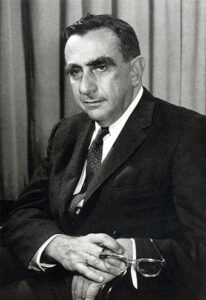
Edward Teller was born on January 15, 1908, in Budapest. He was the son of lawyer Max Teller and his wife, pianist Ilona. The Tellers fasted on Yom Kippur, and the head of the family prayed on the Sabbath and Jewish holidays. Edward displayed extraordinary mathematical and musical abilities. Playing the piano remained a hobby for Teller. Much later, he would sit at the Steinway piano in Los Alamos at night and play Mozart and Beethoven.
In 1919, the Hungarian Soviet Republic was proclaimed in Hungary, led by the Jew Béla Kun. Teller’s family, who lived in the very center of Budapest, was forced to share their apartment with two soldiers who were urinating in a flower pot. The Red Terror permanently transformed an already “socially alienated” teenager into a convinced anti-communist. The communist regime of the Hungarian Soviet Republic carried out a “Red Terror” modeled after Soviet Russia. Of the 49 people’s commissars in the new government, 31 were Jewish, and of the 202 high-ranking officials, 161 were Jewish.
After the defeat of the Hungarian Soviet Republic, the country plunged into the abyss of “White Terror,” which proved to be no less bloody and took on an antisemitic character. The Hungarian Soviet Republic lasted for 133 days. The population perceived the Soviet government in the country as Jewish rule. The uprising against the communists was fierce and bloody and had an antisemitic character. Although Jews were victims of revolutionary repression, many thousands of innocent people suffered from the White Terror and pogroms.
Pogroms in Hungary, which began after the defeat of the revolution, continued until 1921: Hungarians took revenge on ordinary Jews, who had nothing to do with the revolutionary events, for the actions of the communist government.
The numerus clausus, which restricted the admission of Jews to Hungarian universities, forced Edward to leave for Germany in 1926. In 1928, he received a bachelor’s degree in chemical engineering, but he became fascinated with quantum physics. In Leipzig, under the supervision of Heisenberg, Teller defended his dissertation, becoming a doctor of theoretical physics at the age of twenty-two. After the Nazis came to power, he left Germany and became a professor at George Washington University in 1935.
In 1941, Teller worked closely with Enrico Fermi, who infected him with the idea of a hydrogen bomb, whose energy would be tens of thousands of times greater than a conventional nuclear explosion. Teller became obsessed with the idea of creating a hydrogen bomb, but the head of the American nuclear project, Robert Oppenheimer, believed that chasing two hares was an unaffordable luxury, so he focused all his efforts on developing nuclear weapons. By mid-1945, work on the bomb was completed, but the war with Germany had also ended, which, according to many of Teller’s colleagues, made nuclear weapons unnecessary and dangerous.
Leo Szilard, who actively lobbied for the nuclear program six years ago, initiated a petition signed by 30 Manhattan Project participants to the US President, calling for the new weapon not to be used against Japan and for nuclear energy to be placed under international control. Edward did not sign the document: “I don’t see any chance of outlawing any kind of weapon. The fact that we worked on this terrible thing doesn’t give us a say in how it should be used.”
After the use of two atomic bombs against Japan, many participants in the Manhattan Project in Los Alamos began to leave for their universities by the fall of 1945. They had done away with nuclear weapons, but Teller, who was in the minority, dreamed of a hydrogen bomb. On August 27, 1949, the first Soviet nuclear bomb was tested at a test site near Semipalatinsk. The Soviet nuclear project was led by a Jew, Yuliy Khariton. This event confirmed Teller’s point of view. On January 31, 1950, with President Truman’s permission, Teller was given carte blanche to develop the hydrogen bomb. It was detonated on one of the Marshall Islands on November 1, 1952 – the mushroom cloud rose to a height of 37 kilometers, and the diameter of the “cap” exceeded 160 kilometers. Where there was once an island, a crater almost two kilometers in diameter and 50 meters deep has formed.
That same year, at Teller’s initiative, the Lawrence Livermore National Laboratory opened – the leading center for nuclear weapons development in the United States.
In 1964-1967, Teller visited Israel six times, giving lectures on theoretical physics at Tel Aviv University. For many years, he also served as a consultant to the Israeli government on nuclear safety issues, convincing the Israelis never to sign the Treaty on the Non-Proliferation of Nuclear Weapons. He also managed to convince the American government not to inspect the Dimona Nuclear Research Center, even though the scientist confirmed that Israel possesses nuclear capabilities.
Teller is credited with the idea of establishing industrial parks at Israeli universities for the practical implementation of scientific discoveries and with initiating the development of reconnaissance drones in Israel. He promoted the Polaris ballistic missile system for submarines, convinced President Reagan to allocate significant funds to the Star Wars project, and developed the Excalibur space laser gun, which is still being improved today.
Teller experienced antisemitism of various kinds, from Hungarian to German. In an interview given to the Northern California Jewish News on January 22, 1988, Teller said, “More than anything else, antisemitism made me realize the fact that I am Jewish.” Well-acquainted with Nazism and Communism, Teller became an anti-Nazi and anti-Communist. He believed that the only way to combat totalitarian regimes was to use nuclear and other offensive weapons against them.
He believed that such regimes oppose the State of Israel and seek to destroy it. Therefore, he believed that there was no chance for peace with the Palestinian Arabs and that the only language of communication with them was war, which is a struggle for survival. For liberals in the US and Israel, Teller was a reviled figure, a militarist and a “warmonger.”
In his memoirs, A Twentieth-Century Journey in Science and Politics (2001), Teller wrote, “Peace cannot be achieved by wishing alone. We live in the same world as Russia, whose leader has stated that he “wants to bury us” – and he means it. Disarmament and the cessation of testing will not automatically lead us to peace.”
Teller became an honorary doctor of 23 universities, a recipient of the Einstein Award, the U.S. National Medal of Science, and the Presidential Medal of Freedom. Since 1999, the Teller Medal has been awarded for achievements in the field of nuclear fusion. Teller suffered a stroke and died in Stanford, California, on September 9, 2003. He wrote, “I am sure that the 21st century will be the century of Jewish intellect.”
Speaking once before the Subcommittee on Disarmament of the US Senate Foreign Relations Committee, Teller described his position as follows: “I have chosen the profession of scientist and I love science; I would not willingly engage in anything other than pure science… I do not like weapons. I prefer peace. But for peace, we need weapons… I am confident that I am contributing to the cause of universal peace.”
Did Edward Teller make the world a safer place?
*
Alex Gordon is professor emeritus of physics at the University of Haifa and at Oranim, the Academic College of Education, and the author of 12 books.