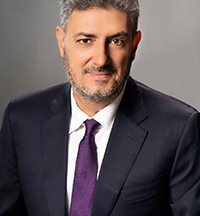
Israel’s Consul General in Los Angeles, Israel Bachar, frames the current Mideast War in broad terms. In his view, the current fighting is not only about neutralizing threats in the present, but about reshaping the future architecture of the Middle East.
In an interview by Zoom, Bachar predicted that the current intensive military phase would conclude within weeks, paving the way for a broader geopolitical realignment centered on the United States. In his view, Iran has long been the ‘dangerous tiger’ in the region, and many states now see Israel as the one country willing to confront it directly. From that, he expects more Arab states to move gradually toward full diplomatic relations with Israel.
That, he suggested, could strengthen what he called a “moderate axis”: a bloc of countries more interested in stability, economic development, and normalization than in the ideological “axis of resistance.” He specifically suggested that Saudi Arabia and other Gulf States could eventually move toward a peace process with Israel due to shared economic and geopolitical interests. When asked about potential blowback from Gulf populations amid the regional chaos, Bachar argued that many in the Gulf understand that Iran, not Israel, has been the region’s primary aggressor.
He pointed to the India-Middle East-Europe Economic Corridor (IMEC) as a strategic megaproject that will likely accelerate once the fog of war clears. IMEC is a U.S.-backed trade and connectivity initiative linking India, the Middle East, and Europe through shipping, rail, and infrastructure corridors. For Bachar, the logic is simple: once the immediate violence recedes and a more secure region emerges, countries in the region will pursue greater security coordination, stronger business ties, and deeper technological cooperation with Israel and the United States.
Ultimately, Bachar predicts the region will recognize Israel not just as a military superpower capable of confronting radicalism, but as an indispensable partner for a stable, prosperous future.
Bachar’s confidence may prove too sweeping for some readers, especially when intelligence assessments and regional politics contest his outlook. But his argument was consistent throughout our interview: this war was brought on to neutralize immediate threats but has the potential to shape a more beneficial future within the Middle East.
That outlook is tied closely to Bachar himself. Consul General Israel Bachar did not arrive at diplomacy by the usual route. Born in Beit She’an and a veteran of the Israel Defense Forces’ Golani Brigade, he built a formidable career as one of Israel’s most sought-after political strategists before becoming Israel’s senior diplomatic representative to the Pacific Southwest region of the United States, a role that has placed him at the center of explaining Israel’s case abroad during one of the region’s most volatile periods in years.
In that context, Bachar spoke bluntly about the war with Iran, the northern front in Lebanon, rising antisemitism abroad, and the regional order he believes may emerge when the fighting ends. For San Diego readers, the stakes are not abstract. Bachar spoke not only about Iran and the wider region, but also about this community’s longstanding ties to Israel through the Jewish Federation of San Diego and Sha’ar HaNegev.
At the center of current global geopolitical friction is the joint military operation against Iran. While critics have questioned the timing and necessity of the strikes, Bachar is unequivocal: the impetus was rooted entirely in immediate national security and military reality.
According to Bachar, Iranian forces had moved into deeply fortified, 200-meter underground bunkers to finalize uranium enrichment, putting the regime weeks, not months or years, away from possessing a functional nuclear weapon. Compounding this was Iran’s aggressive expansion of its intercontinental ballistic missile (ICBM) capabilities.
According to Bachar, Iran was working on an intercontinental ballistic missile range that could reach New York and Boston, noting that intelligence projected an Iranian stockpile of over 8,000 ballistic missiles by 2027.
“Israel cannot stand a mass attack of ballistic missiles. We are small in our geography; that would have neutralized the State of Israel.”
This stark assessment directly counters recent turbulence in Washington. On Tuesday, Joe Kent, the Director of the National Counterterrorism Center under DNI Tulsi Gabbard, resigned in protest, stating his belief that Iran posed no imminent threat and citing pressure from Israel as the reason the United States initiated this war. His resignation underscored how contested the Trump administration’s justifications for the war have become.
Bachar likened the military intervention to treating Stage 4 cancer: while the treatment is aggressive and the future uncertain, the immediate priority is to neutralize the fatal threat today. “We took their capabilities. They were working on this nuclear program for 30 years. We neutralized it,” he said.
On an operational level, Bachar highlighted the deep integration between the U.S. and Israeli militaries, noting daily coordination between the head of CENTCOM and the Israeli chief of staff. He said Defense Secretary Pete Hegseth had described Israel as a ‘model ally’ or a country capable of defending itself while advancing shared security interests.
Bachar acknowledged the global supply chain disruptions, such as volatile oil prices brought about by Iran’s blockade of the Strait of Hormuz. However, the consul general stressed that these are short-term consequences. Iran, he argued, cannot keep the Strait of Hormuz closed indefinitely. Permitting Tehran to threaten the global economy under a future nuclear umbrella would be far more dangerous. The shock to shipping and oil markets has already been more serious than a routine blip, and the consequences may outlast the most intense phase of fighting. But Bachar’s broader point was clear: he sees short-term disruption as preferable to a future in which Iran could use deterrence to extort the world economy with “nuclear immunity.”
Regarding Israel’s northern front, Bachar defended the necessity of Israeli boots on the ground in southern Lebanon. Since 1982, Hezbollah has operated as an Iranian proxy, deeply embedding its forces, bunkers, and ammunition within civilian villages.
He mentioned that Hezbollah’s attacks, which started two weeks ago, also serve a strategic purpose for Iran by trying to divert Israeli military attention away from Iran itself. Bachar says that because the threat cannot be neutralized exclusively from the air, ground operations were the only way to stop the bombardment of northern Israeli communities.
Israel is fighting many wars at the moment, but it is only outright losing one of them: the war for public opinion. Israel has lost much ground across all demographic groups, but especially with younger generations. He said plainly that America is changing sociologically, especially for Generation Z, consisting of people born between 1997 and 2012.
Israel faces a different information environment than it did with older generations, he said. In his words, there is no “silver bullet” that will solve the problem, no one social-media campaign, no single celebrity voice, and no quick communications fix.
Instead, slower and more direct work should be emphasized: outreach events, partnerships with universities, Jewish organizations, and ROTC chapters; ongoing pressure against campus antisemitism; and, most of all, educational delegations to Israel of university presidents, pastors, Hispanic leaders from states like Arizona, and cultural influencers.
Bachar said those delegations are the most effective tool he has seen. When delegates who have never been to Israel experience the country firsthand, he said, the trip can be transformative. According to Bachar, seeing Jerusalem, witnessing the geographical vulnerabilities of the Golan Heights and the Lebanon border, alongside the physical realities of the October 7 attacks, provides an experience that changes how many visitors understand Israel’s geographic vulnerability and daily reality. He conceded that the Israeli government has historically underinvested in these narrative operations, a misstep the Foreign Ministry is now correcting by allocating robust budgets for American outreach.
When asked what Israel can do to help calm the global rise in antisemitism while still prosecuting the war, Bachar resisted the premise that the burden falls mainly on the Israeli state. Israel can do outreach, he said. It can build bridges. It can support programs and relationships. But it does not control what Americans learn in schools, on campuses, or on social media. If antisemitism is to be fought seriously, he argued, it requires education, coalition-building, and civic effort inside the countries where it is spreading.
He also made a broader historical point, saying societies immersed in antisemitism eventually corrode themselves. Hate, in his telling, is not only morally destructive but socially corrosive. At the same time, he insisted that extremist voices are louder than they are representative. He pointed to polling, saying most Americans oppose antisemitism even if the most radical factions dominate attention.
When asked about the mood on the ground in Israel, Bachar described a public that understands the Iranian threat in deeply existential terms. Israelis have heard about Iran’s ambitions for decades, he said, and many are willing to endure economic pain, school closures, repeated sirens, and bomb shelter runs because they see the current hardship as the cost of future survival. Though people are running to shelters sometimes several times a day, schools have been shuttered for now, salaries and businesses have been disrupted, the public understands the trade-offs for a safer tomorrow.
Whether one agrees with his strategic assessment or not, the picture he painted was of a society under strain yet still operating with a high degree of grim cohesion.
One of the more striking parts of the conversation was Bachar’s optimism about the postwar economy.
He predicted that the “winds of war” would rapidly give way to “winds of economy.” For innovators looking to bridge the U.S. Pacific Southwest and Israel, transnational cooperation remains highly viable. Bachar argued that investor confidence in Israel remained strong, particularly in biotech, security tech, mobile tech, and deep tech. He said he was regularly hearing in Los Angeles about new funds seeking to invest in Israeli innovation, and he described this as a vote of confidence in Israel’s ability to continue delivering value under pressure.
The numbers support some of that optimism. Reuters reported last December that Israeli high-tech companies raised $15.6 billion in private funding in 2025, up from $12.2 billion the year before, even as war conditions continued.
Bachar said the consulate-general helps build those ties through business delegations in both directions, bringing Israeli firms to Southern California and helping American partners connect to Israeli innovation. He also pointed to the Merage Institute in Orange County as a successful partner in those efforts. The Institute’s mission is to promote trade and economic growth between Israel and the United States through leadership and market-access programs.
Locally, Bachar had high praise for San Diego’s unique role in the region. San Diego boasts profound people-to-people ties with Israel, most notably through the Jewish Federation of San Diego and its sister-city relationship with Sha’ar HaNegev.
Bachar explicitly commended Heidi Gantwerk, President and CEO of the Jewish Federation of San Diego, for her enduring leadership. He recounted witnessing firsthand how the Federation brought over and supported a family from Sha’ar HaNegev who lost a daughter on October 7, 2023, helping to rebuild their lives. “It’s not only about sending money. It’s about having a real connection with people to people,” he said.
*
Shor M. Masori is back in San Diego from successful master’s degree studies at Tel Aviv University and at the Johns Hopkins University campus in Bologna, Italy, respectively in conflict resolution and international relations. While job hunting, he helps his grandfather, editor Donald H. Harrison, report on Jewish news.