Otherwise Known as Judy the Great: A Poetic Ode to Judy Blume by Selina Alko; New York: Christy Ottaviano Books, an imprint of Little, Brown and Company; © 2026; ISBN 9780316-570633; 42 pages; $18.99.
By Donald H. Harrison in San Diego
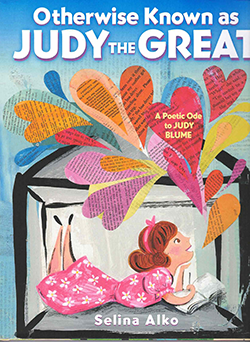
 Children’s author Judy Blume (née Sussman) was born in 1938 and through her 7th birthday listened to the radio and worried about World War II and the fate of her fellow Jews. When she was 13 through 14, three airplanes crashed in her hometown of Elizabeth, New Jersey. Her father, a dentist, identified bodies through comparisons with the victim’s dental charts.
Author Selina Alko, who grew up in Vancouver, Canada reading Blume’s remarkable output of juvenile fiction, believes these newsworthy incidents – plus the normal personal traumas of childhood, puberty, schooling, and family drama – fermented in her idol’s brain until 1969 when at the age of 31 Blume published her first children’s book, The One in the Middle is the Green Kangaroo.
The following year, 1970, she published Iggie’s House and the controversial book that distinguished her as a writer to be taken seriously, Are You There God? It’s Me, Margaret. That one dealt, in part, with menstruation and other body changes as Margaret advanced through puberty.
Some North American parents demanded that the book be banned from school libraries, while other parents stoutly defended the value of Blume’s straightforward approach, saying that the questions Margaret was asking in the book were the same questions juvenile readers were asking in real life.
Later Blume books incorporated such taboo subjects as masturbation and premarital sex, making Blume one of the best read and most banned authors in America and her native Canada. Nevertheless, in a career that up to now has spanned six decades Blume’s books have sold approximately 90 million copies and have been translated into nearly three dozen languages.
Alko, mainly covering Blume’s childhood, hints at her preteen desire to menstruate and become a woman. Alko’s approach, in the persona of Blume, is cute, rather than explicit. The poem “End of Sentence” reads “Are you there God?/ It’s me, Judy/ I can’t wait to be more grown-up./ I am so excited!/ I can hardly hide it./ If not this afternoon,/ God, please let it happen soon./ PERIOD./ End of sentence.”
Owing to Alko’s reticence, Otherwise Known as Judy the Great will not be listed in the top rank of the Blume canon. But it might encourage girls pondering the changes in their bodies to go to those libraries where Blume’s books are not banned and see what still holds true after all these many decades.
*
Donald H. Harrison is publisher and editor of San Diego Jewish World.