Semyon Shubin is undoubtedly one of the most outstanding Soviet theoretical physicists.– Igor Tamm, Nobel Prize laureate in Physics.
By Alex Gordon in Haifa, Israel
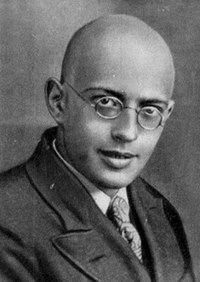
In 1936, the Soviet composer of Jewish descent, Isaak Dunayevsky, wrote “Song of the Motherland,” which became extraordinarily popular in the USSR. It was cheerful and optimistic and did not match the mass repression in the country. In this song, there is a line: “Young people are welcome everywhere.” Let’s take a look at the path that the Soviet Union provided to one of the youngest and most talented physicists in the history of the USSR, the Jew Semen Vilensky (Shubin).
Semyon Shubin was born on July 31, 1908, in the city of Libava, now called Liepāja in Latvia, which was then part of the Russian Empire. He was born into a family of a professional revolutionary, a member of the Russian Social Democratic Labor Party (The Menshevik Faction), and journalist Pyotr Vilensky, who wrote under the pseudonym Shubin.
On the recommendation of the known Bolshevik Nikolai Bukharin, the editor-in-chief of the newspaper “Pravda,” Pyotr Shubin became the editor of this newspaper (1926) and was later appointed as the political assistant to the General Secretary of the Executive Committee of the Communist International, the Bulgarian communist Georgi Dimitrov. Like many revolutionaries, he was subjected to repression for “espionage-terrorist activities.”
On June 15, 1937, he was dismissed from the Communist International apparatus and shot on December 25 of the same year. His wife Khana (Anna), née Tsitron, was arrested in Moscow as a “family member of a traitor to the motherland” and on January 4, 1938, was sentenced by the Special Council of the USSR NKVD to five years in “corrective labor camps.”
At the age of fifteen (1923), Semyon enrolled in the Faculty of Physics and Mathematics at Kharkov University and transferred to Moscow University in the same year. Semyon graduated from the university with honors in four years, in 1927, at the age of nineteen. He studied under the future Nobel Prize laureate Igor Tamm and, as his student, engaged in scientific activities under his guidance. On the recommendation of his teacher, Shubin was admitted to the graduate program at Moscow University, but he did not complete it.
On November 7, 1927, on the tenth anniversary of the Bolshevik Revolution, he participated in an opposition demonstration with Trotskyist slogans. Probably, this was the first and last protest demonstration under the Stalin regime. After that, Shubin was expelled from the Komsomol (Communist Youth League), and in November 1928, he was arrested and exiled to a small town in Siberia as a participant in the Trotskyist opposition, where he worked on translating scientific literature (1928–1929).
In 1929, he was sent to the construction of the Magnitogorsk Metallurgical Combine, where he initially worked as a concrete worker and later as an employe of the factory newspaper. He continued his scientific work and, together with Tamm, developed the quantum theory of the photoelectric effect in metals in 1931 and the band theory of liquid metals in 1933. With Tamm, he published six scientific articles.
In 1932, the Ural Branch of the Leningrad Physico-Technical Institute (later the Institute of Metal Physics) was established in Sverdlovsk. Shubin became the head of the Department of Theoretical Physics at this institute and the head of the Department of Physics at the Ural Physical and Mechanical Institute (later the Faculty of the Ural Polytechnic Institute). On Tamm’s recommendation, twenty-six-year-old Semyon Shubin (1934) was awarded the degree of Doctor of Physical and Mathematical Sciences without defending a dissertation.
Here is what Tamm wrote about him: “In Semen Shubin, we are dealing with an outstanding scientist, and there are all grounds for awarding him the degree of Doctor of Physics based on his body of work, without a dissertation defense.” November 21, 1934.” He worked in Sverdlovsk until 1937. In 1936, he taught as a professor at Ural University.
On April 24, 1937, Shubin was arrested. Three days later, the director of the Ural Physical Technical Institute signed an order for his dismissal: “Remove Semen Shubin, head of the theoretical group, from his position as an active participant in a harmful, counter-revolutionary Trotskyist gang, as an enemy of the people.” Most of the victims of Stalin’s terror could not withstand the investigators’ torture and agreed to all the accusations. Along the way, they implicated colleagues, friends, and relatives in espionage. Shubin confessed to nothing and betrayed no one.
On April 9, 1938, he was convicted by the Special Board of the NKVD of the USSR for “counter-revolutionary Trotskyist activities” and sentenced to eight years of imprisonment. He spent the first year of his imprisonment in jail. According to the recollections of his student and colleague, Academician Sergey Vonsovsky, “From people who were in the same cell as Semyon Petrovich and later appeared in freedom, we learned how bravely he behaved in captivity. By his very behavior, he sought to instill courage and calmness in the souls of his fellow sufferers. He gave popular lectures on physics and read poetry. […] Even in prison, when people in the cell could only take turns resting on the bare floor, he was engaged in science.”
Semyon Shubin died on November 20, 1938, in a “corrective labor camp” from hard labor and cold. He was thirty years old. Shubin left behind a wife and three children. In his short life, he managed to publish 180 articles on the theory of oscillations, solid-state physics, and quantum electrodynamics. Semyon Shubin and his parents were fully rehabilitated in 1956 “for lack of evidence of a crime.” The regime committed crime, destroying a young and talented scientist to whom it promised “young people are welcome everywhere” and to whom it opened the road to hell.
*
Alex Gordon is professor emeritus of physics at the University of Haifa and at Oranim, the Academic College of Education. He is the author of 12 books.