By Barrett Holman Leak in San Diego
A few words are practically imprinted in our Jewish DNA. It’s the very first prayer most of us learned from our parents or grandparents when they tucked us into bed, and it’s the one we still know by heart without even looking at the page: the Shema.
Shema Yisrael, Adonai Eloheinu, Adonai Echad.
“Hear, O Israel: The Lord is our God, the Lord is One.”
We say it so often that it can just become a reflex. But if we slow it down and really look at it, it’s not just a prayer. It’s actually a beautiful, urgent guide for exactly how we navigate the world right now.
We usually translate the first word, Shema as “Hear.” We are being told to listen deeply. It means to pay attention, to really understand, and to take someone’s words to heart.
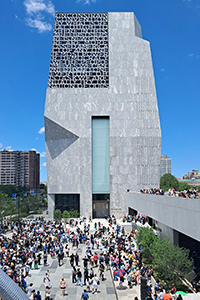
Just this month, the country celebrated the grand opening of the Obama Presidential Center in Chicago. It was a beautiful homecoming. The Obamas wanted to show the neighborhood that they never really left—that their roots are permanently planted there.
They designed the entire place around this idea of listening and connecting. It isn’t a stuffy monument. It is now the only presidential center – a place inviting people to participate not simply in remembering the past but to actively take part in the present and to create a future in that space. Michelle Obama stood at the podium and warmly invited everyone to come use the playing fields, explore the museum, and check out books from the center’s new branch of the Chicago Public Library. But she did add, with a smile, “Just remember to bring them back!”
I love that image, because a library is the ultimate place for listening. It’s where we go to listen to the voices of history, to learn from people different than us, and to connect across generations. That’s exactly what the Shema is asking us to do. It’s telling us that the most sacred thing we can do in our daily lives is to just care enough to listen to one another.
By closing our eyes when we say it, we shut out the distractions of the physical world. As the years go on, our eyes might get a little blurry. Our bodies change, and the world outside changes fast. But covering our eyes reminds us that the most important things—love, faith, and connection—are things we don’t need physical eyes to see anyway. We see them by closing our eyes and listening with our souls to that quiet, steady voice that has been with us through every single chapter of our lives.
That brings us to the next part: Adonai Echad—God is One.
What does it actually mean to say God is One? It’s not just a math lesson. It means God is Unity. It means that underneath all the noise, everything and everyone in this universe is completely connected.
If you walk inside the 225-foot tall granite Obama Presidential Center in Chicago’s Southside, you’ll find a space dedicated to this exact idea of unity: the Rabbi Abraham Joshua Heschel Exhibit Room. It honors one of Judaism’s greatest souls.
The Obamas created a presidential center that will forever honor a Jewish rabbi who stood for the cause of racial equality in the USA – who put his life on the line for it, walking arm in arm as ONE with the African American community. He did it when he could have been shot, badly beaten or killed. He certainly was arrested and jailed in June 1964 alongside 15 other rabbis after holding an all-night prayer vigil and demonstration outside the FBI building in New York City. He did not lead a charge for security measures solely for Jews but not for Black Americans who are another marginalized group. He linked arms. He used his power for the uplifting of everyone, not only a few.
This Obama Presidential Center, which opened on the eve of Juneteenth, gave millions of Americans a collective feeling of hope, or strengthening our courage in dark times like these, reminding us that yes, we can bring about change if we are all aligned with the moral clarity of God, if we act together, if we band together! This was a revolutionary call to arms – to link arms like Heschel and King, Lewis and Obama did, walking across the Edmund Pettus Bridge in Selma, Alabama, for the cause of American freedom for everyone of every ethnicity, skin color, religion, and creed!
We are at a moment where we need signs of the power of acting like the revolutionary Americans and reclaiming American values—values of justice and liberation, values of moral clarity. Rabbi Abraham Joshua Heschel being honored at the Obama Presidential Center is a call out that we can and must have the courage to act as one in doing what is right. The sign has been given. We’re going to be alright so long as we act as one. Just as Israel was to act as one, in alignment with each other, in alignment with God.
When Rabbi Heschel was asked about his experience in Selma, he gave that famous answer that has echoed through the decades. He said, “I felt my legs were praying.”
Heschel understood Echad—Oneness. He knew that prayer isn’t just a script we read in a synagogue. Faith, community, justice, and freedom aren’t separate boxes. They are all One. When we dare to dream that change, justice and equality are possible, and when we band together to bring them about, our actions become our prayers.
Sometimes, our own lives can feel a little fragmented. We look back and see so many different chapters of our lives and the people in our lives. It’s easy to look at the world changing around us and feel a sense of darkness or fractures.
But the Shema comes along to loudly and clearly call us to that exact truth of historic unity. There is a wholeness beneath it all. The very same divine energy that sustained you decades ago is the exact same energy holding you right now. Your stories and your memories are not separate, broken pieces. They are all being stitched together into one continuous, gorgeous tapestry. You are whole, right here, today, exactly as you are.
Right after we talk about oneness, we move into the V’ahavta: “And you shall love the Lord your God with all your heart, soul, and might.”
And the prayer tells us exactly how to do it: we speak these words
when we sit at home,
when we walk on the way,
when we lie down,
and when we rise up.
Notice that it does not say you have to do massive, heroic deeds every single day to show love or change the world. It brings it down to the simplest, daily routines. Loving life and loving God happens in the ordinary moments:
sitting in your home,
walking down the hallway,
waking up in the morning,
and resting at night.
In this community, we get to live this out every single day. We “walk on the way” together in the corridors and the dining room. We practice this love every time we take five minutes to truly listen to a neighbor tell a story, every time we show a little extra patience to someone moving a bit slower than we are, and every time we offer a warm, genuine smile to someone passing by. Linking arms doesn’t just happen on a bridge in Alabama; it happens right here in our hallways and our streets when we look out for one another and stand together in moral clarity.
So, as we continue our service, let us take the comfort and the courage of the Shema with us.
When we cover our eyes, remember that you are not alone in your room or your seat. You are part of a massive, beautiful chorus of voices stretching back generations, and moving forward into the future.
Just like those library books Michelle Obama talked about, our lives are a collection of shared stories meant to be passed around and returned to the community through our conversations, our smiles, and our kindness.
The 225-foot granite structure on Chicago’s Southside will shine a massive actual light through the windows at the top, throughout the evening and all night. A call to hear deep within ourselves that in following God we are called to act as one in doing justice, in repairing this broken world, in calling out to each other in courage, knowing that moving together, yes we can move forward in freedom. We can do the work, even if it is simply a prayer, a word of guidance, a letter written, a postcard sent, a phone call made, or a march participated in.
May we all be blessed with the courage to dream, the strength to link arms, and the ability to listen deeply, to remember that yes, we can (emphasis on the we) bring about change in so many ways—to the quiet spaces within ourselves, and to the irreplaceable stories of the neighbors sitting right next to us. And may we always find peace and strength to hear the call of the unchanging Oneness that has carried us this far and will continue to carry us all the way home.
*
Barrett Holman Leak is a freelance writer based in San Diego.