By Sandi Masori in Carlsbad, California

JFest has come and gone for this year, but not before I got a chance to see one of my favorite parts of JFest, the reading of Ali Viterbi’s newest work.
Viterbi has been writing plays for most of her life. She wrote her first full-length play at 12 and began working with the Lipinsky Family San Diego Jewish Arts Festival at 14, when artistic director Todd Salovey invited her to help create the first “Women of Valor” production.

Now, 18 years later, she has returned yet again to JFest with Budapest, Budapest, her first musical.
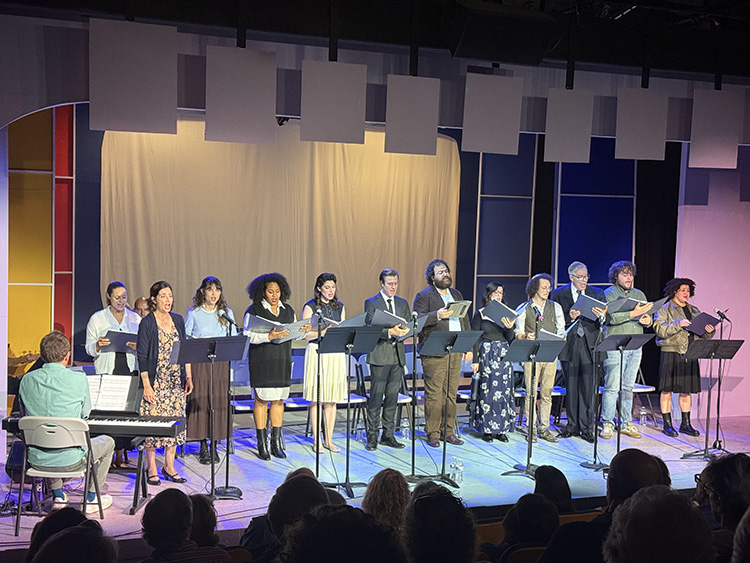
Presented in a staged reading at New Village Arts, the show tells the stories of Hannah Senesh and Rudolf Kastner, two Hungarian Jews remembered very differently by history.
Senesh became a hero after leaving Palestine to parachute into Nazi-occupied Europe. She was captured and executed at 23.
Kastner helped arrange the escape of 1,684 Jews from Hungary but was later accused of collaborating with the Nazis and assassinated in Israel.
Viterbi did not come up with the original concept. Composer Toby Singer contacted her about three years ago with a cold email and a draft of a musical about Senesh and Kastner.
She loved the music, but the lyrics and story needed work.
The first version took place in a coffee shop and involved two ghosts and two Israelis. Viterbi went deep into the history of Kastner and rebuilt the piece around his relationships with the women in his life.
The reading was really good. The actors were incredible, even without a full production around them. We saw the return of some of our old favorites, like Becca Myers, and her brother Danny Myers, who have appeared before in this publication, and also another brother, Austyn Myers. We also got to meet Jacob Caltrider, Anna Mintzer, and Becca Lustgarten. The singers sounded great, and the music was catchy.
One song, “What Are You Going to Do When They Come for You?” was still running through my head after the performance. It’s very poppy, though the lyrics are actually really serious.
That may sound strange given the subject, but the contrast is intentional.
“We smash glasses at weddings,” Viterbi said. “Holding these things that are very joyful and very dark at the same time is really important to this piece.”
The music also sounds contemporary, which keeps the story from feeling locked in the past.
“When you’re hearing ‘What Are You Going to Do When They Come for You?’ it’s not just about the Nazis,” she said. “It’s about what’s happening in America today, or in the world today.”
Viterbi describes the show as historical fiction, but much of the dialogue comes directly from diaries, testimony and historical records.
Some of Senesh’s lines come from her diary. Other characters use words they actually said.
One of the moments that I was curious whether it was fact or fiction involves the Satmar rebbe, who was among those saved on Kastner’s train, but when asked to testify on Kastner’s behalf said that Kastner hadn’t saved him, G-d had.
Turns out, that line was real.
Viterbi said she and Singer were still learning from the show during the JFest performances. She continued making changes as they heard it in front of an audience.
“You really don’t know anything about a play while you’re alone with it on your computer,” she said. “It’s only by getting in the rehearsal room with actors and directors and dramaturgs and the whole team that you really learn.”
Viterbi has had plays produced in Chicago, San Francisco and Washington, D.C., but JFest remains one of her artistic homes.
“I’m so grateful that JFest is a place that develops new, urgent Jewish work,” she said.
There is no full production announced yet. Viterbi and Singer plan to keep revising the musical and sending it to theaters.
Based on what was on the stage at New Village Arts, it deserves another life.
Budapest, Budapest already has a strong story, great performances and music that stays with you. I hope San Diego gets to see what it becomes next.
More information about Viterbi and her work can be found at aliviterbi.com
And to keep informed on JFest, and Viterbi’s next contribution, visit https://www.sdjfest.org/
*
Associate Editor Sandi Masori is a theater and food reviewer for San Diego Jewish World.