By Shor M. Masori in San Diego
Pirkei Avot, roughly translated as Ethics of the Fathers, begins with Moses receiving the Torah at Sinai and passing it to Joshua. Joshua passes it to the elders, the elders to the prophets, and the prophets to the Men of the Great Assembly.
The chain continued through teachers and students until the teachings were committed to writing and studied in synagogues around the world. Stories from the Torah also entered Christian and Islamic traditions. The stories changed through millennia of interpretation, but each generation treated the responsibility of carrying them forward with care.
Judaism calls this responsibility l’dor v’dor, passing tradition from generation to generation.
At Comic-Con, this notion is reflected in pop-culture properties that have spanned decades. Companies own the trademarks. Writers, artists and actors hold the stories for a portion of their lives. Their job is to learn what the universe stands for, add a few chapters and prepare it for the next handoff.
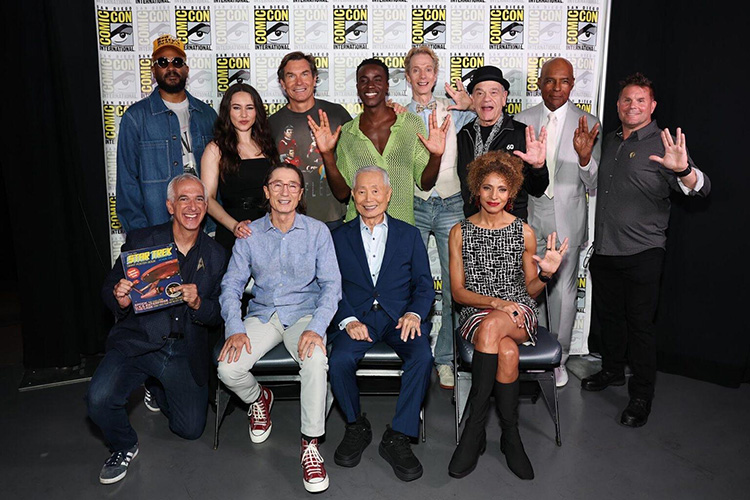
That responsibility filled the Hall H stage during Star Trek’s 60th-anniversary celebration. George Takei, who played Hikaru Sulu in the original series, sat with performers from almost every iteration of the franchise, spanning from The Next Generation through the newest Starfleet Academy. Six decades of television history were present along with the actors and creators bringing the future-based franchise into the present.
The Hall H lineup showed the links within a chain while the Lanterns panel showed the care going into the work taking place at the moment of transfer.
The Green Lantern mythos began in 1940 with Alan Scott, created by Jewish creators Martin Nodell and Bill Finger. In 1959, Jewish writer John Broome and Jewish artist Gil Kane rebuilt the concept around test pilot Hal Jordan and the intergalactic Green Lantern Corps. Writer Dennis O’Neil and artist Neal Adams introduced John Stewart in 1971. Each creative team received the Green Lantern title, expanded its mythology and took its stories to new heights.
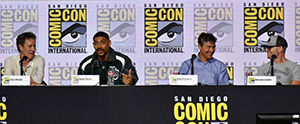
Hal Jordan and John Stewart now lead HBO’s Lanterns, created by Chris Mundy, Damon Lindelof and Tom King. Lindelof, a Jewish writer who spent decades attending Comic-Con as a fan, described the responsibility of receiving characters who already belong to generations of readers.
“You have to have the hubris to feel like you know what you’re doing, but also the tremendous amount of respect there, that a legacy like Watchmen or Green Lantern, or any of these franchises that we love, that we’ve inherited, and that we’re caretakers,” Lindelof said.
A caretaker needs confidence to make decisions. Respect begins with understanding why the characters endured. For Aaron Pierre, that commitment began before he received the role of John Stewart. Shortly before his final callback, a tendon separated from his bone and his bicep rolled toward his shoulder. He underwent surgery but still could not properly rotate his arm and entered the audition wearing a heavy brace.
Thinking about backing out from his dream role, Pierre asked himself, “What would John do?”
He completed the audition and spent months rehabilitating for the role.
The production built its John Stewart from his established history as a Marine and architect. His discipline guides his decisions, and his architectural training shapes ring constructs engineered in detail. Hal Jordan, played by Kyle Chandler, carries the confidence of a Coast City (loosely based on San Diego) fighter pilot chosen for his unwavering will. His constructs come from instinct and immediate need.
The series places them inside an earthbound murder mystery. The setting isn’t the character’s norm; however, it still grounds them in respect for their legacy. John remains an architect and soldier. Hal remains a pilot who acts before doubt can stop him. The creators are using the history of both characters to determine how they enter a new genre.
Those screen versions began on comic-book pages. In the world of comics exciting adaptions are still coming out. “DC’s Metropolis and Beyond” panel discussed the upcoming 1100th issue of Action Comics, the first line to feature Superman way back in 1938. It and other Superman titles are gearing up for their next connected storyline.
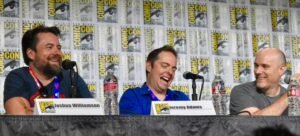
Comics writer Joshua Williamson was discussing the responsibility of writing a character who has accumulated 88 years of adventures when he mentioned one of the privileges of his career: calling Mark Waid, a legend in the comic community, to talk shop about the big blue boy scout.
Waid, who has written comics for over 40 years, explained why an old idea worked, where a story went wrong, and which part of Superman should guide a new plot. Waid says his style is still guided by creators who came before him. Jack Kirby, who co-created most Marvel characters and many others, once gave him a simple instruction: “Don’t do what I do. Do new stuff.”
Waid carried that rule into his Fantastic Four run by almost exclusively using new threats during his first year. Repeating Kirby’s stories would have ignored the lesson inside Kirby’s constant invention.
Tom King applied that principle to his run on Kirby’s Mister Miracle, which he’s now adapting into a cartoon. His comic with artist Mitch Gerads focused on Scott Free (Mister Miracle) and Big Barda’s marriage, trauma, and attempt to build a family amid a war between the gods. Kirby remains present throughout production. New character designs are placed beside his originals. His prose is used in the narration, and King has pushed to keep Kirby’s creator credit visible before every episode. The series carries Kirby’s language and designs into a story shaped by King’s own experiences with marriage, depression, and fatherhood.
While designs and continuity are part of the inheritance, a governing idea gives the universe its direction. Gene Roddenberry built Star Trek after flying combat missions during World War II and serving in the Los Angeles Police Department. He had witnessed cruelty, courage and compassion. His imagined future rested on the belief that humanity could recognize its failures and build a peaceful society.
Asked which Roddenberry principle should be carried into the franchise’s next 60 years, Takei chose IDIC, Infinite Diversity in Infinite Combinations. He explained that diversity includes the histories people carry, the ways they respond, and what they learn from one another.
That principle reached Michelle Hurd through her father. He played Star Trek reruns for her so she could see Nichelle Nichols portraying Lt. Nyota Uhura, a Black woman holding authority on the bridge. Hurd eventually joined the franchise as Raffi Musiker on Star Trek: Picard and sat beside Takei during the anniversary celebration.
The role of Uhura now rests with Celia Rose Gooding on the prequel series Star Trek: Strange New Worlds. Gooding acknowledged that Uhura belongs to the Star Trek community. Fans knew the character long before Gooding accepted the role and will carry Uhura long after her performance ends. Gooding’s contribution will be the beginning of her journey. Her Uhura starts as a young ensign learning how to become the officer Nichols introduced. I covered the franchise’s current generation last year in “Star Trek’s New Generation Confronts the Future—and the Past.”
The values Takei named are now being tested in IDW’s new Star Trek comics. Writer Christopher Cantwell and artist Dennis Menheere are sending Star Trek: Picard’s Captain Seven of Nine, Jack Crusher and Crash La Forge aboard the Enterprise-G into the Epsilon Corridor, a region beyond the known galaxy. Their mission is to relocate the dying Avuran people to three apparently empty worlds known as the Trinity.
The promise of an open world quickly becomes uncertain. The crew finds vanished structures, unexplained artifacts, and evidence that somebody reached the planets before Starfleet. The story forces the characters to examine the notions of exploration and colonization. Though the land may seem empty, it may already carry a history and a claim.
A connected series, Star Trek: Zero Point, sends Raffi Musiker on classified missions guided by an untested artificial intelligence that predicts trouble before it happens. Writer Charlie Jane Anders places Raffi’s distrust of institutions inside a story about whether hope can survive paranoia and whether knowledge gives someone the right to act.
These present-day questions speak to how writers are reacting and interpreting today’s world, which I discussed in “Comic-Con Weighs This Era’s Impact on Fiction Writers.” The new stories carry them through Starfleet values established decades ago: curiosity, contact, restraint and the belief that unfamiliar life deserves to be understood.
Where Star Trek sends its next crew into the undiscovered Epsilon Corridor. Avatar: The Last Airbender is now working through a new challenge, how to tell a story in between generations of lore. It places its new chapter between the Hundred-Year War that opened the original series and the future already established in The Legend of Korra sequel series.
The creators described the original series, which ended in 2008, as “done and baked.” Aang defeated Fire Lord Ozai and began rebuilding society after a century of war and the genocide of the Air Nomads. The new film picks up 13 years later, following Team Avatar in their twenties as they face another crossroads in their lives.
As someone who was a child when the series aired and is now in my twenties, I am ecstatic to see the characters grow up with me.
The film serves as a sequel to Aang’s original series and a prequel to The Legend of Korra, which takes place 70 years later after Aang has died and reincarnated as Korra. The audience already knows the world Aang will leave behind. The filmmakers must develop his adulthood, show the beginnings of Korra’s Republic City, and preserve the history established in both series.
The production spent five years finding space inside that timeline. Lauren Montgomery, who worked on the original series, directs. The characters remain primarily hand-drawn in 2D, preserving the franchise’s roots as a love letter to anime. The production uses 3D environments to add depth to the world.
The creators also worked with calligrapher S.L. Lee to develop Avatarian, a written language shaped by the cultures inside the world and inspired in part by Hangul, the Korean writing system.
The Avatar cycle carries l’dor v’dor directly inside its premise. Each Avatar receives the responsibility of maintaining balance, lives with the consequences left by previous incarnations, and prepares the world for the next.
Just as Avatar’s original creators, Bryan Konietzko and Michael Dante DiMartino, remain involved in guiding the franchise, Mel Brooks has taken that role with Spaceballs, spending years challenging the new creative team and passing his approach to Jewish comedy into their hands. I covered that reunion and the coming sequel in “Spaceballs: The New One Prompts Belly Laughs in Comic-Con’s Biggest Venue.”
While creators guide the next team, ultimately the audience decides whether the chain continues. Parents introduce children to the stories that shaped them. My father and grandfather passed their favorite shows to me, a history I discussed in “Jewish Talent Comes to the Fore at Comic-Con.”
My grandfather gave me DVDs of the original Star Trek series for Hanukkah when I was six. He then watched the entire franchise with me. His gift made me a lifelong Star Trek fan and instilled in me the sense of wonder and hope for a better tomorrow that the series has given to countless others. The child watching beside a parent today may become the writer calling Mark Waid, the actor asking what John Stewart would do, or the artist designing the next Avatar.
A steward receives the story with gratitude, learns its values, creates a chapter and places it into the next pair of hands. A fan carries it home and decides who will see it next.
That is l’dor v’dor. A tradition grows through the handoff.
*
Shor M. Masori is a San Diego-based freelance writer.