By Alex Gordon in Haifa, Israel
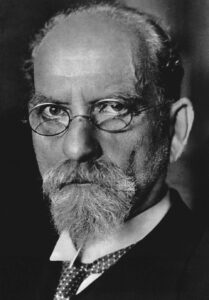
The famous German philosopher Edmund Gustav Albrecht Husserl was born on April 8, 1859, in Prosnitz, Moravia (Austria) into a Jewish family and was the second of four children. The spoken language in the family of his father, a ladies’ hat merchant, and his mother was Yiddish. In 1855, his father established a haberdashery business there, which from 1860 operated a factory. At the age of ten, Edmund entered a real school in Vienna, and a year later, in 1870, he was transferred to a state gymnasium in Olomouc.
In 1876, Husserl was admitted to Leipzig University, where he studied astronomy, mathematics, physics, and philosophy; in 1878, he transferred to Berlin University, where he continued studying mathematics under Leopold Kronecker and Karl Weierstrass, as well as philosophy under Friedrich Paulsen. On October 8, 1882, Husserl defended his dissertation in mathematics On the Theory of Variational Calculus and began studying philosophy under Franz Brentano.
In 1886, two years after his father’s death, Husserl, along with his fiancée, also a Jew, Malvine Charlotte Steinschneider, converted to Protestantism. The wedding on August 6, 1887, took place in the Evangelical Church of Vienna. The purpose of converting to Lutheranism was to avoid discrimination in his academic career. They had three children: a daughter, Elizabeth (1892), and two sons, Gerhart (1893) and Wolfgang (1894). In 1887, Husserl defended his habilitation thesis and began teaching at the University of Halle.
Husserl’s first publications were dedicated to the problems of the foundations of mathematics (Philosophy of Arithmetic, 1891) and logic (Logical Investigations I, 1900; II, 1901). Logical Investigations became the first book of the new philosophical movement founded by Husserl—phenomenology.
In 1906, Husserl became an ordinary (full) professor in Halle. It was during this period that he published a programmatic article in Logos — Philosophy as a Rigorous Science (1911) and the first volume of Ideas: General Introduction to Pure Phenomenology (1913).
Husserl’s philosophy proclaimed a return to “the things themselves” and made consciousness the main object of study. He founded phenomenology, doctrine that explores how the world reveals itself to a person in their immediate perception and experience
With the onset of World War I in 1914, Husserl, like many Germans, including Jews, shared a strong patriotic upsurge. In October 1914, both of his sons volunteered for the Western Front. On March 8, 1916, his younger son Wolfgang, who was 22, died in the bloodiest battle of World War I – at Verdun. His second son, Gerhart, was seriously wounded but survived. Despite these blows, Husserl remained a staunch patriot. The German Spring offensive of 1918 rekindled his hopes for a victorious end to the war. His wife Malvine confided in her diary, “Papa is beside himself. He is convinced that the final victory is now within reach.”
In 1916, Husserl received a chair at the University of Freiburg, where he worked until his retirement in 1928. His publications in Freiburg: Lectures on the Phenomenology of Internal Time Consciousness (1928). Formal and Transcendental Logic (1929), Cartesian Meditations (in French, 1931), parts I and II of The Crisis of European Sciences and Transcendental Phenomenology (1936). Husserl argued that consciousness is always directed toward some object. Every thought, fear, or desire we have has its own purpose. We don’t just think — we think about something. He dreamed of turning philosophy into an exact science that would find universal laws of reason and cognition.
After the Nazis came to power, Husserl was temporarily dismissed as a Jew according to the Baden state law; he was finally removed from his position only after the adoption of the Nuremberg Laws on September 15, 1935, which stripped Jews of their citizenship.
Husserl’s best student, Martin Heidegger, one of the founders of existentialist philosophy, was elected rector of the University of Freiburg in the spring of 1933, where he had previously studied under Husserl and taught. Heidegger did not defend his teacher from persecution. He annulled the university’s autonomy in favor of its subordination to the Nazi government and soon joined the NSDAP.
His colleague, one of the founders of existentialism, the German philosopher Karl Jaspers, wrote: “I did not recognize my friend and no longer trusted him. Now that Heidegger had become a participant in violence, I even felt a threat to myself from him.” In his addresses to students, Heidegger repeatedly spoke of the great new beginning (der neue Anfang), the necessity of following the Führer, the justice of antisemitic ideas of race and blood, and the “inner truth of the great movement.”
After the defeat of the Nazis, Heidegger claimed that he had broken with them back in 1933. But the truth was finally revealed with the publication of his diaries Black Notebooks, which he had kept since 1931. They were published 28 years after his death in 2014. In them, the philosopher reflected on the “spiritual mission” of Nazism, the “greatness of the Führer.” The Black Notebooks also contained antisemitic statements. He sharply criticized the “forgetting of Being,” Western metaphysics, Americanism, Sovietization, and technization, linking them to the processes of world Jewry.
In the Black Notebooks, Heidegger criticized the phenomenology of his teacher for attempting to turn philosophy into a strict science, which, in his opinion, fell under the influence of Cartesianism and the mathematically-oriented science of his time. He viewed Husserl’s phenomenology as an extreme variant of subjectivism. Heidegger accused Husserl’s phenomenology of “worldlessness” (Weltlosigkeit) and mathematical rationalism.
He presented the teacher’s approach not merely as a philosophical error but linked it to the “rootless” Jewish mentality, which, in his opinion, is incapable of true understanding of Being. Heidegger borrowed ideas about “world Judaism” and incorporated them into his own history of Being, where Jews were assigned the role of carriers of a destructive principle.
Husserl was banned from participating in the philosophical congresses of 1933 and 1937 both officially and privately; his old books were not removed from libraries, but the publication of new ones was impossible.
Husserl, long having forgotten about his Jewish origins, got into trouble as a Jew. His conversion from Judaism to Lutheranism had no significance for the Nazis’ racial approach. His patriotism for Germany, having lost a son on the front lines of World War I, turned him into an outcast in his own country.
His merits as a thinker and teacher, his title of honorary professor did not help him. He fell into isolation, was excluded from academic and public life. He was expelled from the academic community, deprived of the right to teach and use the university library in Freiburg, and his works were subjected to discrimination. His best student betrayed him. In letters to colleagues, the philosopher bitterly wrote that he found himself in a “spiritual ghetto,” and that his many years of work were being erased from the history of German culture by Nazi ideology.
Husserl’s philosophical response to Nazi ideology was his extensive work The Crisis of European Sciences and Transcendental Phenomenology (1936). He described a deep disappointment in European culture, which allowed barbarism to come to power. In a letter to the French philosopher of Jewish descent, Lucien Lévy-Bruhl, in 1935, Husserl reflected on the profound spiritual crisis and the “darkening” of Europe, which was betraying its own fundamental values.
He criticized the Nazi theories of “blood and soil,” which were based on racial biologism. He actively criticized the rise of irrationalism and antisemitism in Germany in the 1930s as a betrayal of the true values of European reason and humanism. But despite the hostility surrounding him from the Nazi regime, Husserl did not emigrate (his son and daughter moved to the USA). He died in Freiburg on April 27, 1938, from pleurisy, almost entirely alone.
*
Alex Gordon is professor emeritus of physics at the University of Haifa and at Oranim, the Academic College of Education. He is the author of 12 books.