By Alex Gordon in Haifa, Israel
Sir Ernst Boris Chain, winner of the Nobel Prize in Physiology or Medicine, was born on June 19, 1906, in Berlin. His father, Mikhail Chain, a native of the Belarusian city of Mogilev and the son of a tailor, came to Germany in the late 19th century, studied chemistry, earned an engineering degree and later a doctorate, and became a successful industrialist who built a chemical plant near Berlin for the production of salts of various metals.
Chain’s mother was Margarita Eisner, the sister of Kurt Eisner, a well-known German Social Democrat and prime minister of the defeated Bavarian Soviet Republic, who was assassinated by a nationalist on February 21, 1919, in Munich.
Ernst grew up at the intersection of several worlds: his father, who had escaped from the Pale of Settlement of the Russian Empire, achieved success, but remained a devout Jew; his mother, born in Germany into an assimilated Jewish family with far-left views; his grandfather Shmuel, a tailor from Mogilev, who once visited them in Berlin— “a tall old man with a long beard who prayed constantly and studied sacred texts,” as Ernst remembered him.
The young Chain’s interests were torn between science and music; he received an education in both chemistry and music. In addition, he was a polyglot: the family spoke German, Russian, and Yiddish, but he was fluent in English and French and later learned Italian well enough to give lectures in Rome.
His father died when Chain was 13 years old. The business went bankrupt due to postwar inflation, and his family (his mother and sister) struggled financially. This forced Chain to give up his dream of becoming a musician, although he never stopped playing the piano for the rest of his life.
Ernst Chain attended the Luisengymnasium in Berlin and developed an interest in chemistry at a young age, inspired by visits to his father’s laboratory and factory. It was not until 1928 that he received German citizenship. He was an outsider in antisemitic Germany, a society that his uncle Kurt Eisner had failed to transform.
From his father, he inherited Jewish piety, a love of chemistry, a work ethic suited to hard labor, and the ambition of an emigrant and a Jew driven by a passion to rise in a society that considered him a person of inferior status.
In 1930, Ernst graduated from Friedrich-Wilhelm University, having defended his doctoral dissertation in chemistry and physiology. His first independent position was at the Kaiser Wilhelm Institute for Physical Chemistry (affiliated with the Charité Hospital), where he spent three years conducting research on enzymes and biological toxins.
In Berlin, Chain had to supplement his income by giving private lessons, writing music reviews, and even performing in concerts. In 1930, he traveled to Russia to organize an exchange between musical ensembles.
When Hitler became chancellor in January 1933, Chain decided to emigrate to England. As he later wrote, he did so “out of hatred for Hitler’s gang, not to save his own life.” He assumed, like many others, that the “Thousand-Year Reich” would not last more than a few months. He could not forgive himself for not taking his mother and sister with him; they perished in the Theresienstadt concentration camp in 1942. His hasty departure was apparently also because Chain feared persecution because of his relationship with his uncle Kurt Eisner.
With 10 pounds in his pocket, Chain arrived on British soil. The Liberal Jewish Synagogue awarded him a scholarship of 250 pounds a year, which, combined with his salary of 200 pounds, allowed him to make a decent living. Two weeks after moving to Great Britain, Chain began working in Cambridge, where he stayed for four years and defended another doctoral dissertation—this time in English.
Chain was recommended to the Oxford group led by the young Australian physiologist Howard Florey, who needed a skilled biochemist. Florey enlisted him to work on natural antibacterial substances found in the secretions of certain glands in higher animals and humans, for example, in saliva, tears, and egg white. This sparked his keen interest in the mechanisms of antibacterial action of various biological products, and while reviewing the literature, Chain stumbled upon Sir Alexander Fleming’s discovery of a bactericidal substance produced by a certain mold that was non-toxic to animals.
Fleming discovered this substance in 1929 but was unable to isolate it in its pure form or “put it to practical use” due to its instability in the external environment. There were no qualified chemists in Fleming’s circle.
Inspired by the discovery in the 1920s of the antibacterial effects of sulfanilamide drugs, the dream of the German-Jewish scientist Paul Ehrlich, a Nobel Prize laureate in Chemistry, was revived: the dream of creating magical “bullets” that were harmless to humans but deadly to microbes. Chain “dusted off” the long-neglected idea of penicillin out of pure chemical curiosity and persuaded Florey to conduct exploratory research.
Chain was convinced that he would be able to solve the problem of producing a stable penicillin preparation task that Fleming had been unable to accomplish.
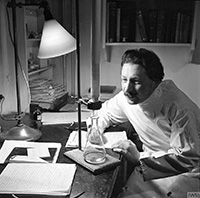
Work began in September 1939. Penicillin was first isolated from the mold extract in an extremely low concentration. By December, using low-temperature evaporation, they had succeeded in obtaining powdered preparation suitable for research and further experiments. The decisive experiment was conducted in March 1940. The powder, injected into the peritoneal cavity of mice, did not cause any toxic effects. Eyewitnesses reported that Chain danced with joy, while Florey limited himself to the cool remark: “A very interesting result.” The results of the experiment were published in the summer of 1940 in The Lancet, a British medical journal. Soon afterward, the effectiveness of penicillin was proven in humans as well.
While working at the University of Oxford, in 1943, Chayne met his future wife, Anna Beloff. Anna had graduated from the Department of Chemistry at University College London and had been accepted into the doctoral program at the University of Oxford. She was 22; he was 37. They began dating but were soon forced to part ways because Anna received a scholarship to study at Harvard and left for two years in the United States. Anna went on to become an outstanding biochemist. She was the sister of the prominent British historian Max Beloff, an emigrant from Russia and a devout Jew. Ernst and Anna had three children, who were raised in the Jewish faith.
England was at war with Nazi Germany, and the issue of penicillin became a matter of national importance. In 1945, Chain was awarded the Nobel Prize, which he shared with Fleming and Florey. The prize was awarded “for the discovery of penicillin and its curative effects on various infectious diseases.”
The inventors of penicillin transformed the fields of medicine and veterinary science, found applications in agriculture and the food industry, and had an impact on the lives of all humanity.
The Nobel Prize for the discovery of penicillin was divided into three equal parts. Although Fleming was the discoverer of penicillin, starting with his 1929 paper, penicillin remained a great but unrealized idea. The compound was unstable. It could not be used as a medicine. The drug had to be produced and made accessible to millions of patients. Healing many patients and saving many lives is the harmonization of life—Friedrich Schiller’s “Ode to Joy.” And this idea had to be harmonized.
Chain was a gifted pianist. And his scientific work also reflected a striving for harmony. In his book The Life of Alexander Fleming, French-Jewish writer André Maurois describes Ernst Boris Chain as an outstanding, passionate, and determined scientist who played a decisive role in transforming a chance discovery into a powerful medicine. Maurois notes that Chain could be quick-tempered and demanding. He was known for his meticulousness, which helped him isolate pure penicillin from an unpurified solution, even though his colleagues initially considered the task impossible.
Chain often clashed with his colleagues, but it was precisely his exacting nature that drove the project forward when others had doubts. Chain’s tenacity and meticulousness helped bring this extremely complex work to a successful conclusion.
The discovery was made during World War II. It saved millions of lives. The use of penicillin raised humanity to a higher standard of living and health. To bring such a great idea to fruition required a skilled master tenacious, meticulous, demanding champion of the quest for a stable drug, a conductor of the molecular world. Chase brilliantly played his part in this symphony of life.
In 1973, Chase retired and settled in Ireland. He was a Fellow of the Royal Society, held numerous honorary doctorates, was awarded the Louis Pasteur Gold Medal and the Paul Ehrlich Medal, and in 1969 he was knighted for his achievements. Starting in 1954, Chain served on the Board of Directors of the Weizmann Institute in Israel. Chain was a devout Jew and a critic of the theory of evolution. He articulated his views in 1965 at the World Conference of Jewish Intellectuals in a speech titled “Why I Am a Jew”. He argued that the survival of the Jewish people depended on religious education. He believed that faith preserves the moral and intellectual identity of the Jewish people.
Chain, who lost his mother and sister in the Holocaust, paid particular attention to how Judaism had survived millennia of persecution. He attributed this survival to the close connection between Jewish heritage and religious education. Chain argued that Jewish religious traditions offer an unparalleled moral foundation necessary for guiding human behavior. He emphasized that passing on Jewish values to the next generation through rigorous study is of vital importance. He opposed the idea of complete assimilation into secular society. He warned that rejecting one’s Jewish roots leads to the loss of a vital cultural identity.
*
Alex Gordon is professor emeritus of physics at the University of Haifa and at Oranim, the Academic College of Education. He is the author of 12 books.