By Alex Gordon in Haifa, Israel
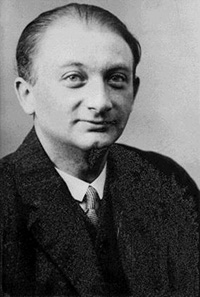
Joseph Roth, an Austrian writer and journalist, was born in Brody, on the distant northeastern edge of the Austro-Hungarian Empire, a few kilometers from the Russian border, on September 2, 1894, into a Jewish family that was part of a large Orthodox community.
His father, Nahum Roth, was an unsuccessful traveling salesman who suffered from mental illness and died in 1910. Joseph was raised by his mother, Maria (Miriam), née Grübel, and his grandfather, Yehiel Grübel. Joseph studied German literature and philosophy at the University of Vienna but did not complete his education, as he left for the front in 1916 to fight in World War I.
Roth viewed the collapse of the Austro-Hungarian Empire in 1918 as a catastrophe that deprived Jews of a stable “home” and plunged them into the abyss of ethnic strife. He idealized the multinational Habsburg Empire, where Jews were protected by law and felt part of a common, supra-ethnic space.
In 1919, at the Herrenhof café in Vienna, Roth met his future wife, the Viennese Jewess Frederika (Fridl) Reichler. The following year, Roth decided to move to Berlin. In 1922, he married Friedl. The marriage took a tragic turn—in the early 1930s, she was diagnosed with schizophrenia, and in 1940, after her husband’s death, she was killed by the Nazis as a mentally ill person under the euthanasia program.
After the war, beginning in 1918, Roth worked as a journalist for newspapers in Berlin and Frankfurt; by 1920, he had become a well-known journalist and continued to work for newspapers until 1933. His first major work of fiction, The Web (1923), was serialized in Austrian newspapers and was not particularly successful. The novel was inspired by the assassination of Rathenau and the attempted assassination of editor Maximilian Harden, both of whom were Jewish. In the book, Roth described circles of far-right war veterans preparing to seize power and establish a regime of terror. With remarkable foresight, he predicted the rise of Hitler, Hindenburg, and Ludendorff.
In 1924, Roth published the novels Hotel Savoy and The Uprising as separate volumes. As a special correspondent for the German newspaper Frankfurter Zeitung, he undertook an extended trip through the USSR in 1926. He was critical of communist ideology and of the idealization of Soviet Russia characteristic of some Western writers, including Nobel Prize in Literature laureates Bernard Shaw and Romain Rolland.
In 1926, Joseph Roth published the book Juden auf Wanderschaft (Jews on the Move). “The author cherishes the naive hope that he will find readers before whom he will not have to defend the Jews of Eastern Europe; readers who will bow their heads before suffering, before the greatness of the human soul, and indeed before the filth that is the eternal companion of grief,” Roth wrote in the preface.
In the first chapter—Eastern Jews in the West—he reflects on those Jews who leave for the West and those who remain at home; on the fates of those who left; about Orthodox Jews and Reform Jews; about Jews as a “national minority” and their struggle for their rights; about what constitutes a “Jewish nation” and whether Jews need their own state; and about the arbitrariness of the concepts of “Western” and “Eastern” Jews.
In the following chapters A Jewish Town, Western Ghettos, “A Jew Goes to America”—the author does not so much analyze and reflect as he tells stories and describes what he sees with his own eyes. By depicting life in an unnamed Jewish town—unmistakably Brody—Roth gives the reader a glimpse into the Jewish quarters of Europe’s capital cities and tells the story of a Jewish family that has decided to emigrate to America.
In 1930, Roth wrote the novel Job, the story of an Eastern European small-town Jew named Mendl Singer; his young son is a mute cripple. With a heavy heart, Mendl parts ways with his son and moves to America. But the pain of his loss is healed many years later when his son—now a brilliant musician—unexpectedly, just like the prophet Elijah, appears at Mendel’s home during the Seder. Roth describes the scene of recognition in a captivating and poignant way—in the spirit of the biblical story of Joseph. Job was popular.
Roth never renounced his Jewish identity. “In any big city, I look for Jews from Radziwillów [a town near Brody],” he said. “I am a patriot; I have a Jewish heart.” “A gifted Jew: you can never tell whether he is talented or whether it is his Jewishness making itself felt,” he joked. Yiddish, Roth said, “is the collective destiny and fateful language of the Jews.” (However, he wrote in German.) In a letter to his friend and benefactor Stefan Zweig, written in 1936, Joseph Roth described himself as “a devout Eastern Jew from Radziwillów.”
In 1932, Roth completed his longest and most famous novel, The Radetzky March, which contains strong elements of nostalgia for the Austro-Hungarian Empire during the reign of Franz Joseph. Roth wrote with incredible speed and continued to do so until the end of his days (he died at age 44, having published 17 novels and more than a thousand essays). The novel The Radetzky March, written in 1932, is a text of astonishing beauty and inner coherence, permeated by a sense of sadness, disintegration, and loss. The novel’s title refers to Johann Strauss’s famous march The Radetzky March, composed in 1848. Marcel Reich-Ranicki, a renowned literary critic and journalist—a Polish Jew who survived the Warsaw Ghetto and held Joseph Roth’s work in high esteem—included The Radetzky March among the 20 best German-language novels published over the past two centuries.
Stefan Zweig was Roth’s friend and patron, providing him with financial support. He held his friend in high esteem as a writer and described his character as follows: “Joseph Roth had a Russian nature—I would even say a Karamazov-like one. He was a man of great passions who always and everywhere strove for extremes; he possessed the Russian depth of feeling, the Russian fervent piety, but, unfortunately, also the Russian thirst for self-destruction. A second nature also lived within him—a Jewish one—to which he owed his clear, mercilessly sober, critical mind and his just, and therefore gentle, wisdom; and this nature watched the unbridled, demonic impulses of the first with both fear and secret love. His origins also imbued Roth with a third nature—an Austrian one; he was chivalrously noble in every action, charming and affable in everyday life, and artistic and musical in his art. It is only through this exceptional and unique combination that I can explain the uniqueness of his personality and his creative work.”
Roth left Germany on January 30, 1933, the day Hitler was appointed chancellor. He emigrated to France. As early as June 1932, he wrote to Stefan Zweig: “They intend to burn our books, and with them, us as well.” Roth, with his keen writer’s intuition, was fully aware of where “the wheel of history” was rolling. “Now you will understand that we are facing a terrible catastrophe. Not only has our literary and material existence been destroyed, but everything also that has happened is leading to a new war. Down with all illusions!” (From a letter to Stefan Zweig, March 1933).
Roth wrote to Zweig: “War is approaching. Do not delude yourself. Hell has come to power.” At times, he sympathized with Zionism. “Zionism is the only way out: patriotism, yes, but only toward one’s own land.” At the same time, Roth believed that the Jews were doomed.
The “Anschluss” of Austria in 1938 was perceived by Roth as a personal tragedy. The inglorious end of the state he idolized heralded, for him, the end of all of Europe. Deeply distressed by these events, Joseph drank heavily, and his health deteriorated with each passing day.
One of Roth’s correspondents was his friend and colleague Ernst Toller (1893–1939), a German writer, revolutionary, prime minister of the Bavarian Soviet Republic, poet, playwright, and one of the leaders of Expressionism, who came from an assimilated Jewish merchant family. After the Republic’s defeat, Toller was sentenced to five years in prison. Following the Nazis’ rise to power in 1933, Toller left Germany and lived in Switzerland, France, Great Britain, and, beginning in 1936, the United States. The imprisonment of his brother and sister in Nazi concentration camps and Francisco Franco’s victory in Spain drove Toller to despair.
On May 22, 1939, the day of the Nationalists’ victory march in Madrid, he hung himself in the bathroom of his room at the Mayflower Hotel in New York. While sitting with friends in a Parisian café on May 23, Roth was horrified to learn of Toller’s suicide. He became ill and was taken to a hospital. Four days later, Roth died there. On May 30, 1939, Roth was buried at the Thiais Cemetery in Paris. The inscription on his tombstone reads: “Austrian writer—died in Paris in exile.”
In his obituary, Stefan Zweig mourned the loss of a brilliant literary master whose life had been shattered by Europe’s tragic political collapse. In his private notes and broader reflections, Zweig noted how Europe’s devastating political collapse and the rise of the Nazi regime drove Roth into hopeless, incurable alcoholism, which led to his physical collapse in Paris. Apparently foreseeing his own imminent end, Zweig wrote: “We will not grow old, we exiles.”
*
Alex Gordon is professor emeritus of physics at the University of Haifa and at Oranim, the Academic College of Education. He is the author of 12 books.