Beth El dedicates ‘Tree of Life’ mural for Yom HaShoah
May 2, 2019
Tree of Life Mural was unveiled at Congregation Beth El on May 2, 2019
By Donald H. Harrison
Donald H. Harrison
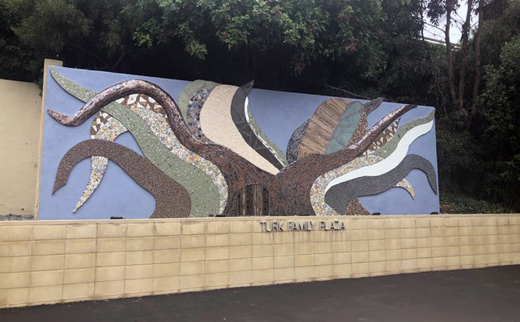
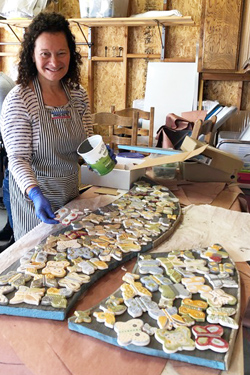
LA JOLLA, California — Congregation Beth El dedicated a 30 by 9 foot mural of a Tree of Life on Thursday, May 2, that incorporates, among other elements, ceramic butterflies symbolizing children who were murdered in the Holocaust.
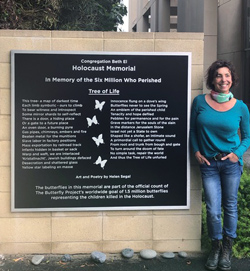
The outdoor Yom HaShoah ceremony led by the congregation’s former president Sonia Ancoli Israel featured the reading of a Holocaust poem by artist Helen Segal that is engraved on a nearby monument, the lighting of six candles to remember Holocaust victims, and a story shared by Israel about her mother’s efforts to help smuggle Lithuanian Jewish children out of Communist-controlled Eastern Europe en route to British Mandatory Palestine.
Additionally, Cheryl Rattner Price, who co-founded The Butterfly Project 13 years ago with Jan Landau, discussed the project’s symbolism and history. Rabbi Ron Shulman, in an introductory talk, linked the 6 million murdered Jews in the Holocaust to modern-day victims of violence aimed against the Jewish community. More than 200 persons attended the ceremony.
Segal said the mural took a year to construct. That came after seven years of planning and a fundraising campaign to which more than 70 families contributed.
“The engineering was a challenge, translating a small initial sketch to large scale completion while attempting to make it look effortless,” she said. “But it was also physically and emotionally taxing, as with the laying of each tile, pebble, mosaic and butterfly I contemplated the enormity of this history.”
Explaining why she chose to construct a Tree of Life, she said: “I didn’t want to create a panorama only of tragedy but to suggest that despite the horror of the Holocaust the Jewish people have survived and flourished — as a tree continues to grow and spread.
“It is a recognition and condemnation of the darkness but also a prayer for rebirth and growth toward the light.”
In a reference to last Saturday’s shooting at Chabad of Poway, she added: “The recent attack in our midst is a strong reminder that misfortune can occur at any moment. But we refuse to allow hatred to take over in our hearts and evil to prevail.”
Segal read the “Tree of Life” poem that she wrote to accompany the mosaic.
Artist/ Poet with Holocaust Memorial Poem
This tree- a map of darkest time
Each limb symbolic – ours to climb
To bear witness and introspect
Some mirror shards to self-reflect
There is a door, a hiding place
Or a gate to a future place
An oven door, a burning pyre
Gas pipes, chimneys, embers and fire
Beaten metal for the munitions
Slave labor in factory positions
Mass exportation by railroad track
Infants hidden in basket or sack
Warp and weft, we are interlaced
‘Kristallnacht’, Jewish buildings defaced
Desecration and shattered glass
Yellow star labeling en masse
Innocence flung on a dove’s wing
Butterflies never to see the Spring
An emblem of the perished child
Tenacity and hope defiled
Pebbles for permanence and for the pain
Grave markers for the souls of the slain
In the distance Jerusalem Stone
Israel not yet a State to own
Shaped like a shofar, an intimate sound
A primordial call to gather round
From root and trunk from bough and gate
To turn around the doom of fate
No simple task, repair the world
And thus the Tree of Life unfurled
Israel, who chairs Beth El’s Holocaust Memorial Committee, related in prepared remarks that she is the daughter of Esther and Nissan Ancoli, who survived the Holocaust through a combination “of luck, of miracles, of chutzpah, of strength, and of love.”
“My grandparents and uncle and many others in our family were not so lucky and were murdered in the streets, in the camps, and in places we don’t even know,” she added.
Israel said that her mother, born Esther Bekin, was from Radvilishkes, Lithuania, but lived following the end of the war in Vilna, Lithuania’s capital city.
“One day, there was a knock on the door, and a young man stood there with a telegram,” she said. “It read that the Brecha, the Jewish underground, had heard she could be trusted and enlisted her help to smuggle children out of Lithuania into Poland, from where they could be sent to what was then Palestine. The word spread and young survivors from all over Lithuania appeared at her door. Her job was to make false papers for the children and to bribe people to get trucks. Once a week, in the middle of the night, in the darkness, she would send three trucks across the border and to freedom.
“One night they were betrayed and the trucks were caught” by Communist authorities who opposed Jewish emigration. “My mother never knew who survived and who was murdered on that night of betrayal. But that story is not over. Fast forward 60 years to February 2004. My mother is wintering in Florida, as New Yorkers were apt to do, and is invited to a social gathering for survivors from Lithuania. Someone points out a woman recently arrived from Israel, and my mother, always being the most friendly welcoming person, goes over to say hello.”
“The woman, Gila, tells my mother that she arrived in Israel from Lithuania only in 1976. ‘Why so late?’ my mother asked. Gila replied, ‘I tried to get there once through the Bracha, in Vilna, in January 1946. But the truck I was on was caught and we were sent to Siberia.’
“My mother stood there just staring at her. And then she whispered, ‘I was in the Bracha in Vilna in 1946.”No,’ Gila replied, ‘I only knew one person there. Her name was Esther Bekin.’ My mother gasped. ‘I’m Esther Bekin! I’m Esther Bekin! And I am so sorry that because of me you ended up in Siberia.’
“‘No,’ Gila replied as they hugged. ‘It is because of you that I am alive.'”
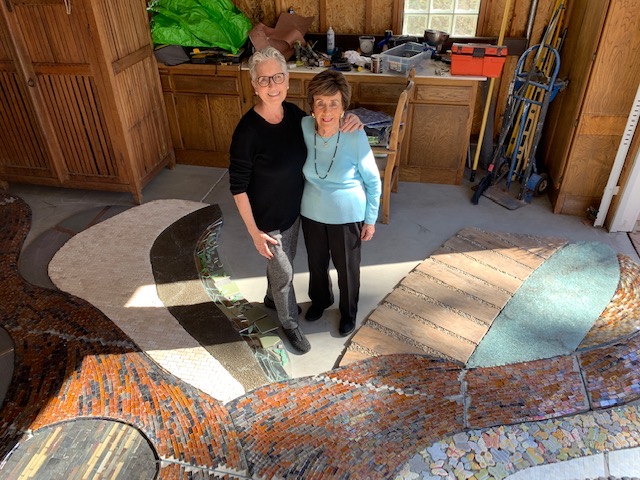
Sonia Ancoli Israel, who chairs Congregation Beth El’s Holocaust Memorial Committee, and Fanny Krasner Lebovits inspected mural before it was mounted at Congregation Beth El.
Beth El’s two Rabbis, Ron Shulman and Avi Libman, led the congregation in prayers; congregants David Lipsitz and Nick Akers chanted “Ani Ma’amin,” which many Holocaust victims sang to indicate their continued belief in God — even as they were being led to their deaths — and next, the ceremonial candle lighting, a regular feature of Yom HaShoah commemorations, was conducted. During that ceremony, congregants read the names of family members who were killed in the Holocaust.
To light the first candle, Holocaust Survivor Fanny Krasner Lebovits and any others who might be attendance were invited to come before the assemblage.
For the second candle, the second generation — the children of survivors.
For the third, the third generation–the grandchildren of survivors
For the fourth, the fourth generation — the great grandchildren and any great-great grandchildren who might be in attendance
For the fifth, Congregation Beth Israel’s Holocaust Memorial Committee and The Butterfly Project’s Education Team.
For the sixth, Cheryl Rattner Price and Helen Segal.
Cheryl Rattner Price prepares ceramic butterflies (The Butterfly Project photo)
Following the chanting of El Maleh Rachamim, the Butterfly Project’s co-founder (in partnership with Jan Landau), said congregants, teachers and students at Congregation Beth El had participated in the painting of some of the 661 butterflies that were incorporated into the mural.
“We are so proud to include your butterflies in our official count towards 1.5 million ceramic butterflies around the world in memory of the children who were murdered in the Shoah,” Rattner Price said. “You are a true model to other synagogues and we are so proud to stand together with you on this day as we dedicate your years of work in creating a lasting legacy at Congregation Beth El.”
Rattner Price told the Assembly that “every installation should be a teaching site,” and urged that the area in front of the mural in the Turk Family Plaza “be a space for small and large conversations that we keep coming back to in order to create a more peaceful world.”
She added: “I can assure you that The Butterfly Project is now more than ever, in light of the horrifying hate-filled attack last Shabbat, committed to step up what we do and reach more teachers and students with our educational programming with a clear goal to empower and fill our world with more ‘upstanders’ for justice.”
An “upstander” is someone who acts in the face of injustice, as differentiated from a “bystander” who does nothing.
The April 27 attack in Poway left Lori Kaye, 60, dead, and wounded three other persons: Rabbi Yisroel Goldstein, visiting Israeli Almog Peretz, and his 8-year-old niece Noya Dahan of San Diego County.
Following the speeches, a temporary cover hiding the mural from view was removed, and the rabbis led the congregation in reciting the Kaddish. Afterwards, individual Memorial Candles were distributed for attendees to remember the Six Million Jewish victims of the Holocaust.