
Other items in today’s column include
* International Holocaust Awareness Day in San Diego
* Political bytes
* Recommended reading
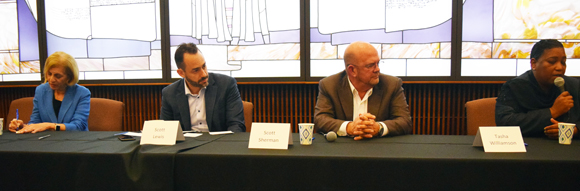
SAN DIEGO – Anti-semitism? City Councilwoman Barbara Bry blames President Donald Trump. City Councilman Scott Sherman points his finger at the Internet. And Tasha Williamson says it’s the fault of domestic terrorists, who ought to be prosecuted with the same tenacity as are terrorists from foreign countries.
The three candidates made their comments Sunday night at a forum at Temple Emanu-El skipped by Assemblyman Todd Gloria, who polls show to be the frontrunner in their race to be San Diego’s next mayor.
Asked by moderator Scott Lewis, editor in chief of the Voice of San Diego, about what can be done to curb the rising rate of anti-Semitism, Barbara Bry, who is Jewish, said last Passover’s fatal attack by a gunman at Chabad of Poway was not only a manifestation of anti-Semitism. “It is really anti-Black people, anti-people of color; anti-gay people. There is just so much hatred in this country right now, and honestly it starts at the top with President Trump.”
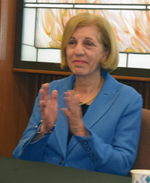
Bry, a Democrat, reiterated that hate in this country “really emanates” from President Trump, without offering her reasoning for the charge. “It’s a horrible time in our country and as mayor, I want to be a symbol [of being] welcoming of all communities, of all kinds of people,” she said.
Bry noted that everyone who attended the mayoral forum at Temple Emanu-El had to pass through security, and said the same is true at her synagogue, Congregation Beth El of La Jolla, and at the Jewish Community Center in La Jolla and the San Diego Jewish Academy in Carmel Valley. “What a horrible way for our children to grow up!” she said.
She added that she was proud how Jewish Family Service responded to the many refugees seeking asylum at our southern border by working in conjunction with other charities to set up the Rapid Response Network, where she said she had volunteered.
“I was so proud of our community for leading the way in helping people who want to come to this country in search of a better life and wanted to go through the legal process. They were seeking asylum. They understood they all would go to court. The adults all had ankle bracelets on and court dates and they wanted to do it the legal way.”
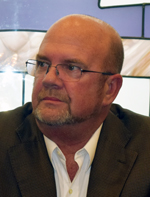
City Councilman Scott Sherman, a Republican, said that the mayor of San Diego has a “bully pulpit” from which he or she can “lead by example in showing inclusivity and to make sure that the people understand that hatred and looking at people as this group or that group, or this sexual orientation or this gender, serves nobody any good. At the end of the day, as my parents always taught me, we all bleed red.”
He went on to say that “the social media has a lot to do with some of the things we see nowadays because people who weren’t communicating before their terrible extreme views now are communicating much easier [and] making matters worse,” Sherman said.
“We really need to have a leader in the city who focuses on bringing people together, concentrating on what we all think is important, no matter what our background is: a safe neighborhood, good roof over our head, kids have a good opportunity for education, and we have good employment.”
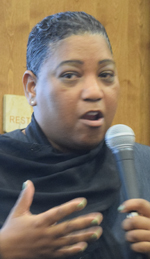
Tasha Williamson, founder of the San Diego Compassion Project which provides resources and counseling for families affected by violence, told her Jewish audience, “I’m sorry what happened to you. It happens to us [African-Americans] all the time, and I am sorry that it has happened to you. Some of the things that we have done in our churches is that we have armed guards that you don’t see because we have had our pastors targeted.”
“So often when we talk about ‘terrorism,’ we are talking about people who are from other countries,” she added. “We track them almost in expert fashion: we know what they look like, we know their names. They try to have facial recognition when they are in airports. Well, we do not track domestic terrorists well at all. As a matter of fact, we don’t even call them that. We call them ‘hate groups.’ You guys were terrorized in your own synagogue. That was a terrorist and he was from this country. He was home-grown and we need to increase that relationship that we have with law enforcement from many sectors – federal, local, state – to make sure that we are doing due diligence to track domestic terrorism and domestic terrorists.”
She said that law enforcement closely monitors communities of color, but fails to do likewise in white communities, where domestic terrorists [white supremacists] live. She said law enforcement fails to focus on communities where people look the same way way they do “because people don’t generally see themselves when it comes to criminality. When you are in our community of color, they do. All I am saying is that they need to have a tracking mechanism. We need to be sure we are looking at them.”
Williamson said that in the African-American community, there are efforts to meet with people who have been haters, because “there were some who went to prison and they changed their lives and they are no longer people who hate us. There are actually people who talk about the shame of living that way, and how they turned themselves around.”
She said “when hate shows up, we should show up together.” After a gunman killed Lori Gilbert-Kaye at Chabad of Poway, and wounded three other persons including Rabbi Yisroel Goldstein, “I was there handing out candles, and greeting people in the park. There were Muslims who came to say, ‘I’m sorry, but we are here.’ That’s what it should look like.”
Similarly, she said, when African-Americans are attacked, members of the Jewish community and other religious and ethnic groups should show up for them.
The candidates also tackled issues about homelessness, city hiring practices, and housing during the 2-hour long forum.
*
International Holocaust Awareness Day in San Diego
Darren Schwartz, chief program officer for the Jewish Federation of San Diego County, on the occasion of January 27th being International Holocaust Remembrance Day, notes that San Diego “is home to nearly 500 Holocaust Survivors – at least one-third of whom are living in poverty. … We want to ensure they live comfortably and with dignity for the remaining years of their lives. Taking care of Holocaust survivors is not just the responsibility of any one organization, but the responsibility of our entire community.”
Some steps that have been taken toward that goal, Schwartz said. “Federation has secured over $300,000 of national matching funds to meet our local needs. Organizations like Hillel, Ner Tamid, and Tifereth Israel have developed new programs and ways to engage with Survivors. A historic Survivor monument (commissioned in 1971 by the New Life Club, a group that consists of local Holocaust Survivors), will be installed at the Joseph and Lenka Finci Jewish Community Building – home to Federation and many other important Jewish organizations.”
*
Political bytes
* Sara Jacobs, a candidate in the 53rd Congressional District from which Susan Davis is retiring, has been endorsed by Lemon Grove City Councilwoman Jennifer Mendoza and La Mesa City Councilwoman Kristine Alessio. Said Mendoza: “She not only listens, but also comes to the table with the experience to fight for the funding of our community needs and plans to address homelessness and the high cost of living.” Alessio said: “She is a listener, a coalition-builder, and she will work with anyone to solve problems and get things done for our community.”
* San Diego City Council President Georgette Gomez, a candidate in the 53rd CD, noted that she was a community volunteer before her election to public office, leading the toxic-free neighborhoods campaign to protect children from lead paint exposure. She also worked as a victims’ advocate for survivors of domestic violence and sexual abuse. “The point is, this campaign isn’t just about politics or winning a congressional race. This is about truly addressing the issues we face—whether we are talking about expanding affordable housing, ending poverty, achieving environmental justice, or protecting health care access for all.”
*
Recommended reading
The Times of Israel reported on former U.S. Ambassador to the U.N. Nikki Haley’s assessment of the timing of President Trump’s Mideast peace proposal rollout and hinted about her own plans to someday run for President.
*
Donald H. Harrison is editor of San Diego Jewish World. He may be contacted via donald.harrison@sdjewishworld.com