Other items in this column include:
*Political bytes
*Jewish American Heritage Month
*Recommended reading
*In memoriam

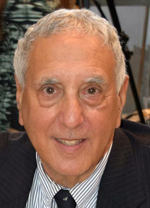
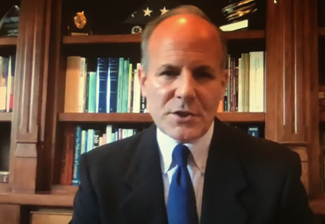
SAN DIEGO — On the positive side of the Jewish experience in America, Elan Carr, the U.S. Special Envoy to Combat anti-Semitism, mentioned today the late Dr. Jonas Salk, developer of the successful anti-polio vaccine, and founder of the Salk Institute for Biological Studies in La Jolla. On the negative side, he brought up last year’s attack on Chabad of Poway, at which Lori Gilbert Kaye was murdered.
The occasion was a global webcast in which Carr addressed the month of May being designated as Jewish-American Heritage Month, and also took reporters’ questions about the rising incidences of hatred toward Jews being expressed on the Internet as the coronavirus pandemic continues. The U.S. State Department provided a transcript of the discussion, which San Diego Jewish World edited to delete extraneous material.
MR CARR: A few days ago, President Trump proclaimed that May 2020 is Jewish American Heritage Month. In his proclamation, the President declared that, quote, “From the arts and sciences to business and public service, nearly every facet of our society has benefited from the talent, inspiration, vision, expertise, ingenuity, and sacrifice of Jewish Americans,” end quote.
There are two reasons why this occasion merits attention. One reason is that it is appropriate to show appreciation for ethnic communities that have shaped the fabric of our country, and the Jewish American community is one that certainly has. From Albert Einstein to Jonas Salk in the sciences, to Louis Brandeis and Benjamin Cardozo in jurisprudence, to Irving Berlin and Leonard Bernstein in music, Jewish Americans have made an indelible imprint on U.S. history. But perhaps even more importantly, Jewish values – for example, that all human beings are created in the image of God and are endowed by our creator with inalienable rights – have undergirded the very founding of our country and have animated its mission throughout the centuries.
The second reason why Jewish American Heritage Month is so important is that it allows us to go on the offense in our fight against anti-Semitism. President Trump always refers to anti-Semitism as, quote, “a vile poison” because of the destructive power of this pernicious and indefatigable hatred. The opposite of ant-Semitism is not tolerant. The opposite of anti-Semitism is Philo-Semitism, the appreciation, respect, and affection for Jewish values and the Jewish community. Jewish American Heritage Month is an important vehicle for driving that critical Philo-Semitic narrative.
In our diplomatic work, we must and often do play defense against anti-Semitism. For example, we address the physical security of Jewish communities around the world, we work to promote training on hate crimes investigation and prosecution, we stress the importance of strongly and unequivocally condemning anti-Semitic speech, and we advocate for the adoption of the standard international definition of anti-Semitism; but in addition to all of those important defense measures, we are determined also to work with our allies in developing and driving Philo-Semitic narratives for their country, in the hope that we can reach the day when every society dedicates itself, as the United States has, to embrace and to treasure its Jewish community.
Thank you again for joining us, and I’m happy to take your questions.
QUESTION: I’m just curious, as we’re entering this month, if your – what your concerns are and how deep they are about the rise of the conspiracy theories about COVID-19 and the Jewish community and for other religious communities, and if there’s anything in particular you guys are doing to address that. Thanks.
MR CARR: Well, thank you. Yes, deeply concerned. And what we’ve seen in the past two months is really a wave – a tsunami, I might say – of anti-Semitism on the internet focused on the coronavirus. And this is really nothing more than the recycled blood libel of the Middle Ages. Jews were blamed for spreading the Bubonic Plague and the Black Plague in the Middle Ages. And so this is really a hallmark of anti-Semitism that it morphs to adopt whatever current events has and focuses its venom using the vehicle of the day.
We see this also with Israel hatred. Before there was a state of Israel there was hatred of other aspects of Jewish life, then after the founding of the state of Israel then the Jewish state becomes the target. So here, too, now we have a global pandemic, and so there’s a wave of anti-Semitism that bears that flavor and uses that vehicle.
And so yes, it’s concerning. And we’ve got to fight it. We’ve got to combat it. I’m proud to say that for the first time a special envoy on anti-Semitism has a staff member, a member of my team, an assistant special envoy, is specifically dedicated to combatting internet hate. It’s the first time ever that there has been a member of the special envoy’s team dedicated to it. So we’re taking this very, very seriously and we’re determined to fight it.
I want to also say, though, that the virus eventually – God willing soon – will be over and done with, but what might be longer lived is the economic dislocation that results from this pandemic. And when one looks at world history, whenever there have been periods of deep economic downturn and economic suffering, Jews have been targeted.
And so yes, we’ve got to focus on this coronavirus-type conspiracy anti-Semitism, but we also have to be very mindful – and my team is strategically focused on this – that over the long haul, even when the pandemic is over and the restrictions are lifted, that we really have to be very aware and very sensitive to this focus on the Jewish community as the source of blame for economic woes. That really is something very serious..
QUESTION: Hi, thanks for doing this. I was wondering if any of your efforts are focused inward given that we’ve seen a number of these (inaudible) stay-at-home protestors espousing some anti-Semitic messages, and if there’s any sort of whole-of-government approach to condemning these messages. Thank you.
MR CARR: Yes, by inwards you mean in the United States, I assume. Correct?
QUESTION: Yeah, mm-hmm.
MR CARR: Yeah. So yes, I mean, there is a whole-of-government approach. I’m – I was very proud to have participated in an extraordinary interagency forum addressing anti-Semitism globally. This was hosted by the attorney general at the Department of Justice. Attorney General Barr spoke, Secretary of Education DeVos spoke, the director of the FBI spoke, I was involved. There were – I mean, really, it was a whole-of-government approach to dealing with what is really a global problem, and that’s the key here.
What’s going on in the United States is no different than what’s going on elsewhere. It is a global rise. There was a Yom Kippur attack on a synagogue in Halle, Germany, and I arrived to visit that synagogue specifically selecting the date October 27th to arrive in Halle, Germany, because that was the one-year anniversary of the massacre at Pittsburgh’s Tree of Life synagogue and the six-month anniversary of the murder at Chabad of Poway, which, by the way, we just commemorated the one-year anniversary of the Chabad massacre.
And so I specifically arrived in Halle, Germany on that date to make the point in as clear a way as I can that this rise in anti-Semitism, which we’re seeing on the far right, the ethnic supremacist far right, the radical anti-Zionist left, militant Islam – I mean, it’s all of it, but this is not a German problem or a European problem or a Latin American problem or a U.S. problem. This is a global problem that requires a global coordinated, focused response. And so yes, there is a whole-of-government approach. I will tell you that President Trump, Vice President Pence, and the entire leadership team at the White House is deeply focused on this, as is Secretary Pompeo and the leadership team at the State Department. And so we are definitely bringing to bear the interagency on this.
QUESTION: Hi, thanks so much for doing the call. I just wondered, with some of the moves that have been recently made to designate those white supremacist groups which often run in parallel to anti-Semitic actions, there’s been any change in the amount of anti-Semitism you’ve seen, if there’s been any response to seeing groups designated.
MR CARR: Well, thank you. That’s a great point, and it’s early. I mean, that designation of the Russian Imperial Movement was recently made, but it’s very important to point out – I was asked about – in my last question about a whole-of-government approach. This is really groundbreaking. First time ever that the United States has designated a far-right white supremacist group as a terrorist organization, and that’s really a critical point. Also a first is President Trump’s executive order that accords the Jewish community Title VI civil rights protection, especially on college campuses.
And so we are really sort of approaching this with a full-court press and using all the tools at our disposal to confine, contain, and pressure anti-Semitic hate groups, all the while, by the way, while maintaining the First Amendment. We’re not – certainly we would not trespass on the First Amendment. It’s sacrosanct. But when it comes to incitement to violence or harassment or discrimination, that’s not protected speech, and this administration has shown that we will – we’re very serious about taking action against these forms of hatred.
QUESTION: Hi, thanks. Sorry, just wanted to follow up if you could say specifically how you’re planning to address the latest COVID-related anti-Semitism here in the U.S. Will there be any sort of statement of condemnation from State at all? Thank you.
MR CARR: Well, there has been. I mean, there has been very clear condemnation of this kind of anti-Semitism from the administration. But that’s step one. I mean, that doesn’t end the process of addressing it.
We have been dealing, literally in the last three weeks specifically, with internet hate speech. We’ve actually brought together various authorities that work in this area, in governments, ours and others, and in the private sector or for-profit, but also NGOs that specifically address internet hate speech. And we’re bringing together these authorities specifically for the purpose of producing a framework to address this.
Now, it’s evolving, but what I will say is this. To give you a preview, what I will say is this, and this is no secret. I’ve actually testified to this very point on Capitol Hill. And so I’ll state again: The moment that hate speech on the internet leaves the ambit of the First Amendment – for example, by venturing into the area of incitement to violence, which is not protected speech – the moment hate speech does that, we’ve got to be very, very aggressive in coming down on all instances of unprotected hate speech on the internet.
Then with regard to protected speech, the answer there isn’t censorship, but the answer to protected hate speech is strong, unequivocal condemnation. And to have strong, unequivocal condemnation, there has to be coordination. It can’t be piecemeal. And so a lot of our efforts are to focus on how we can coordinate condemnation so that people espousing despicable, vile, hateful speech that is protected face the kind of wave of condemnation that they deserve to face.
And it’s got to be unequivocal and it’s got to be strong. I will tell you in my work overseas, without going into diplomatic confidences, in many cases I’ve pressured countries to be more forceful in condemning anti-Semitic movements and anti-Semitic speech, or, for example, condemn it at a more senior level than they have. And so this is something we’re deeply focused on and something that I think in the long run will be critical to winning this, especially when it comes to online hate.
By the way, a recent study, a European study, shows that the process, the time it takes to radicalize somebody online, is 25 percent of the time that it takes to radicalize someone offline, for example, in meetings and rallies. So you’re talking about data now that shows that the – that online hate has deep, real impact. And you’ve got kids around the world – not only in the United States, all around the world – that are being seduced and lured into the most despicable, vile, hate-filled, venomous chat rooms where they feed off of this stuff for years. And so again, the moment speech becomes unprotected, we’ve got to come down on it. But once it’s – but as long as it’s still in the ambit of protected speech, the answer has to be coordinated condemnation, and that’s what we’re working on.
*
Political bytes
*Joe Leventhal, a candidate in the 5th District of the San Diego City Council, has called for a reduction in the budgets of City Council members’s districts to meet a coronavirus-induced budget crisis. Leventhal proposes that “every council office have the same budget, doing away with the inequities in the current budgeting for city councilmembers. As a benchmark, Leventhal proposes using the lowest FY2021 budgeted council district amount—which is $1,158,217 in District 3—and applying that amount equally to all council districts totaling $10,423,953. This amounts to a reduction of 19.4% and a savings of over $2.5 million over FY 2020’s budget. ‘Now is the time to do things differently and in a way that preserves the most services for the citizens of San Diego,’ said Leventhal. ‘There is no reason the largest council member’s budget should be over 30% higher than Councilmember Ward’s budget, the lowest.'”
*Marni von Wilpert, the deputy city attorney who is opposing Leventhal in the 5th District race, wrote a column for Times of San Diego telling what her office is doing to combat scams during the coronavirus pandemic.
*
Jewish American Heritage Month
EMET (Endowment for Middle East Truth) continues its celebration of Jewish American Heritage month with profiles of former Los Angeles Dodgers pitcher Sandy Koufax, and composer Irving Berlin. To view previous profiles, please click here.

*While we’re on the subject of famous Jews, above is a video telling about some of the Jews who have made important contributions to civilization. Not all of them are Americans but many are.
*
Recommended reading
*Times of San Diego reports that the Coastal Roots Farm at the Leichtag Commons in Encinitas is continuing its “Pay What You Can” program at its fresh vegetable stand.
*Anna Jeng, a professor at Old Dominion University in Virginia, whom Nancy and I had the pleasure of getting to know on a transcanal cruise last December, suggests in The Virginian-Pilot that cell phone apps may the best way to trace the spread of coronavirus, assuming privacy safeguards can be put into place.
*
In memoriam
*Am Israel Mortuary reported the death of Philip S. “Phil” Weiss, 81, of Friday, May 1. Funeral details were not available.
*
Donald H. Harrison is editor of San Diego Jewish World. He may be contacted via donald.harrison@sdjewishworld.com Free obituaries in memory of members of the San Diego County Jewish community are sponsored on San Diego Jewish World by Inland Industries Group LP in memory of long-time San Diego Jewish community leader Marie (Mrs. Gabriel) Berg.