Prepare My Prayer: Recipes to Awaken the Soul by Dov Singer and Leah Hartman (Translator); Maggid; ISBN 15926-45372; $17.99; available on Amazon.
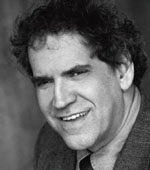
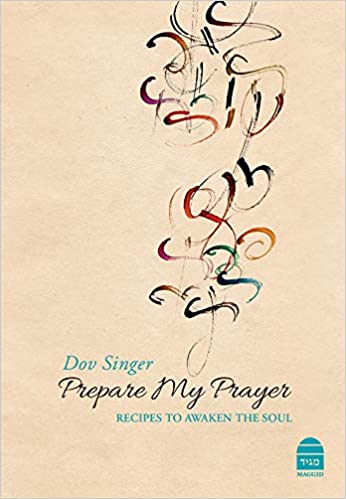 CHULA VISTA, California — Rabbi Dov Singer’s Prepare My Prayer: Recipes to Awaken the Soul is one of the best books I have read in recent years on the meaning of Jewish prayer. The author is head of Yeshivat Makor Chaim in Israel and has done considerable work with Israelis showing them how Judaic prayer can facilitate a meaningful spiritual renewal in the worshiper. Rabbinical tradition since ancient times encouraged people to innovate prayers when communing with the Divine. Most of the prayers we have in the liturgy developed as spontaneous expressions of piety. The author encourages readers to create their own spiritual dialogue with the liturgy. The book, true to its title, contains a series of prayerful “recipes” that invite contemplative thought and reflection.
Singer has written a fabulous and original guide to help people find more meaning in prayer. The book contains excellent selections from the great teachers of Jewish meditation and prayer such as Rabbi Abraham Isaac Kook and Rav Nachman of Bratzlav. It is difficult to summarize everything this fine book does. But in one section, he titled, Opening the Senses (p. 6), he writes:
- For every part of creation has an inner point that was clarified by God’s honor. . . .And this is the meaning of Perek Shira – that every part of creation has its own song and praise for the Blessed God. And, “then Israel sang … this song” (Numbers 21:17), meaning the known song that arises from all things – R. Yehuda Aryeh Leib of Gur, Sefat Emet, Beshallach 5731.
- The walk to the synagogue
Is the beginning of prayer
It is an invitation to be present.
To step inside.
To stand before God.
In our day to day we are often a bit fuzzy and imprecise.
The path to prayer is the beginning of the path.
To presence, to clarity, to precision.
Arguably, the oldest prayer book of ancient Israel is the Psalms. The writers of the Psalms communicated its words through heartfelt imagery.
One of the classical statements concerning innovation in prayer/worship is the old Hassidic teaching attributed to the Ba’al Shem Tov, who asked: Why does the prayer say, “God of Abraham, God of Isaac, and God of Jacob,” and not “God of Abraham, Isaac, and Jacob,” for this indicates that Isaac and Jacob did not merely take over the tradition of Abraham; they themselves searched for God.”
I would like to present the reader with a few selections from Rabbi Singer’s book that reflect his philosophy of prayer.
- Prayer encompasses our whole being: It peeks out at us from an obtuse day-to-day life at moments of crisis, when a crack appears in the sense of security that envelops us. It smiles at us at moments of great joy. It whispers to us when we are stirred by the beauty of nature or the perfection of a passing moment. The call to prayer is a call to life, a call to open to the deep primal voice that stirs within us and in all of reality in every moment (p. xxvii).
Much of the book touches upon a variety of liturgical themes where the author encourages the reader to create a spiritual dialogue with a particular prayer. Here is another example. On the verse, וַאֲנִי בְּרֹב חַסְדְּךָ אָבוֹא בֵיתֶךָ אֶשְׁתַּחֲוֶה אֶל־הֵיכַל־קָדְשְׁךָ בְּיִרְאָתֶךָ “But I, through the abundance of Your mercy, will enter into Your house. I will bow down toward Your holy sanctuary out of fear of You” (Psalms 5:8):
In our prayer we come to the House of God
Stand before the Sovereign
Turn to the One full of mercy,
Give ourselves to the love of our Beloved.
Prayer is devotion
The devoted pause, preparing the heart before their prayer
Like a musician tuning an instrument before beginning to pray
Hoping for a clear bright place (p. 6).
The author makes it a point to keep his prayers gender-neutral, which is not something you would find in any Modern Orthodox prayer book. He evokes romantic imagery, suggesting that prayer is really much like a love song, where God and us intertwine in love.
His approach is similar to a technique I have used when teaching liturgy. Rabbi Singer is a skillful master; he understands what prayer can and ought to mean.
Rabbi Singer’s lyrical style is captivating. For anyone who has ever thought of what prayer can and ought to mean, Prepare My Prayer: Recipes to Awaken the Soul provides ample food for the soul to think and engage prayer in a manner that is substantive and compelling.
*
Rabbi Dr. Michael Leo Samuel is spiritual leader of Temple Beth Shalom in Chula Vista. He may be contacted via michael.samuel@sdjewishworld.com