Jewish Rome
By Stephen Burstin
ROME– Heard the one about the Pope who presided over the cruel imprisonment of thousands of Jews and yet had the chutzpah to ask the Rothschild banking family for a loan? It’s no joke!
Neither is the one about the rabbi whose synagogue is now a top class restaurant with the mikvah accommodating a much revered wine cellar.
And there’s the other rabbi who regularly conducted Shabbat services in his synagogue under the noses of nazi stormtroopers patrolling outside.
It’s all true and just a few of the incredible tales (and amazing sights) in the 2,200- year-old history of Rome’s Jewish community, the longest continuous Jewish presence outside Israel.
It all began in 161 BCE when a delegation of Maccabeans arrived in Rome from Judea during Chanukah. They were on a mission seeking the Romans’ protection, for back home the Greek ruler King Antiochus was giving the Jews a tough time trying to impose Greek customs and rites upon them. Word soon went back from the Maccabean emissaries as to what a nice place Rome was – a bustling wealthy metropolis with a large and efficient port close to the city’s biggest market and boasting a wonderful all year round climate,
A migration of Jews soon began from the Holy Land, neighbouring Alexandria in Egypt and the Greek islands. Initially, they were merchants seeking their fortune and they came ladened with silks, carpets, jewellery and even medicines. Before long humbler Jews with an eye to a more prosperous future made a beeline for Rome. The area of Trastevere, adjoining the River Tiber in the city centre, soon became the home for thousands of Jews.
The next 1,500 years proved a roller coaster existence for the Jewish community with periods of tranquility and times of sheer torment. Julius Caesar was a true friend to Rome’s Jews before he was assassinated in 44 BCE. Hundreds of Jews attended his funeral and spent day and night mourning at his tomb. His successor, Augustus, was equally compassionate to his Jewish subjects, even ensuring the weekly grain distribution to the community avoided the Shabbat.
By the end of the first century ACE, Rome played host to 30,000 Jews out of a total population of just one million. A majority of the community were shopkeepers, craftsmen and peddlers while others were poets, actors and physicians.
Once Christianity became the official religion of the Roman Empire, around the end of the fourth century, life took a turn for the worse for the Jewish community. There were periodic acts of mob violence with the destruction of synagogues in Trastevere and the civil and political rights of Jews deteriorated. Then in 1215 Jewish males were ordered to wear yellow patches on their clothes and women yellow headscarves, the latter being a sign in those days of a prostitute. Because of this very humiliation Rome’s female Jewish congregation today do not cover their heads in the synagogue.
The Renaissance period that followed the Middle Ages saw the Jews of Rome fully participating in the flourishing economic and intellectual climate. They became merchants, traders and bankers, as well as artisans. The Medici Popes treated the Jews particularly well, abolishing various discriminatory practices, relaxing the rules on yellow distinguishing items of clothing and the Vatican even retained Jewish physicians.
But then, in the early 16th century, came the Protestant Reformation and the tide once again turned. The Catholic Church fought back with its Counter Reformation and clamped down on all other religions, calling them heretic. Judaism especially came in the firing line, culminating in the infamous decree by Pope Paul IV, who on July 14th, 1555, stated: “It is truly absurd and utterly inconvenient that Jews should live side by side with Christians”. With this he set up the Ghetto, a six acre site across the river from the quarter of Trastevere and in which the Jews were moved and remained for more than 300 years.
Five gates surrounded the Ghetto with the Jews locked in from dusk to dawn. Inside was a tangle of small streets, alleys and cul-de-sacs and the people existed in a heap of dark and unhealthy hovels, with gloomy little shops. With the Ghetto’s population reaching at its height a staggering 8,000 inhabitants conditions were intolerable, made even worse by frequent flooding from the overflowing adjoining river.
To add salt to the wounds of their miserable existence, every Shabbat the Jews were ordered out of the Ghetto and into the adjoining churches where they were scolded for the error of their ways and Judaism demonised. But first, before these attempts at indoctrination, Vatican soldiers stationed at the church doors inspected Jews’ ears to make sure they had not put in wax or bread to muffle the sermons.
In 1870 the Ghetto was disbanded after the Papacy lost its political power, following the bitter civil war that ended with the unification of the Italian states and creation of the Kingdom of Italy. The Jews of Rome and other Italian states previously under Papal rule became free and emancipated, equal citizens of the new liberalised nation. However, it was to be only a short respite in their suffering because 50 years down the line Mussolini’s Fascist party came on the scene with further fatal trials awaiting the Jewish people when the Nazis later occupied Rome and deported more than 2,000 to Auschwitz.
Thousands of Rome’s Jews avoided transportation to the death camps during the city’s nine months of occupation by the Germans. Scores of convents provided a refuge for hundreds as did sympathetic non-Jewish neighbours. Many Jews fled to the countryside and mountains where several joined the resistance.
And out of the darkness also came individual tales of heroism and courage such as a non-Jewish nursing sister who saved a dozen elderly Jews from the Nazis’ clutches by hiding them in an old people’s home. There was also that rabbi who, throughout the nazi occupation, secretly conducted Shabbat services in his synagogue on the small island of Tiberina, next to the Ghetto quarter.
Just 100 yards away from the island and taking pride of place today in the former Ghetto quarter is the awesome Tempio Maggiore (Great Synagogue) built in the first decade of the 20th century and housing a unique Jewish Museum with incredible examples of the community’s rich heritage on display. This includes an enormous collection of exquisite torah covers with a colorful history and other precious ritual objects.
Rome is home today to 15,000 Jews, one third of whom have their origins in Libya, their families having been exiled from the former Italian colony after the Six Day War of 1967. Many found their way to the Italian capital.
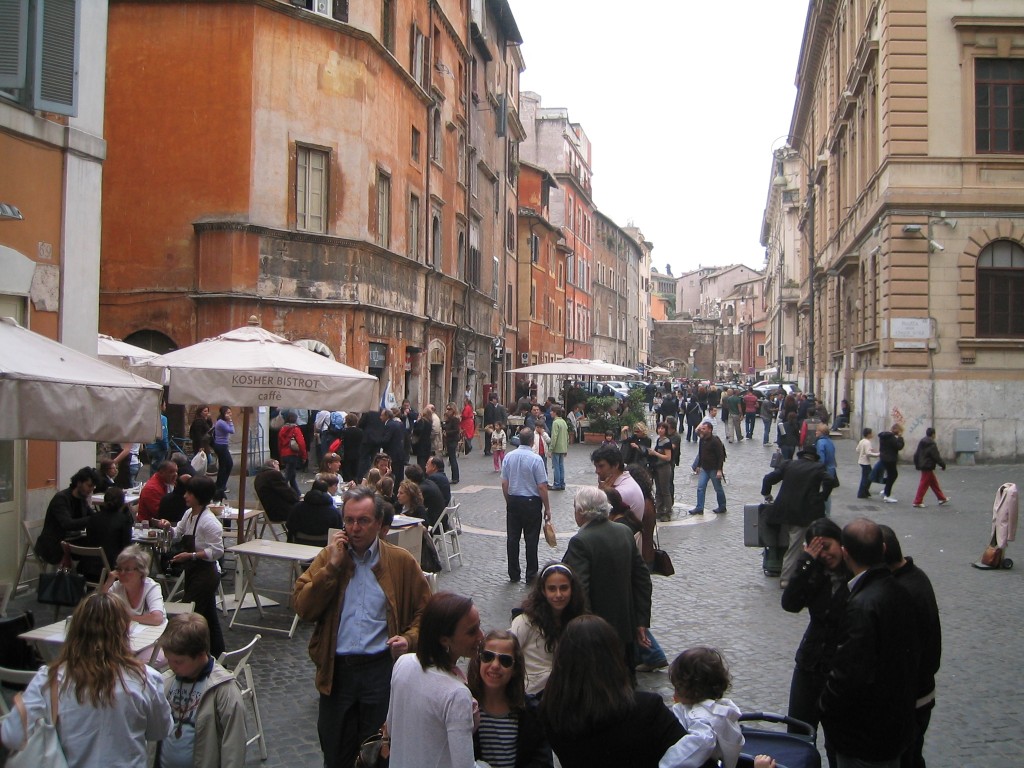
Although most of the Jewish community now live away from the former Ghetto, the area is still a vibrant Jewish quarter, especially at night when many gather to chat, enjoy a meal in one of the numerous kosher restaurants or quietly sit on a bench devouring Carciofi alla Giudia, the delicious Roman Jewish delicacy of fried artichokes. And early afternoon sees a boisterous scene developing in the Ghetto piazza as parents gather at the pavement cafes and bars awaiting the exodus of children from the Jewish primary and high school.
Many sites of Jewish interest in the long and fascinating history of Rome’s Jews make a tour of Jewish Rome a must for visitors to the Eternal City. So, while we have been promising next year in Jerusalem, let’s also ensure 2011 is the year for a visit to Rome.
*
Stephen Burstin is part of a Roman Jewish family that proudly traces its roots back more than 2,000 years to the first Jewish settlers in ancient Rome. He conducts walking tours of the Jewish Ghetto and surrounding areas. Visit his website at www.jewishrome.net