By Sheila Orysiek

SAN DIEGO –City Ballet of San Diego closed its season on May 1 at the Spreckels Theatre with a dynamic program.
Enigma by resident choreographer Elizabeth Wistrich received a Tommy Award when this work was first performed in 2000 and it is easy to see why. This is a complete concept – entirely integrated throughout: music, set, visuals, dance and costuming. In fact, the pieces fit together so well it’s difficult to separate the parts in order to describe them.
The taped music by Michael Cretu is a creative and successful synthesis of disparate sounds ranging from Gregorian chant, to whispering water, from hoof beats to soprano voice and more. At no time does it intrude on the other production values but is the structure upon which the entire piece coalesces setting an almost religious mood.
The curtain opens with a row of four lit panels across the back of the stage which then rise to reveal four male dancers in black briefs with long cloth panels front and back hanging from the waist. They are soon joined by women in black thigh length unitards. The costuming (by David Heuvel) is simple but effective and as the piece proceeds evolves into variations of the first theme and eventually to other colors as well as diaphanous white tunic wraps.
The lit panels become screens projecting video (by Peter Oliver) of the dancers dancing the same choreography as the live dancers on stage – but as mirror images and one or two seconds early or late – thus giving not only a mirrored effect but a visual echo of the live action. The panels also showed non dance action such as wild galloping horses. There was video of the dancers in filmy dresses in a bucolic setting; walking in wooded places and wading in softly flowing water. All the while the live dancers were in action in front of their own images. It was altogether mesmerizing. The only point at which I felt the integration was less than successful was the video of the horses – not because I disliked it, but because I liked it too much. It was hard to watch both dancers and horses – I wanted to place my attention one hundred percent on one or the other.
The choreography is modern neo-classical, on pointe, with exciting lifts – but never sacrificing beauty of line for forced innovation. Wistrich lets the music give birth to the dance rather than gluing the dance onto the music. Only once or twice was there a moment of doubt about the security of a lift, however, it seemed the more difficult the movement the more secure it was. This is truly an exemplary work. The entire cast deserves mention: kudos to Emily Kirn, Ariana Samuelsson, Janica Smith, Gerardo Gil, Geoff Gonzalez, John Henry Reid, Megan Jacobs, Bryce Corson, Kyle Rivieccio, Eric Roberts, Travis Morrison, Brook Ogle, Angela Leone, Karin Yamada, Sayaka Otani and Patrick Lahey.
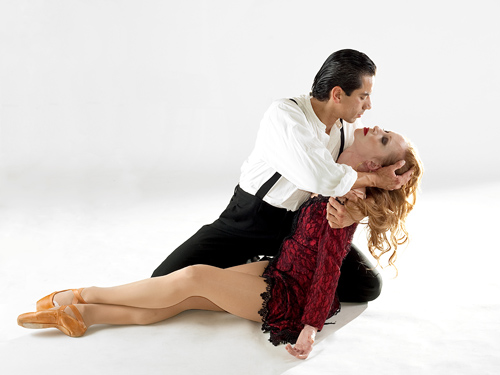
Carmen which followed seemed almost trite – or at least that’s how it began. Using Georges Bizet’s music arranged by Rodion Schchedrin and Leonard Bernstein, Wistrich’s choreography condensed the story to its essentials with some side action such as the “urchins” in the town square. The sets (by Stivanello of New York) were interesting and effective but tended to close in the stage; they made the action and the dancers seem small. Some squeaky stage mechanics didn’t help.
David Heuvel’s costumes while detailed and varied in cut – needed much more color. I can’t imagine Carmen in the bland dress she wore in the first part – she’s far too colorful a character to have anything monotone in her closet. As the ballet moved along the stage lit up with reds but even here it was often overlaid with black. Except for Escamillo and Don Jose in a white shirt at the very end, the men were invariably in black, black and more BLACK; black trousers, black boots and long sleeved black shirts with high black collars. They were swallowed in black. Sure, surely there has to be some other color for the male dancer.
Out of curiosity I went to Google/Images for male Spanish dancers and while there certainly is black, it is usually combined with red, gold, white, silver, and gray. Even though these men are supposed to be small town police/soldiers – a red belt, red edgings, a bandana – something to relieve the utter blackness.
I’m also not a fan of bare legs and pointe shoes as seen on Ariana Samuelsson’s Carmen. What is the message here? Realism? If I want to see realism – I don’t go to the ballet – I go to the mall or walk a city street. There is a reason for tights: smoothness of line uninterrupted by creases of the knees and the shadowing of other anatomy.
Toward the middle of Carmen the initial impression of “trite” had passed and by the time Samuellson and Gerardo Gil were tearing at one another in a passion of love/hate – the story had worked its magic. Like Romeo and Juliet, while the ending is known, it still holds us breathless with hope that it will somehow be different this time.
Gil reached beyond himself and found a new level of layered drama and gave a deep reading of Don Jose’s soul. Samuelsson was his worthy antagonist and while hot fleshed was cold hearted. Also special was John Henry Reid’s Escamillo – wonderfully portraying the foppishly arrogant self absorbed slash and dash of the toreador; dispatching bulls and collecting hearts of the women who surround him. He was spot on.
This has been a good season for the Company and it has been especially rewarding to see the stage fill with a growing cadre of fine male dancing.
*
Orysiek is a San Diego-based dance critic. She may be contacted at sheila.orysiek@sdjewishworld.com