Chutzpah Girls: 100 Tales of Daring Jewish Women by Julie Esther Silverstein and Tami Schlossberg Pruwer with illustrations by 12 female artists; Jerusalem, Israel: The Toby Press, an imprint of Koren Publishers; © 2024; ISBN 9781592-646920; 216 pages including appendices; $32.67 on Amazon.

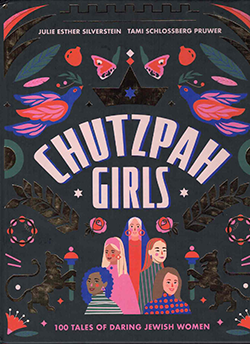 SAN DIEGO – Beautifully illustrated, Chutzpah Girls tells the stories of remarkable Jewish women from biblical times through the present with six continents represented.
Rather than chronologically, the book progresses in alphabetical order by the women’s first names – a wise choice as biblical figures do not have surnames. Thus Ruth (and Naomi, her mother-in-law) of biblical fame are preceded by Rudolphina Menzel and followed by Ruth Bader Ginsburg.
Rudolphina, born in Austria in 1891, was a canine behavioralist who trained dogs to provide security. When she got to pre-state Israel, she helped create the Haganah’s canine unit – later the Oketz unit of the IDF. The dogs carried messages and supplies and detected explosives. Later, she established the first guide dog center in the Middle East.
Associate Supreme Court Justice Ruth Bader Ginsburg’s story is more familiar – The “Notorious RBG” fought for equal treatment under the law for both genders.
“Chutzpah girls” from the six continents included:
Africa: Ashager Araro, born when her parents trekked from Gondar, Ethiopia, to the capital city of Addis Ababa en route to Israel. There, as an adult, Ashager established the Ethiopian Israeli Heritage Center. Also, the book sketches the life of Helen Suzman, a South African parliamentarian who opposed apartheid, when doing so publicly was an act of courage.
Asia: In 19th Century India, Flora Sassoon was elevated to the leadership of her family’s trading company and used her position and wealth to stand up for women, successfully fighting India’s Purdah laws that required women to cover their entire bodies. She was devoutly religious, known throughout India’s Jewish community as a Torah scholar. Another “Chutzpah Girl” was Bracha Kapach, a Yemenite immigrant to pre-State Israel, who was a one-woman social services agency. She improved living conditions of her fellow immigrants, providing jobs and clothing for adults; clothing, schools and camps for youngsters,
Australia: Annalouise Paul, of mixed Sephardic and Ashkenazic parentage, studied flamenco in Spain and now choreographs dances bespeaking her heritage.
Europe: Anne Ross was a World War II codebreaker living in London, heading a staff of 80 at Bletchley Park. The cover name for her organization was “The Gold Club and Chess Society.” … Edith Eger, now living in San Diego, studied ballet and trained for the Hungarian Olympic gymnastic team but when Germans took over Hungary, she was sent to Auschwitz, where Dr. Josef Mengele, the Nazi doctor who decided the fate of concentration camp inmates, ordered her to dance in front of him. She survived the Holocaust and became an author and lecturer.
North America: Sheyna Gifford is both an astronaut and medical doctor at the National Aeronautics and Space Administration. She participated in a year-long mission on the Mauna Loa volcano in Hawaii, where conditions of a mission to Mars were simulated. … Rosalie Silberman Abella was the first Jewish female judge and youngest in Canada’s history, serving in a lower court for 25 years before being named a judge of Canada’s Supreme Court. Her tenure as a judge has been noteworthy for ending disadvantages of minorities, disabled, and women.
South America: Frida Alexander grew up in the cattle-raising Jewish colony of Filipson, Brazil, and wrote about the experiences of the “Jewish cowboys and cowgirls.” She was active in the Women’s International Zionist Organization (WIZO). … Bruria Benbasat de Elnecavé meanwhile rose to the leadership in Argentina of WIZO, spearheading the compilation of a Hebrew-Spanish dictionary, lecturing, and remaining active until the age of 90.
I’ve purposely chosen to cite the accomplishments of lesser-known Jewish women from the six continents rather than sketching Anne Frank, Barbra Streisand, Bella Abzug, Deborah Lipstadt, Esther, Gal Gadot, Golda Meir, Judith, Leah, Mayim Bialik, Miriam, Rachel, Rebecca, Sarah, and others whose stories are universally well known.
Leo Rosten famously defined chutzpah as a Yiddish term meaning “colossal nerve,” citing the hypothetical example of a boy who murders both his parents and then tells the judge he deserves mercy because, after all, “I’m an orphan.”
Authors Silverstein and Pruwer, who have done a commendable job with this book written for children but suitable for the whole family, have provided a more expansive definition.
According to them, chutzpah is “a Jewish superpower: the daring to speak when silenced, to take action when others won’t, to try when they say it’s impossible, to persevere in times of doubt, to be yourself when it’s easier to conform, to stand tall when made to feel small, to believe when it all feels hopeless, to shine your light in the face of darkness.”
*
Donald H. Harrison is publisher and editor of San Diego Jewish World